Paris Travelog #7 – A Melange
Filed in Travel, February 4, 2010, 10:00 am by Priya Raju TweetPlease checkout Sukumar’s most previous serving of Paris here.
Say “Paris” and images of the French Revolution, the excesses of King Louis XIV and Napoleon Bonaparte spring to mind. Visitors to Paris will find “Haussmannian Paris” stickier still. Baron Haussmann was a town planner in Emperor Napoleon III’s reign. He almost single-handedly modernized Paris, changing it from a medieval town with narrow, chaotic streets & unsanitary living conditions – to a triumph of modern urban planning. He gave Paris a major make-over, with wide boulevards, geometrically intersecting streets, parks, bridges, modern sewers, water-works, wide open spaces – and beautiful buildings, with uniform facades, built with locally quarried limestone. Numerous buildings from Haussmann’s period are impeccably maintained.
Arguably, the most touching site we visited was the Shoah (Holocaust) Memorial, located in the Jewish Quarter in Le Marais. During WW II, almost 76,000 French Jews were rounded up & sent to Nazi concentration camps. Even the children & the elderly were not spared. Only 2,600 of them returned. The French police maintained detailed records of Jews – even those of their colleagues in the Police force. The shameful part played by the Vichy regime in the annihilation of its own citizens was not disclosed till 1995.
The most poignant parts of the Shoah Memorial are the Crypt & the “Wall of Names”. The names of people who died – and those presumed dead – in the concentration camps are engraved on the wall, alphabetized. I would strongly advise the sensitive & the weak-hearted to stay away from the wall. It was very painful, like being knifed in the stomach. The grim black crypt in the basement is shaped like the Star of David. It has ashes collected from the Warsaw ghetto. It is a reminder of the devil in all of us & how easy it is to lead us astray. All it takes is a mad-man with a cause.
I feel duty-bound to tell you that the 2 major shopping destinations in Paris – Au Printemps and Galeries Lafayette offer a 10% discount for all foreign tourists. Carry your passport to prove your domicile though. Here is the disclaimer: There are no tales of personal triumph from me, in clinching deals in either of the malls. France is very expensive. An intelligent South Asian would simply go to the Takashimaya store in Singapore for good deals. Or if the said smart South Asian is in North America, s/he is better off looking for steals in Canada or in the US of A. I’m thrifty by nature – I demand value for money. If you insist on splurging in France on over-priced items, go ahead. I won’t stop you.
One of the most enduring symbols of Paris is the Arc de Triomphe, with its “Tomb of the Unknown Soldier”. This monument is located at one end of the Champs Elysees, one of the most expensive avenues in the world. The largest Louis Vuitton store is located here, for e.g. Champs Elysees is sort of New York’s 5th Avenue & Times Square rolled into one. Here is where Parisians get together to welcome the New Year on Dec 31st.
Some of the snootiest shops in Paris – jewelers such as Boucheron, Van Cleef & Arpels, Cartier et al – are in PlaceVendôme. It is in the 1st arrondisement, the oldest part of Paris. In the center of this square is a monument erected by Napoleon – it stands sad & lonely like a gawky, self-conscious giant, amidst its glitzy & glamorous neighbors. Directly opposite the monument is the Ritz, one of the most luxurious (read: expensive) hotels in the world. I don’t even want to know their tariffs.
The 2nd most formidable street in Paris is Rue du Faubourg Saint Honore. Perhaps it is no coincidence that this is close to Place Vendôme. All the leading designers such as Hermes, Versace, Gaultier & co have their flagship stores here. The most famous resident of this street is the French President: The Elysee Palace, the official residence of the Premier is located here.
Which brings us to the most interesting President France has had in a long time. Nicholas Sarkozy is the son of Hungarian immigrants. Well, his father was a Hungarian aristocrat who moved to Paris. Did the French have any concern about electing someone of Hungarian descent? And his wife Carla Bruni is an Italian, though she’s a French citizen now. Does the fact that the 1st lady of France is an Italian bother the French?
Our questions were met with bafflement. How does it matter that Sarkozy is ethnically a Magyar? – They wondered. Or that Bruni was an Italian once. All that matters is that they’re French now, n’est-ce pas? Excellent, we said meekly. We felt like hugging them & giving them an air-kiss, French-style.
An often overlooked site in Paris is the Pantheon. It was built as a church, but it is known more as a crypt & for its starring role in a scientific pursuit: Foucault hung his pendulum from its dome to prove that earth rotated on its axis. A replica of the revered Foucault’s pendulum still oscillates in the Pantheon. The Who’s Who of French elite are buried in the crypt – For e.g., Voltaire, Rousseau, Emile Zola, Alexandre Dumas, Victor Hugo, Pierre & Marie Curie and Joseph-Louis Lagrange. We perked up when we saw Lagrange’s tomb. Amidst a sea of philosophers, writers & politicians, the mathematician-astronomer seemed like a kindred spirit to yours truly, both engineers by profession. We touched his tomb with awe & reverence.
While we loved the French for their open, liberal attitude and for preserving their heritage, they sometimes – many times – drove the author of this post crazy. I must have been a German in my previous life. Punctuality is my affliction. I may need therapy if I’m seriously late for an appointment. I plan & schedule even the minutiae, like Armageddon was tomorrow. And in France, time is elastic, stretchable. They don’t think anything about 30 minute delays. I did not expect this in a 1st world country. Please hold my paws, I get emotional just thinking about it.
I don’t know how the Germans occupied this country for any stretch of time. Technically speaking, they should have gone mad in a week. Tearing their hair & clothes, they should have run amok on the streets. But it took the Allied Forces landing on Normandy to drive them out. Hmmm – I’ll never understand it.
Sukumar will continue this series with another photo essay on Paris.
Paris Travelog #6 – Third Photo Essay – Louvre
Filed in Travel, January 31, 2010, 2:26 pm by Sukumar TweetPlease read Priya Raju’s excellent write up on the Louvre to appreciate this photo essay better. I want to start the essay with Vermeer’s lace maker that refuses to leave my head even after a month – some what like the earworms that people talk about in the realm of music.

The glass pyramid at entrance of Louvre is much talked about, but i couldn’t get a decent enough picture of it. Instead i choose to present you the inverted pyramids from inside the Louvre. This area is always crowded and this is the best i could do. It is spectacular to say the least. The inverted pyramids became very famous after Dan Brown’s Da Vinci Code. After i saw the glass pyramids in the Louvre, the symbologist in me couldn’t help guessing that the famous 5th Ave Apple Store in New York is inspired by the glass pyramid in the Louvre. Does anyone else think that?

While we are on the subject of symbols, i think the Winged Victory of Samothrace (below) inspired the famous scene in the movie Titanic with Kate Winslet standing with her arms outstretched on the hull of the Titanic before Leo De Caprio joins her. The typical photo of this sculpture leaves out the boat/ship below the sculpture, which is what make me think it inspired the famous Titanic scene. Do you all agree?
As Priya Raju mentioned, this sculpture is one of the top 3 highlights of the Louvre alongside Monalisa and Venus de Milo.

Priya is right. Shouldn’t this magnificent Athena be in the list of top 3 highlights?

Count Baldassare, which in our guide’s opinion, is better than the Mona Lisa, as Priya mentioned. This was done by Raphael one of the greatest Renaissance painters.

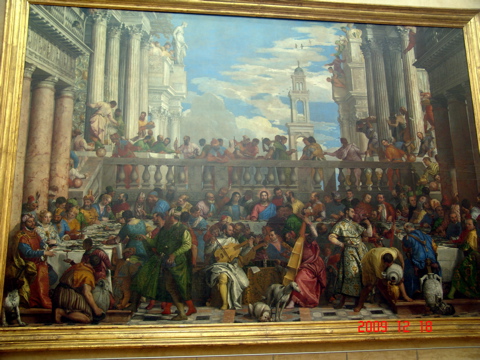
As Priya mentioned, most people miss the masterful Wedding Feast at Cana by Veronese, though it is right opposite the Mona Lisa.
Here is Napoleon’s coronation by David, one of Napoleon’s favorite painters. He created 2 copies of the same painting, one is at the Versailles Palace. There are a couple of interesting stories about this painting – Napoleon’s mother who is in the painting watching the proceedings, never really attended the coronation ceremony. Napoleon had David add her into the painting. I guess this is how history gets distorted! It is said that David was in love with one of Napoleon’s sisters present on the left side of the painting and he deliberately made her look better than the others.

Hobbema’s windmill in the Northern Gallery is a thing of beauty.

As a researcher into the Indus Valley Civilization, the near eastern antiquities section fascinated me the most. Unfortunately, we couldn’t spend too much time. I saw a cylinder seal, used by the Sumerian/Akkadian seals in the trade with the Indus, for the first time. They are so tiny, which make them quite comparable to the Indus seals which are also equally tiny. Here is an example – you can see how tiny it is when you look at the size of the scaled up images to the right of the seal. Wow!

The Louvre left me with a sense of awe that puts almost every other museum, that i have been to, to shame, including the Smithsonian Museums, the British Museum, the Athens Museum, Egyptian Museum at Cairo etc. The Louvre will play a great part in luring us back to Paris soon 🙂
The paris travelog series will continue with a post from Priya Raju titled “Melange“. Stay tuned.
Celebrating the Indian Constitution in the Comity of Nations
Filed in General Interest, January 26, 2010, 8:45 am by Abdul Fakhri TweetOn the occasion of Republic Day this year, it is important to recall that this day in 1950 we gave to ourselves our Constitution.
The Constitution of India is the most sacred and central legal document. It is on the basis of this document that many other laws are derived and that we learn to uphold the ‘rule of law’ in a democracy under all circumstances.
Critics of our Constitution have been silenced as the document has shown its strength and mettle for more than 60 years. This just goes to show that it is critical to salute and reaffirm our faith in the Constitution because around us in South Asia and other parts of the world we see ‘failed’ if not ‘almost-failed’ states where the rule of law has broken down and anarchy prevails. Again, in the media when there are references made to ‘banana republics’ it’s a vicarious reminder to the achievement of our founding fathers in consolidating the ‘rule of law’ and state in India in what they envisioned would befit generations of Indians to come.
The history of the forming of this Constitution goes back to several decades of legal debates under British rule. The defining debate and draft was the Government of India Act of 1935 which functioned as the backbone of the later-to-be Constitution of India. With the Constituent Assembly in place, Dr. B. R. Ambedkar was appointed the chairman of the drafting committee of the Constitution.
In the transition between colonial rule and freedom, our leaders showed a remarkably global outlook in learning from the political and constitutional experiences of other countries and this has stood us in remarkably good stead. Some highlights of the borrowings for our Constitution are as follows:
Chapter on Fundamental Rights in the Indian Constitution [Part III] which are enforceable if a citizens rights has been infringed by any action of the State : modeled on the American Constitution notably the American Bill of Rights (contained in the first Ten Amendments to the Constitution of USA).
Parliamentary System of Government which is based on that of Britain [Part V]: The system has three main institutions, the Parliament, the Executive and Judiciary each with their roles and responsibilities cut out for them. This was adopted because our leaders had some experience with this system during years of British rule.
Directive Principles of State Policy based on that of Ireland (Eire )[Part IV] : These are broad guidelines of action for the state and society in India but they are not enforceable in a court of law. Despite this, these principles are considered fundamental to the governance of the country and achieving social and economic justice in Indian society.
Emergency Provisions based on that of the German Reich [Part XVIII] : clause 48 of the Weimar Constitution.
It was a continuing testimony to the Indian historical experience, even post-independence, that we have never been an insular people. East or West, what would work is what needed to be retained, borrowed and built upon into the fabric of our national life. The members of the Constituent Assembly showed tremendous acumen and foresight in the melee that was partition and the transfer of power. I suppose this is why in all the countries mentioned above and other like-minded ones continuing generations refer to the ‘wisdom’ and ‘sagacity’ of the ‘founding fathers’. Cheers to them !!!
Paris Travelog #5 – The Louvre
Filed in Travel, January 18, 2010, 10:00 am by Priya Raju TweetThis is the next serving of our Paris Travelog series. The previous post was a photo-essay by Sukumar. You can check it out here.
A trip to Paris is incomplete without a visit to the fantastic Louvre, which has been a museum since 1793. It is the largest museum in the world. The sprawling complex, spread over 645,000 square feet has around 40,000 exhibits in its permanent collection. Even if one spends 2 or 3 minutes per exhibit, it will take 5 or 6 months to see the museum in full!
The much-talked about Glass Pyramid of the Louvre, “immortalized” by Dan Brown in his book The Da Vinci Code is in the entrance. Conceptualized & built by the American architect I.M.Pei in 1989, the modern composition in metal & Saint Gobain glass has nothing in common with the building behind it. The French were prostrated with grief, they were inconsolable. Then they got used to the pyramid & started bragging about it.
The best way to see Louvre is to take the 2 hour long guided tour, which covers the major attractions, then spending the rest of the day – or 2 – in the galleries of your choice.
The museum is divided into 3 wings – Denon, Sully & Richelieu. Each wing has several collections, spread out over many Salles (rooms). Salle 7 in the Denon wing has the most famous painting in the world – Mona Lisa or La Giaconda. Protected by a glass pane, the small – and some say highly over-rated – painting by Leonardo da Vinci has no dearth of admirers. But the undisputed star of Salle 7 is the riveting Wedding Feast at Cana by Italian Master Paolo Veronese. The huge, colorful painting has a Biblical theme, like most Renaissance art: It depicts a miracle performed by Jesus Christ at Galilee. It makes the almost mono-chromatic Mona Lisa on the opposing wall look drab & dreary by comparison, da Vinci’s Sfumoto technique notwithstanding.
In my opinion, the best painting by da Vinci is St John the Baptist. Unfortunately, it was loaned to another museum & we couldn’t see it. Now, St John the Baptist was a prophet who foretold the birth of Christ. Look at the painting, the beautiful androgynous face & the enigmatic smile. Prophets have no business looking so good. The step-daughter of King Herod – Salome – fell head over heels in love with St John the Baptist. Sadly, the prophet didn’t find the princess hot enough 😉 Some people can’t take a “No” for an answer. So, Salome had the holy man – beheaded.
Our guide clearly didn’t think much of da Vinci. She showed us a remarkable portrait done by Raphael Santi: Count Baldassore Catiglione. “Look at the wonderful painting!” she ordered. “From his elegant clothes, you can make out that he’s wealthy. From his demeanor, his kind eyes & the expression on his face, you can guess that he was a friendly, approachable man!” she said. “This is how a portrait is supposed to be – it should convey the essence of the person being painted. What does Mona Lisa convey?” she spat out. “Which portrait do you prefer – Count Castiglione or Mona Lisa?” she asked me. “Well, its difficult to choose between them” I hazarded. Wrong answer. Our guide snorted.
The most depressing painting in the Denon Wing is Théodore Géricault’s The Raft of the Medusa in Salle 77. Done mostly in sorrowful grays, browns and black, it depicts a group of starving ship-wrecked sailors adrift on a sorry-looking raft. Some are dead. The rest look miserable. Some have lost all hope & some are almost mad with grief. If this grim painting doesn’t make you cry, I don’t know what will.
Probably one of the most controversial paintings in the Louvre is Caravaggio’s Death of the Virgin. The painting has darkened with age & depicts the grief-stricken apostles & Mary Magdalene upon the death of Mother Mary. The painting, completed in 1606 AD, caused a stir since it depicted the death of the Virgin – a subject that shocked people. Plus, Caravaggio allegedly used a prostitute as a model. People back then were easily shocked – just like people now. Guess some things never change 😉
Apart from Mona Lisa, the most prized possessions of the Louvre are Venus de Milo and the Winged Victory of Samothrace. The latter dates back to the 3rd Century BC. We admired the artist’s skillful rendering of the statue’s flowing drapes. But, Venus? She & Mona Lisa suffered from the same problem: An even better work of art – a colossal Pallas Athena, in this case – was positioned on the opposing wall. We liked the majestic Athena, the warrior goddess, better than the limb-less Venus. Why, she couldn’t even gather her slippery robes! Perhaps we have a rather common, unartistic soul. Hey, we like what we like.
If you have some time, scoot over to the Near Eastern galleries in the Richelieu wing, if only to see 2 exhibits. Salle 4 has a recreation of an ancient Assyrian temple in Khorsabad, from the time of Sargon II. You can see many people mooning over 2 huge – really huge – sculptures of the Lamassu, mythical winged beasts with a human head & a beatific smile. But the author, obsessed with law, found another exhibit historically more significant: The Codex of Hammurabi. I had goose-bumps when I saw it 😀
Created in the 18th Century BC in Babylon, this is one of the earliest comprehensive compendium of laws created in the world. Written in the Akkadian language in the Cueniform script, the basalt stele covers Commercial, Agricultural, Family & Administrative laws. There are laws governing divorce, inheritance, adoption, incest, slavery etc. The letter of the law. What an integral part it plays in attempting to keep humans human! I almost genuflected before the stele.
The Louvre has something for everyone, whether that someone loves art or not. Our suggestion is to head towards the “Northern School” galleries in the Richelieu wing, which houses paintings by Dutch & Flemish Masters. The subject of the paintings are pastoral scenes, still life, peasants & landscapes – AKA, the life & times of the little people. Far from being coarse, common & unworthy, these paintings are more pleasing – a whole lot more pleasing – than the ones about Kings, Queens, Gods & mythology. If you snort when you hear the word “Art” & dismiss it as high-brow – you should stop by these galleries. The paintings were so soul-satisfying, calming & refreshing.
The most famous painting in this gallery is Jan Vermeer’s Lace-maker. Here are a few more that we couldn’t get enough of: Hobbema’s Water Mill, Van Mieris’s Soap Bubbles, Coorte’s 6 Shells on a Stone Shelf, Snyders’s Group of Birds Perched on Branches, Heda’s Still Life with Silver Goblet & Cuyp’s Landscape Near Rhenen. Their beauty is their sheer simplicity & universal appeal.
We did find a jarring note in the Louvre. Every single artifact was labeled in French & only in French. Some of the Salles had A-4 sheet-sized cards, listing main attractions in English, but these were hard to come by. Yes – in France, people speak French. But, the world speaks English. It would make the lives of tourists a lot easier if the exhibits are also labeled in English. We found it very difficult to check out the smaller exhibits in the Near Eastern galleries, for e.g. The Louvre does have the mother of all Multimedia Guides, but it covers only their prized possessions – which is < 5% of the permanent collection.
Sukumar will continue this series, with a photo-essay of the Louvre.
5th Annual Blog Pongal – the best posts of 2009
Filed in General Interest, January 14, 2010, 6:00 am by Sukumar TweetProlog
Happy Pongal/Sankranti to those that celebrate it. We have been celebrating the Pongal festival on the same day since the days of the Indus Valley Civilization (according to my research) making it a 4,500+ year old tradition. On this blog, we have been celebrating it with a harvest festival of our own – the annual Blog Pongal – a harvest of the best posts on this blog. Here are the previous editions – 2004-5 , 2006, 2007, and 2008 .
5th Edition of Blog Pongal – Best posts of 2009
Choosing the best posts out of 48 is a tough task. I have tried my best to present you the best dozen (one per month approx). Hope you like them.
1. Ganesh Vaideeswaran’s thought provoking post – American Politics and Religion – on the occasion of Obama’s swearing in, a historic occasion for the USA.
2. In India, Satyam’s Ramalinga Raju created history of a different kind. Priya Raju’s unusual take on the event – Satyameva Jayate.
3. Slumdog Millionaire created more reams of writing than possibly what the movie making team did. Sibu Kutty with his insightful post on the movie.
4. I never expected my post Soul of Success to garner so many insights from the community. Personally, a very enriching post.
5. The Indian elections threw many a surprise. Priya Raju called it the Great Indian Rope Trick stirring a great debate amongst the readers. Considering the scope and scale of it, i guess only India can pull such a thing off.
6. Dr. Abdul Fakhri’s thought provoking question – does friendship have value in the new millennium.
7. Kumaran ponders the existential question – types of actions and concludes as three buckets of actions.
8. Sultana’s beautiful tribute to the Teachers on Teacher’s Day.
9. My post on the Aha Moment and its connection to Learning.
10. Abdul Fakhri’s provocative post for Mahatma Gandhi’s birthday – what can we celebrate on Gandhi Jayanthi?
11. Priya Raju’s poignant post on the Plight of the Invisible. Hard not to get teary-eyed after reading this.
12. Vamsi Poondla’s superb posts on the Telangana Crisis – Part 1 and Telangana Crisis – Part 2 – a great piece of research. Vamsi did a timely yeoman service to this community by explaining the problem and the potential solution(s).
Epilog
Hope you all enjoy reading this blog as much as we enjoy writing it. Many of you read this blog without commenting. May i request you all that read, but don’t comment, to make an exception this time and write a comment on this post, so that our writers get some encouragement? Thanks in advance.

 Entries


