The Real History of India Part 2 – Anthropological Plate Tectonics?
Filed in General Interest, February 3, 2008, 10:39 am by Sukumar TweetThe Indus Valley Civilization (IVC) has always fascinated me. One of the main reasons why it is so fascinating is because all other neighboring areas in the Indian subcontinent were far less advanced. In other words, while the IVC had some fantastic features like the Great Bath, Manhattan-like street topology, covered sewers, complex weights and measures etc, the other sites had simple neolithic clay brick settlements. But my attempt to understand IVC better always landed me square in the ideological debate going on between Aryan Invasion Theory (AIT) proponents and opponents.
That is when I realized that I must start to look at the whole ancient world from an anthropological perspective. As i read the various books on India as well as brilliant anthropologists like Jared Diamond and Mark Kurlansky, i understood that human cultures transmit their ideas and technologies in a package (a term Jared Diamond uses). I tried to convey in my earlier post about Gonds, that people also move with the package in tow – India was a recipient of the people and the package of the pleistocene era hunter-gatherers bearing the M* haplogroup DNA, and Gonds and other ancient tribes are vestiges of that package. It is not that IVC people were the only original inhabitants of India, but there were lots of other peoples who have come in over thousands of years and have created a set of people who have mixed-racial-profiles for the most part. The current era, we are in, is known as the Holocene Era in Anthropology which started 12,000 years ago (if you add 1 before the gregorian year, you get the holocene year, so 2008 is 12008 in the Holocene Era). I concluded that for me to do any meaningful analysis of the evidence, the pleistocene era with its hunter-gatherer culture, lack of writing etc would be extremely difficult if not impossible for a lay person like me.
So i decided to look at the Holocene Era to understand human civilizations. One of the first places i started is Sumer – the place where the wheel was invented, earliest agricultural societies were established, writing was invented (all the three predating the Egyptian cvilization by 2000 years approx).
The Sumerian agricultural package originates sometime in the year 8,500 BC and it starts fanning out of there. It reaches Egypt by 6000 BC and surprisingly it reached Indus valley by 7000 BC a full 1000 years ahead of Egypt. This data point is from Jared Diamond’s brilliant Guns, Germs and Steel book. He refers to the area occupied by Sumer and adjoining areas as the Fertile Crescent. Here is how the Fertile Crescent looks (from the Wikipedia)
Okay if the Sumerian package reached the IVC ahead of Egypt, how come IVC is not in the Fertile Crescent? Oh, may be it is a western conspiracy 😛
It turns out that an American Egyptologist by name James Henry Breasted coined the term Fertile Crescent sometime in 1900. Although, by then, we knew the existence of the IVC, the distance between IVC and Elam (the easternmost component of the Fertile Crescent) was large enough to, I guess, to exclude IVC from the Fertile Crescent. [please see the Fertile Crescent map above again for understanding this].
So i started looking at what was between Elam and IVC and I found that there were several neolithic settlements in Afghanistan (Deh Morasi Ghundai) as well as the famous Mehrgarh lies in this region. As I researched further, I found neolithic settlements in the Indian subcontinent, all the way to Burma and in the south all the way to Tamilnadu.
Therefore, clearly IVC and the entire Indian subcontinent belongs in the Fertile Crescent. Next i decided to look to the west of Sumer to see what we would find there. I landed on the Catal Hoyuk site in Anatolia (present day Turkey) – one of the oldest Neolithic sites. As I turned by focus further west, i landed at the Minoan Crete, which is another advanced civilization like IVC (Crete is in current day Greece). After that, as I looked further west, I found that the entire area all the way to Celtic, UK contained several neolithic sites. [BTW even the Catal Hoyuk site was discovered much later than James Breasted, so I guess his mistake is pardonable :P]
Now if you look at the sweep of the modified Fertile Crescent, it extends all the way to Celtic, UK in the West and to Burma and Tamilnadu in the Indian subcontinent. Wow! I am calling this whole area the Neolithic Plate, instead of Fertile Crescent, which I explain below.
Finally, I am ready to talk about the title of my post. Plate Tectonics is the geological model that explains how the movement of the continental plates creates earthquakes, volcanoes and other geographical features like the Himalayas. Essentially, most of the disturbances occur in the regions where the plates meet (San Andreas fault line is an example).
Now I started wondering, what if the civilizations were like plates and the collision of these plates causes upheavals and transformations in human societies. Based on this I divided the ancient world into a few plates – the Neolithic plate, the Central Asian Plate, the Americas plate, the Chinese Plate, the Austronesian Plate and the Australian Plate.
Another unifying feature of the Neolithic Plate is the fertility goddess/mother goddess worship, bull cult. These 2 are recurring features in the entire Neolithic Plate.
At this point, I came across the mention of 3 important places Sumer traded with Magan, Meluhha and Dilmun. Which are those places in the ancient world? My understanding of these 3 places led me to another startling understanding about the Neolithic Plate that I almost fell out of my chair. What is the finding I made? Stay Tuned.
Millenium Bat Awards
Filed in Science, January 30, 2008, 10:44 pm by Priya Raju TweetDear Readers, I’ve been thinking. And that should make you very nervous – almost as nervous as a long-tailed cat in a room full of rocking chairs. So far, I’ve wrought nothing but mischief with my thinking. This is a fair warning: I’ve been using the spaghetti between my ears.
There are so many awards given out each year – Nobel, Pulitzer, Booker, Sahitya Academy, Peabody, Oscar, Grammy – its a long list. For people that inspire others thru exalted performance. For people that set a high-water mark for human endeavor. For people who open new doors in the quest for knowledge. For people that are brilliant.
But what about the dumb & the batty, huh? What, no awards for them?? Isn’t that tantamount to discrimination? I’m particularly distressed that we don’t have awards to recognize charlatans, quacks & assorted purveyors of pseudo-science. So, I decided to rectify this grievous miscarriage of justice. IMHO, such people deserve awards ceremonies amidst fanfare. I decided to give out awards for those that are so batty that “batty” ain’t the word to describe them anymore. And the ones that bamboozle simple folk, because – well, their bam is just too easy to boozle 😉
I announce the “Millenium Bat Awards”, the awards for the snake-oil selling crocodiles. I give out these awards only once in 1000 years, so pay attention. Winners have been selected for furthering the cause of science: their ideas are so bizarre, that their very mention will make sensible people say “YEWWW!”. I believe that this “YEWWW!” factor will send people careening towards genuine science.
What kind of bats-in-the-belfry ideas are high in “YEWWW!” factor? Take utter bunkum like the takionic headbands. For a mere $29.95, you can get a head or wrist-band that will counter your stress levels. Its the elastic equivalent of the happy pill, “Prozac”. Its energy is harnessed from “Tachyons that are not from the electro-magnetic spectrum. They are (drum-roll, please) Magneto-Electric!”. Gee, that sounds scientific! Thank God James Clerk Maxwell is dead. If he were alive, he’ll be so depressed that he’ll need a takionic wrist-band.
Now, for the awards – “Delirious Dingbat” and “Wonky Wombat”. There’s a certain hierarchy & a pecking order in these awards. DD is easier to get than WW. Sort of like the difference between Padma Shri & Padma Bhushan given by the Indian government. Only the “Padma” awards are for heroes. And mine are for crackpots. Indeedy yes!
I regret that I had to overlook a few stellar performers for these awards. Deepak Chopra – His accomplishments straddle several disciplines. Quantum Physics, Neurology, Philosophy, Logic, Statistics, Religion, Psychology. If we let him compete, he’ll win all the awards hands-down – so, in the spirit of competition, I had to drop this over-achiever. Tom Cruise – For his immense contributions to Religion & Philosophy. I was particularly moved by his latest Youtube video where he talks with wisdom (& without blinking, if I may add) about KSW, E-Meters & Thetans. But since the Church of Scientology relentlessly sues people for slander, I had to reluctantly drop Tommy from my list. And Dinesh D’Souza? Give that man a few more years, I say. He has tremendous potential. As it is, he’s just warming up.
I award Uri Geller the “Delirious Dingbat” award. Geller is known for his prowess in bending spoons – “Psychokinesis”. He would merely “stroke” the spoons for a few minutes & voila, – they broke into 2 pieces! Not to mention “Telepathy” – He could describe hidden drawings! Many people were hysterical, ecstatic or both & hailed their latest Messiah.
Ah, but there were a few flies in the ointment. Many magicians did the things Geller did, using simple “Parlor Tricks” – without claiming to be “Psychokinetic”. Noted skeptic James Randi was one of them. Nobel Laureate Physicist Richard Feynman, who needs no introduction, stated that Geller couldn’t bend his car keys 🙂 Geller routinely used his “Telepathic” powers to predict the outcome of sports events – only to be routinely wrong. Geller faced a public denouement on national TV in Johnny Carson’s program: You see, he couldn’t bend Carson’s spoons. His tricks only worked on spoons from the Geller home 😀
In spite of all this, people believed Geller, more voceiferously than ever. Because he claimed to be a Juju man. And he is utterly believable, right? The fact that he once was an amateur magician can’t have a bearing on anything, would it?
Masaru Emoto gets the “Wonky Wombat” award. Emoto is known for his New Age Woo Woo stuff of “Messages from Water“. He says that your thoughts have a deep impact & hence, positive thoughts are better. So far, I agree. But the dude went on to postulate how our “vibrations”, words, thoughts and music have a profound effect on the crystal structure of snow & ice. He took pretty pictures of these crystals & published it as a book to drive home his point.
Water must be a very impressionable & confused beverage that needs therapy. Water from city reservoirs formed ugly crystals – but when they heard chanting from a priest, they felt better & arranged themselves into beautiful crystals. It didn’t stop there. Apparently, water can read very well. Emoto typed a few names on a piece of paper & tagged it to ice trays. Pretty crystals formed when the name tag “Mother Theresa” was affixed – and ugly crystals when “Adolf Hitler” was affixed. Hey, I’m not making this up. Its all in his book.
Its unclear at this point if water from Japan (where Emoto carried out his experiments) can only read Japanese, or can do equally well with English or Spanish 😉 Skeptics have challenged Emoto to do a double-blind study, where the experimenter won’t know what words the water was exposed to. They also want him to publish photographs of different parts of the ice specimen. I don’t know what his plans are, but I’m not waiting with bated breath. As Andy Warhol famously noted, Emoto got his 15 minutes of fame. And sold his books.
Albert Einstein once said, “The most beautiful and profound emotion we can experience is the sensation of the mystical. It is the power of all true science.” I’m not immune to the allure of mystery. Mysteries give us the scope to think, to analyze, to imagine, to expand our knowledge. If someone can really exhibit paranormal powers, for e.g. – I’ll be blown away. But before that, I’ll ask many, many questions to ascertain the truth. And then, I’ll try to find out how it happens. For you don’t leave a mystery alone. The beauty of a mystery is in cracking it.
The Real History of India Part 1 – The Gond-Australian Aborigine Connection?
Filed in General Interest, January 27, 2008, 11:07 am by Sukumar TweetUpdated Feb 16,2008: JK from Varnam.org has included this post in their history carnival. Thanks JK. We are honored.
Updated Feb 2, 2008: This post has been Desipundited. Thanks a lot Patrix.
Updated Jan 30, 2008: Thanks everyone for the great discussion. Ganesh, Karthik and Senthil raised some important points on genetics. Based on some more research, it turns out that Gonds are not the only ones that can lay claim to the oldest people of India. There are the tribes in Andaman & Nicobar Islands and the Munda who speak an Austro Asiatic language. I am still looking for clear genographic proof on which is the oldest. For now, i am concluding that Gonds are only one of the oldest peoples of India and may not necessarily be the oldest.
Many of you know that Anthropology is one of my favorite subjects. Recently, I have been reading up a lot on India’s history to get a better understanding what exactly has happened in India since the Indus Valley Civilization and before. I am utterly shocked by right wing demagogues who are systematically revising India’s history to suit their Hindutva needs. I am okay if someone wants to propagate Hindutva or any other ideology, but when it extends to doctoring history and spreading hatred and divisiveness, I am AGAINST it. I have learnt a number of things about India and I decided to share that with you all in a new series – The Real History of India. You are welcome to offer criticism.
With that prologue, I want to write about some of my findings from the period 60,000 to 5,000 BC. This post has been triggered by Archana Raghuram who says in her most recent post on tribal art in India:
There is a striking similarity between this art form and Australian aboriginal art form, in the sense they use dots or lines as fillers and not continuous color.
In my research I learnt that India was populated by Australoid People during this time. The reason for the term Australoid to is denote the unique physical characteritics of the Australian Aborigines. A majority of australoid people in India from this time speak Dravidian Languages including the Gonds – a lot of whom speak Gondi – a central dravidian language. Attempts have been made to connect Dravidian Languages to Australian Aboriginal Languages, but have been unsuccessful so far.
Let us come back to what Archana has said. Interestingly a key variety of Australian Aboriginal Art also known as Desert Art or sometimes Dot Art is mainly composed of Lines and Dots like the Gond Art. I picked up Archana’s Gond Art exhibit and a dot art painting from the Munupi tribal art from Australia and included side by side below.
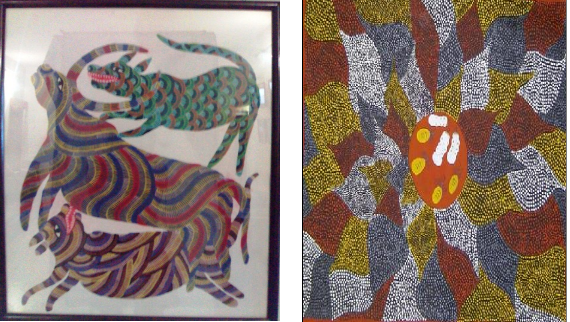
I am sure you can see how similar this is although the Australian example is dot art. If you look at the Gond religion, it is a tribal religion with many similarities to other tribal religions. In my research I could not find similarities between the religions of Gonds and the Aborigines, not could i find similarities in burial/cremation customs etc.
Now let us look at physical similarities. Here is a picture of an Aboriginal man from the Encyclopedia Brittanica.
Here is a picture of a young Gond boy. I am sure you can see why these are called Australoid people.

Next I decided to see if there could be some clues in Genetics. So I turned to National Geograhic’s amazing Genography project which is attempting to map the movements of human beings across the planet all the way from pre-historic times (200,000 BC). My jaw dropped when i looked at the snapshot from 60,000 to 55,000 BC. You can see from the picture below that the M* genetic group left Africa and reached Australia and they passed through the Gond’s area in Madhya Pradesh. If this is the same people from that time, Gonds are likely to be the most ancient people in India one of the most ancient peoples of India.
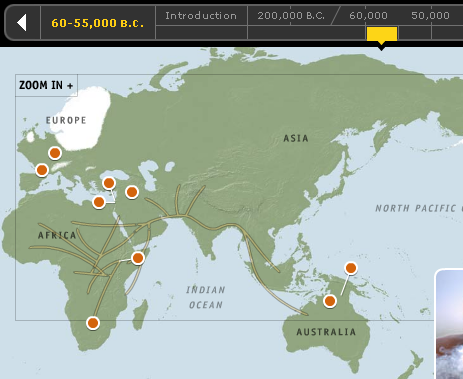
If you look at Aboriginal Art from 40,000 years ago it is mostly rock art and there is no comparable Gond rock art that is similar, so I looked at the Genography project’s data from the year 10,000-5,000 BC. You can see the picture below and see that some more groups have passed through to Australia via the Gond Area in India. It is likely that these latter day genetic groups who developed this dot art form took it with them all the way to Australia.

It will be easy for revisionist Hindutva ideologues to conclude that the Gonds also follow Hinduism – nothing could be farther from the truth. Please read this description of the Gond religion. Having said that, today’s Gonds do practice Hinduism and their contemporary art may reflect this.
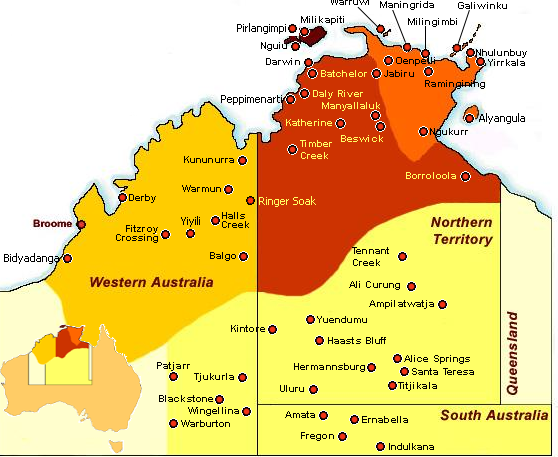
I picked the dot art painting from the area where Australian Aborigines landed. See picture below from aboriginalart.org which shows the various tribes populating this area. The inset shown in the map below matches with the genography map above.
In sum, we seem to have found one of the oldest peoples of India.
Blood on the streets? You must be kidding ..
Filed in Management, January 25, 2008, 9:57 pm by Sukumar Tweet
Please welcome Sridhar Iyer back after a long time. He is a financial industry expert, working for the company that loves urban landscapes 😛 – Sukumar
“It’s mayhem out there,” cries the CDO trader to a fat cat investor on a long distance phone line. We could get 20p to a dollar if we are quick and lucky. The client shudders “ I am already down 20MM, and this will wipe me out ”. “Things could get worse. It is best to close positions now. DB is offering 18.6, MS 19 and Merrill only 17.2. 20p is a great price, given the state of the market ” pearls of wisdom on recorded lines travel through fibre optic cables across continents. The trade is booked, the deal is done and the market crashes even further.
And as if to console that far away investor, FT headlines cry out the next day “ Chuck(ed) out – Citi fires CEO ” followed by another lyrical one “O’Neal exits Merrill ”. New phrases are added to the financial services lexicon and bandied about by every expert worth his salt – credit squeeze, liquidity crunch, the balance sheet impact of a low tier one capital, sovereign funds …… . .. If you are not predicting recession, you are definitely not in vogue. Fed cuts interest rates, stock markets plummet, job cuts all over.
Given this scenario, you would think that the financial services industry was in deep turmoil .It is time to tighten belts and see through this difficult period. Well, not quite. That , certainly is not the signal if one were to go by the bonuses that have been handed out to the big shots this week – both to current and former bosses.
Chuck made $94 MM as farewell gift from Citi and O’Neal showed what a good negotiator he was by plucking out $150MM from Merrill. Chuck’s successor, at Citi made a healthy $28MM for 2007 , and the new head of the of Citi’s fixed income division ( which caused all the write downs) a cool $22MM.
But surely, a whole bunch of traders and analysts were fired and they bore the pain. Fired, yes. But pain ? That’s a different story . Look at this career model – a crisis like the present one, occurs once in 5-6 years and lasts at best for a year. The last one occurred in 2001 and was followed by 5 years of undiluted prosperity. In a decent year, an average trader makes a modest $0.5 to 0.7MM. So while the good years last , the kitty fills up pretty quickly. Will s/he complain, if in order to calculate the new average pay for all 6 years, nothing incremental is added to the numerator ?
But what about their reputations, loss of face? Here is a secret – a trader’s worth in the job market goes up with the number of down turns he has managed – whether in the job or out of it. And if nothing else, most top business schools offer great 1 year programs, which will help change career paths.
So who lost out and who gained? – Consumer banks, that wrote off substantial portions of mortgage loans to the sub-prime segment (an estimated 200$Bn) especially in the US made big losses. The CDO crisis, though, is a zero sum game. There are winners and losers who balance each other out. Citi, Merrill and the other big banks, which betted on sub prime lost heavily while Goldman Sachs and numerous hedge funds profited to the same extent. The hedge fund owners who made billions, must be wondering what this furore is all about. One thing is for sure though, the traders and investment bankers, who precipitated the crisis certainly did not lose out. They never do.
So why are you not a trader? Well, that is another long story.
Diary of an Atheist
Filed in General Interest,Science, January 24, 2008, 5:26 am by Priya Raju TweetI never start anything with an apology. What the heck, I’ll set a precedent here & get the queasiness out of the way. My Mea Culpa: This post is auto-biographical & I’m not at all sorry about that. I’ve compulsively & maladroitly changed the names of all the characters. But they are all from real life, poorly & incompetently veiled. Now I can get on with business. Sehr Gut, Nicht Wahr – as they say in Germany. Not that I’ve ever been to Berlin, but I imagine that’s how they speak. My imagination is as limited as my German vocabulary.
I called this a “Diary”, but I don’t have the habit of keeping one. Once when I was 12 years old, I decided to keep one – since all the girls I knew had one. They wrote their most intimate thoughts in it, in pink ink. “Sheetal loves Fayaz”. “Meera Smoked a Ciggy Today!” They never traveled anywhere without their diary, tooth brush & Teddy Bear. How can I be left behind. I wrote on the fly leaf of a thin, dark blue leather-bound diary: “Its indecent to read another person’s diary”. After that, much to my chagrin, I had run out of material. And I had misspelt “diary” as “dairy” in my hurry. So, I filled my “dairy” with New Words & Phrases, World Capitals, Cricket Scores (Edited mendaciously to favor Kapil Dev & Vivian Richards), Favorite Theorems, Lyrics for Thomas Dolby’s songs, My “Discoveries” such as “Why I believe Hydrogen to be a Metal”.
Why am I saying all this? I want you to know that I’m using the term “diary” simply to denote the veracity of my post. These things happened, mostly as narrated. Events are not presented in a strict chronological order, because – Well, everything in life isn’t neatly docketed & ordered. Dissonance, the way of life. Our hope, to untangle it to a more coherent mess.
When I was in 4th grade, my favorite possession was “Our Solar System” – a small, 100 page book on Astronomy. I loved this puny book. There were 9 planets. Some of them had many moons. Planetary flotsam called “Asteroids” could hit us any time. The sun was a star (Yowza!). Our galaxy is shaped like a “J”. Soon after, I acquired another fascinating book – “The Composite World Atlas”. I also owned a less revered text book on “Moral Science”. In retrospect, it is the latter that gave me much food for thought. In my Roman Catholic school, “Moral Science” was a euphemism for teaching a bland, secular hodge-podge of “good & wholesome” ideas taken from various religions.
I bluntly asked my dad one day: “Appa, I can’t locate any place in the Atlas marked “Heaven”. Is there such a place?”. My father looked at me & smiled. “Also – I’ve read my Astronomy book. And all my text books on Science. Nowhere does it mention God”. “So what do you make of it?” asked my dad. “Well, all books talk about the big bang & how it caused us into being. It talks about how atmosphere & water help us live. And about planets without life. There are theories & experiments to prove all this”. My dad looked at me encouragingly – “Go on”. “I mean, my legitimate text books don’t leave a place for God in their scheme. Only my namby-pamby Moral Science book talks about God. Do you believe in God?” My dad scratched his head & said – I’ll never forget it – “If there isn’t a God, we’ll create one to regulate our lives”. I stoutly said, “Well, I don’t believe in God”.
“You can’t disprove God, can you?” – This was Mr Swami, our neighbor & Math Professor at the local university. We were walking around the lake & we sat on a grassy knoll. The university’s adopted dog, Blackie, looked at the professor lovingly & slobbered all over his face. “No Sir, I can’t. But that’s not how science works. You believers haven’t provided a shred of evidence to prove God exists”. The professor chuckled. “Consider this, Priya. What do you have to lose by believing in God? In any case, that’s a safe bet!” I burst out laughing – Pascal’s Wager! I should have expected this from a Math Professor. “Sir – You want me to hedge my bets? What are we discussing – my investment portfolio or my belief system?” The professor shrugged – “Eternal Consequences, my dear girl”.
My friend Pat asked me once, “Believing in God gives me strength. What does your disbelief give you?” I thought about the “Digital Signal Processing” exam that I had endured last semester. It was too advanced a subject for Under Grad levels & our lecturer was as ignorant as his students on the nuances of signals. We were quaking in our boots before the exams. But many of my classmates – sent a prayer to their favorite presiding deities. And entered the exam hall more resolutely than me. All I had was existential angst – that’s what my disbelief had given me. Faring well in this exam was almost completely dependent on how well I had prepared. Knowing this fact certainly did not help me. I ended up acing that exam – but all I remember is how my stomach was in knots the day the results were announced. It was an ugly feeling.
“So what is your stance?” – my mother asked me one day – “There may be a God, you know”. Yes, I agreed – “Amma, there could be a God. But as of now, God is a moot point”. My mom asked me – “Then, are you an Agnostic? There seems to be some doubt in your mind”. “No mom – Agnostics think the existence of God & After-life are unknowable. I merely think its a matter of time before we know the truth. If we don’t have answers to many questions today, we should be patient & try to uncover more data. Instead of jumping into the conclusion – that there is a God”. As Albert Einstein said, “The important thing is not to stop questioning”. The answers are not too important, but an enquiring mind is.
Where does that leave me? People are free to follow a religion of their choice. I just choose not to. Again, if people choose to believe in God – I respect, but don’t share, their opinion.
As for God – who knows, there may be one. Till that is proved to the satisfaction of the scientific community – by that I mean the skeptics, not some crazy dude with a doctorate who believes in “Magic Messages from Water” – I classify myself as an atheist who’s almost sure there’s no God.

 Entries