Alternative Medicine: Take 1
Filed in General Interest,Science, February 15, 2008, 11:01 am by Priya Raju TweetTalking about oneself is crass solipsism at worst & a crashing bore at best. Be that as it may, I have to resort to some over-sharing – all for a good porpoise, I mean, purpose. Fear not, I won’t make this a meandering personal narrative. So, bear with me. Or not – At this mo’, I don’t particularly care which.
{Flashback Fades In Here} Many years back, I developed a stomach ailment – Acid Reflux, to be precise. “Developed” – What a word, as if I’m a photographer working on a roll of film 😉 It was particularly severe & my doctor hyper-ventilated whenever she heard my symptoms. I had to pat her back sympathetically. She set out heart-breaking wails every time she upped my dosage. My family became woozy with worry when the doctor started bringing in interns to study my “interesting case”. So in the Winter of 2001, a relative offered to cure me thru Reiki.
“Just believe fully in my powers to cure you!” his voice fluted pleasantly. I had to lie down on the sofa & close my eyes. “Er, what happens then?” I asked, cheering up. Alternative medicine is glamorous if nothing else – so I was hoping for fancy-shmancy pyrotechnics. “I move my hands above your stomach for 10 minutes!”. “What, that’s all?” I asked, outraged. Any reader of my post knows I’m a skeptic: I was deeply suspicious of Reiki by now. I’ve swallowed enough Zantac to fell a giant, 1 of the interns opined that I had no oesophagus left & hence had no business to be alive – and this bloke thought randomly flailing his arms would cure me.
I chewed my nails for a few minutes pensively. There are many things that we don’t know. So I agreed in-principle that Reiki might work. I suspended all judgement & put myself in his hands – literally. After the session, he asked me “Did you feel your body bounce off the sofa? That usually happens during healing!” I mulled over this honestly & told him – “No”. “But, you must feel some heat on the stomach now!” he piped in, crest-fallen. “Er, my acidity keeps my stomach rather hot & lively all the time. I didn’t feel anything unusual. And I don’t feel better either” I said helpfully. “I…I can’t continue this treatment” he said nervously. “Why not? I persisted. {Flashback Fades Out Here}
The Stitch On My Side
Seriously now. I’ve been watching with increasing discomfort at how the mind-share of science is shrinking in the 21st century. Its premature to order a coffin – but educated people are ready to jump head-long into any “New Age Cure” flapdoodle. Pseudo-scientific healing methods spring up more quickly these days than mushrooms after a rain. For the record, science doesn’t brush aside anything that can’t be proven. If some form of alternative medicine is unable to show how it works, but is able to cure patients – I won’t attempt to deconstruct it. The means or the end – if neither can be shown – stop sniveling. Skeptics will jump in for the kill, with pleasure.
If you came to this site wanting to hear plaudits sung on Alternative Medicine, you’ll be sorely disappointed. I’ll explain as lucidly as possible why I don’t have a scintilla of belief in unproven methods. Now, how should we go about methodically figuring out whether an Alternative Healing technique is any good? Here are some indications that some mischief is afoot & all’s not well in Eden:
Power of Placebos
If the miracle cure says, “You’ve gotta believe in it for it to work” – That’s a clear signal that they absolve themselves of all responsibility. If the treatment didn’t work, they can always blame it on your “attitude”. If it does work, they get free word-of-mouth publicity. Either way, they win. If it works, its the “Placebo Effect” – also called “Faith Healing” – masquerading as new age jiggery-pokery.
The “Placebo Effect” is a well documented phenomenon, where the patient feels better – not because of the munificence of the treatment, but because the patient believes fully in it. Most of the benign alternative therapies work this way, by harnessing your own belief. Approximately, 35% of the people are susceptible & they feel marginally to considerably better after ingesting placebos. Pharmaceutical companies have to conduct Double-blind Experiments – Where the experimenter doesn’t know who the “Test” & “Control” subjects are. They are expected to prove that their drugs work better than “Sugar Pills” – which is what is used as placebos in their control experiments. Ergo, they have to prove that their remedies work as advertised.
Practitioners of quackery have no such obligations. What isn’t rigorously tested may not work.
Nature <> Benign
I was jawing with my hair-dresser Amy on her mom’s impending menopause. Amy said “Oh, I’ve put my mom on natural estrogen!” – She was positively beaming & looked at me like a Labrador Retriever in dire need of petting. “Ah – Excellent. But, Amy, have you checked with her doctor before starting her on this?” I asked. “B-But – Plant Estrogens are natural!!” said Amy indignantly. “Well, I wouldn’t try it without a doctor’s say-so” I persisted. “Really? Not even something Natural?” wondered Amy, banishing further thought. As far as she was concerned, that settled it.
“Well, Rattlesnake Venom & Latin American Toad Poison are natural. Hot Lava cremating us ahead of schedule is natural. A tiger chomping someone’s butt off is natural. Heck, aging & death are natural. I don’t see you queueing up for any of that!” – I said. Actually, I didn’t. My good sense prevailed. Arguing with someone wielding scissors is a no-no in my book.
Just because natural drugs don’t have “chemicals” doesn’t make them good for you. There are definitely some very beneficial natural therapies – but it would be a fallacy to think they are good because they are natural. Before you lose fistful of $$ for that natural remedy, research it for contra-indications. For all you know, it may be a poison. Or, it may interact with other drugs that you take.
Weasel Words
Look for “Weasel Words”, the Lingua Franca of quacks. The advertiser may manipulate you by hiding behind ambiguity, by being dodgy, shifty & crafty. Stated simply, you can’t accuse them of being straight arrows 😉 Examples are:
1. “Studies done by leading doctors prove this!!!” – Which doctors did this study? Who determined they are “leading”? Who commissioned the study?
2. “It has been well accepted that our capsule gives excellent results!!!” – Accepted by whom? Define “Excellence” in terms of relief – 10%, 20% – What?
3. “90% of the people saw improvement after our electro-static massage!!!” – How many people were studied? How many times was this study repeated? “Improvement” is an ambiguous word – How did the subjects feel 1, 3 or 6 months after the treatment?
Such claimants hope that you won’t poke your nose & demand specifics. If their treatment is so good, why don’t they get an FDA certification? Or, publish their findings before an August committee of doctors, who can independently verify their claims? You’d think they’ll be making a beeline to present their therapy & win the Nobel! If their claims are true, they will. On the other hand, if they are liars & cheats, they have every reason to avoid peer reviews.
“Ancient Therapy” Ploys
Some of you may now say, “There are age old cures that work, you git!”. Granted, there are some ancient therapies that work. Neem extracts, Tea Tree Oil (good for nail fungus ; for the nail, I mean – not the fungus), Vajradanti Tooth Powder, Candied ginger for nausea – its a long list. Most – not all – of these cures were arrived upon by the ancient people after repeated experimentation & observation. That’s the basis of science.
But, before using any “ancient” therapy, check how old it really is. Reiki for e.g., is touted as an ancient therapy – if you consider “150 years old” ancient 😀 So, to get public benediction, a shyster simply needs to state that their therapy is based “On the Ancient Wisdom of Japan/China/Tibet/India”. Poor Iraq, Iran & Egypt. They have older cultures, but they haven’t managed to capture sufficient woo-woo mind-share.
Please note that modern practitioners of ancient therapies make marked departures from the proscribed medical texts! Some acupuncturists for e.g. – pass a mild current thru the needles. I may be wrong, but something tells me that electricity wasn’t freely available 1000 years back 🙂 Still think its based on “age old” wisdom?
Some of the ancient therapies – we know now – are extremely harmful. Certain Ayurvedic medicines use Antimony compounds – and they are as toxic as Arsenic. Semi-literate people scoop, pound & package these chemicals cheerfully. What, they are gonna exercise special precaution because you are buying? Improper synthesis of such drugs can kill you. Per Ayurvedic texts, these compounds should be fired at a certain temperature to lose their toxicity. And no qualified person is regulating all this. If someone is dead set (pun intended) in popping these pills, I’ll get some for them 😉
Summing Up
Consider this – There’s no money in skepticism & cart-loads in mumbo-jumbo. Who is more likely to gip you? Me or them? I have to catch my breath – None of us is getting younger & I’m totally winded out after all this pontificating.
Whenever I exhibit my inner skeptic, I get hate mail from people, threatening a punch in my solar plexus – and I didn’t know I had this “solar” gimcrack 😆 If I’m not killed or maimed – and otherwise feel reasonably alive & limping, I’ll pen a follow-up post on how quacks abuse science to confound people & sell more of their tripe.
The Real History of India – Part 4: A new IVC Symbology for better decipherment
Filed in General Interest,Reviews, February 13, 2008, 7:29 pm by Sukumar TweetUpdated Feb 16, 2008: Priya Raju suggested 2 more dimensions – food and attire to the framework. I have added them below.
Prolog:
I pointed to a seal in my previous post with a link to Parpola’s interpretation. He interpreted the lower part brilliantly as the Seven Sisters (Sapta Kannika) which is the “Pleaides”. And I think he is also correct in that the Vernal Equinox – when the Sun enters Pleiaides – is the New Year. He also correctly references the myth where Lord Muruga (Karthik in Bengal) was born and was tended to by the Karthikai (“Krithika” in Bengal) Penngal [Krithika Women a.k.a Pleaides].
But what about the tree, the god within the tree, the human worshipping the tree, the goat etc? A.L. Basham in his “The Wonder that was India” talks about women worshipping the peepul tree for fertility. I recalled my grandmom talking about this. Therefore, the tree is the Peepul (Arasa Maram) – look how closely the leaf’s characteristics on the seal resemble the real one in the wikipedia. The horned figure is the Mother Goddess that we worship till date in Tamilnadu for fertility. The belief is the worshipper will beget a handsome baby boy like Lord Muruga. Infertile women are asked to go around the Peepul tree on certain auspicious days and make votive cradle offerings tied to the tree to become pregnant. I believe that the small object besides the kneeling woman is the votive cradle offering [Citation Needed]. I asked for the Tamil Farmer’s Almanac (“Paambu” Panchank) from my father and figured out the exact auspicious days on which this ritual is done.
Why the Goat? A possible explanation is this: every star has a symbolic deity and an animal. For Krithika, it is the goat. Another point to note is – in Celtic religion, sometimes infertile animals are part of the ritual. Interestingly, the animals depicted in the IVC seals are real animals with their distinctive species markings. For instance, this goat is the Pashmina/Cashmere Goat (one that gives the Cashmere wool). This is how a modern day cashmere goat looks (look at the characteristic wavy antler and look at the seal again). This just shows the powers of observation of these people.
The humans in this seal are all women because they have a feminine triple horn (to be covered later) and they all wear bangles – these bangles were made of shell. To this day, in Bengal women wear Sankha Pola – shell bangles during weddings and auspicious days. You can also see the plaited hair which is another feature in the woman’s attire till date in Tamilnadu. BTW, Shell bangles were a key manufactured item of the IVC people.
Please note that I am yet to attempt to decipher the script: my focus has been only on the pictures on the seals because I felt that we must first understand the symbology.
Existing Models for IVC Decipherment:
Currently there are 3 models per my own classification:
 [source Harappa.com]
1. Parpola Model – Sir John Marshall, who discovered Harappa had hypothesized, that the language of the IVC was Proto-Dravidian. The Indus symbol above is known as the Fish. Father Heras proposed that it means “Meen” in Tamil which means “Star” since the phrase “Vinn Meen” (literally, Sky Fish) denotes “Star” even today. Asko Parpola is the first historian to accumulate a significant corpus of decipherment of the Indus script – and he agrees that “Meen” = Star. He has systematically proved that claim with a lot of data. Before you jump into any conclusions about his intent, Parpola is a Sanskrit Scholar and has done a lot of work on the Vedas and Upanishads.
2. Vedic Model – This model attempts to fit the Vedic Symbology onto IVC and tries to prove that Sanskrit was the language spoken in the IVC. Quite obviously, the historians who propound this view – including some western historians such as David Frawley – are the darlings of the Hindutva-vadis.
3. Mahadevan Model – Iravatham Mahadevan is one of the greatest Indus researchers India has produced and is the leading expert on the Brahmi script. He has also deciphered a huge number of Indus seals. Mahadevan supports the Parpola Model in that he thinks the language is Proto-Dravidian – but he adds that there is also a Vedic component. So his is a hybrid model.
The erstwhile “European Model” has been subsumed by these models. It is important to remember that it was Sir William Jones who proved that Sanskrit is Indo European with his path-breaking comparative linguistics method and the brilliant Caldwell who proved that the Dravidian languages were a separate language family distinct from Indo European. Max Mueller has also made some key contributions. But the Europeans introduced several errors which still affects the way we think about the IVC.
For the record, initially I was in the Mahadevan camp but after considerable rethinking, I am firmly in the Parpola camp. In my review of the IVC research done so far, I have identified some major gaps which can be attributed to the lack of a Symbology [Thanks Dan Brown for popularizing this term]. I think a new symbology framework will help us unearth some clues which we will later use for script decipherment.
Proposed 8-point 10-point Symbology Framework:
1. Religion – What was their religion? Most evidence points to a non-Aryan religion, centered around a fertility/mother goddess. I believe this was not a simple fertility cult – but a dramatically different religion with an astronomical foundation. This will be covered in the next post.
2. Language – What language did they speak? Many languages including Sanskrit and Elamite have been proposed as candidates – ideas without definitive evidence. Parpola and Mahadevan are right in believing that the IVC inhabitants spoke Proto-Dravidian. Parpola has even applied some ideas from the Dravidian language spoken by the Gonds. If you apply the principles of language drift and comparative linguistics to existing Dravidian languages, it can be proven quite easily that Tamil, the Gondi and a few more Dravidian Tribal languages will be the closest to Proto-Dravidian. Tamil is a natural choice to decrypt the IVC seals because of its richness – linguistically and culturally. Not to forget, the abundance of native Tamil speakers.
4. Flora and Fauna – Given that many of the IVC seals depict animals and plants in great detail, we need to understand their flora and fauna better.
5. Astronomy – All agrarian societies had a pretty advanced knowledge of astronomy for their time. We need to understand their core astronomical beliefs, especially since my research indicates that it was closely tied to their religion.
6. Economics – What means of livelihood did they have? We already know that they traded with Sumer using standard weights and measures, they had workshops that made beads, bead necklaces, shell bangles, toys and votive offerings. Agriculture and Animal husbandry were also key components of their economy. Priya Raju made an interesting suggestion that maybe some of the seals represent the place where the goods being traded are sourced from. Definitely worth investigating, right?
7. Engineering/Architecture – We need to learn how they built fantastic buildings, arrived at a city plan, great bath and an advanced sewer system. What clues does their script bear in relation to this topic.
8. Collation Scheme – One of the most surprising aspects of the IVC seals is the small number of characters. In fact, this has led to historians like Witzel/Farmer to conclude that IVC was illiterate – which I believe is highly improbable and totally ludicrous. Why are they assuming that each seal is a stand-alone? So I started thinking about it and wondered if there was a collation scheme to tie the seals together ? Mahadevan has talked about how every seal had a hole at the back through which a thread can be passed. And based on that he concluded that every seal was worn as a pendant around the neck. This didn’t make sense to me – till I remembered that one of the key products of the IVC economy were beads and bead necklaces. I put these two together and I realized that they must have strung a set of seals together on a string and form longer sentences and possibly many strings could together form a chapter/book etc. No one seems to have thought of a collation scheme, so I couldn’t find any material on this. But this must be explored seriously.
9. Food – what food did they eat – grains, cereals, fruits, vegetables, animals. These will also have some language clues.
10. Attire – what did they wear – we already know that cotton was a key export item, but what kind of dresses did they wear? Are there any clues in the seals?
Epilog:
To illustrate the framework, let us pick the popular seal known as the unicorn:
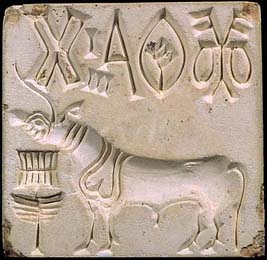 [source: Harappa.com]
Calling this the Bull Unicorn (Bull with a single horn) is an European error – caused by their identifying it with unicorn myths from their cultures. IVC people were extremely scientific and I doubt if they’ll represent mythical creatures on their seals – when all along, they’ve only depicted fauna native to their region as we have seen above with the goat. My interpretation is that this is a cow – specifically, the species Bos Indicus (or the Zebu) with a short or non-existent hump and horns. Look at a picture of the current day cow from this breed.
Okay, but why only one horn, then? I thought long and hard about this and finally tied this to their engineering/architecture capabilities. One of the first lessons in Engineering Graphics I learnt in college was the Plan View and Elevation View (also known as perspectives) – a system to represent 3D objects in 2D using the observer’s view point. They must have used these techniques to create the layouts for their buildings and town plans – and they must have applied those to their seals as well. Now, if you observe an animal on its side and profile it, you will notice only one horn.
In fact, this plan view and elevation view perspectives repeats itself in many seals, so i see it as a critical component of the Indus Symbology. For instance, the bangles in the peepul tree worship seal. If you use the perspectives method, you can see why they depicted the bangles the way they did.
By now I am sure you appreciate the 8-point 10-point symbology. Are there any dimensions missing? I’d love to hear your views on this.
Next week we cover the IVC religion in-depth. Stay tuned.
The Real History of India – Part 3: Neolithic Supply Chain
Filed in General Interest, February 10, 2008, 3:48 am by Sukumar TweetUpdated Feb 12, 2008: Ganesh and Karthik have raised excellent questions on methodology. I had included a segment on the methodology I used. You would have seen that part if you had read my post on Sunday. Later I took it out because the post was already way too long. Here is the methodology I used. As always critiques are welcome.
—
Prolog:
In the previous post, I explained how the Neolithic Plate was united by a common religion. In this post, we look at the economics of the Neolithic Plate, the other big aspect of civilizations. Not only did the Sumerian package include agricultural elements, it included supply chain economics and a written script. Why is all this context important? I believe with this context we can pass judgement on whether AIT is valid or invalid with certainty.
Pentagonal Supply Chain:
This episode in my journey of discovery started when I read the following lines in Page 88 of Romila Thapar’s The Penguin History of Early India:
The harappan system was a network linking the urban to the rural and some features could have been maintained in the rural areas, even if these areas suffered administratively and economically from the removal of this protective system.
Maybe other historians have also said this, but somehow this statement took my imaginaton by storm. I saw many things about IVC in a new light – they had a complex system of weights and measures, workshops for manufacture, seals, various tools and techniques, advanced town planning, a covered sewer system, fancy multi-storeyed buildings and of course the now famous Great Bath.
I also came across a news item in the Hindu newspaper about an Indus seal depicting Bull Leaping. I already knew by then that the same bull leaping was there in the Minoan Civilization in Crete, Greece that I talked about in my previous post. I even found this fresco of the Minoan Bull Leaping which is eerily similar to the Indus seal. This time, I read some more about the Minoans and I realized they have a similar mother goddess worship, a great lily pond (similar to the Great Bath), palaces, complex weights and measures, covered sewer and water management systems, advanced town planning and also a heiroglyphic like script that has not yet been deciphered.
Since I already came up with the realization that this entire region was acting like a continental plate – Neolithic Plate as I called it, this set of evidences told me that the connection between Minoans and IVC was much stronger.
Armed with this interpretation, I now went back into looking at Sumer and I came across the fact that there were several references to 3 places Magan, Dilmun and Meluhha from where they received ships. This clearly told me that there was some kind of trade network that Sumer was having with these three trading partners.
1. Meluhha – Asko Parpola, the f***ing brilliant Finnish Indologist had already proven that Meluhha was Mel Ahha (which he further derived to Met Agam = High Abode in Tamil, don’t know why he chose Met when Mel itself suffices) and it was the IVC. He also concluded that the Sanskrit term “Mileccha” meaning foreigner was a derivative of Meluhha. Al though i was convinced of this, i was not completely satisfied because I didn’t understand why people in the Indian subcontinent and Sumeria call the IVC by a term that means foreigner! So i thought about this further and I realized that “Mel” means “Upper”, “Agam” means Inside or House (as in Ezhil Agam or Thamizh Agam). Therefore Meluhha = Upper House, corroborated by evidence that houses in the IVC cities were often multi-storied and also included a citadel which could be called Upper House.
2. Dilmun -Researchers have already shown that Dilmun is Bahrain, a sea port in the persian gulf and a key part of the Arabian Peninsula. Interestingly, they simply used the IVC weights and measures. It is not clear if they also had their own script and IVC, Minoa like urban infrastructure. But without a doubt, they were a key trading partner of Sumeria and IVC.
3. Magan – Current research places Magan either in Oman or Yemen, but it also says the place is not known with certainty. Somehow this placement of Magan struck me as odd because when I was researching the Minoan civilization, i found that they were also a mercantile people who did trading. Not just any trading: it was a trading network that hooked together UK, Cyprus etc and traded with Mesopotamia as well!
At this point i made the intutive leap that Magan is the Minoan civilization. So i started to look for proof and went back to look at the Minoan as well as the Mycenaean that immediately succeeded the Minoans.
Interestingly, it turns out the decipherment of the Mycenaean Linear B script has shown that the name “Mycenaean” is incorrect, when applied to the civilization of mainland Greece.
At this point, I began to run out of steam. How do i connect Magan to Minoa – I got a couple of ideas – from my trip to Greece, I knew that there is a place called Mykanos which is a Mycenean place. In Greece, K and G are interchangeable – for example Knossos is also Gnossos. So Myganos maybe equivalent of Mykanos [Citation Needed] and if you strip the OS which is a standard Greek suffix, you get Mygan, pretty close to Magan.
Another thing I realized is that when Arthur Evans discovered the Minoan civilization, he simply named it after the King Minos. So this is another mistake in the Greek Historical Nomenclature. Now I was almost convinced that Magan = Mycaenae which is actually Minoa.
To see if i could find any other evidence, i looked to Egypt another culture which had a history of writing since 3200 BC to see if they had any references to Magan. It turns out Amenhotep III, refers to a place called Mwkinu or Mycaneae. Amenhotep III’s time is past the Minoan civilization but i think the name of the place wouldn’t have changed within 300 years of the decline of Minoa.
Need for a Complex Supply Chain:
Now, I landed in another problem – i didn’t understand why they had such a complex supply chain moving goods from Magan, Dilmun, IVC and Sumer because it looked like any other ordinary trading going on between countries since time immemorial.
As i wracked my brains, it dawned on me that we were dealing with the Bronze Age, which means one of the key metals is Bronze which is an alloy of Copper and Tin. I had read that Sumer, IVC, Minoan, Egypt all had Copper [Citation Needed]. Additionally I found with Priya Raju’s help that Tin is significantly rarer than Copper [2.5 ppm for Tin vs. 75 ppm for Copper].
Aha! that maybe what is driving this supply chain. I went back to Minoa again and started looking and voila, one of the main exports of the Minoans was Tin which they imported from Celtic UK!
Now that i knew that it was the metal trade that was driving this supply chain, it was pretty easy to connect Egypt to the network, it had Nubian Gold and Papyrus, as the fourth arm. From my Egypt trip, I knew that they had an alloy of Gold and Silver called Electrum. So i needed to find a source of Silver and it was right there in Anatolia (Luwia) near Catal Hoyuk which i wrote about in my previous post. Curiously Luwia also had Anatolian Hieroglyphics.
The Pentagonal Supply Chain is complete – Magan, Dilmun, Meluhha, Egypt and Luwia with Sumer being the orchestrator of the supply chain – can you believe this – a multi-hub-and-spoke model from 5000-6000 years ago!
One small problem remained – Magan is in the Mediterranen Sea and it needs to cross over to the Red Sea to reach Sumer. I guessed that Suez Canal which connects these 2 seas in the modern day may have been a small canal through which small boats might have passed through in ancient times [Citation Needed].
Epilog:
Next week I will show how the context we have established helped me decipher parts of the Indus Script. I started with this seal:

Check out Parpola’s interpretation of this seal
I will prove next week that aside from the brilliant connection to the Pleaides, Parpola’s interpretation is not completely correct. You all can also try your hand at interpreting this seal [Priya Raju is excluded because she knows the answer].
My Tribute To S.K.Iyer
Filed in General Interest, February 8, 2008, 9:45 am by Priya Raju Tweet23 years ago, my grand father – S. Krishnaswamy Iyer – passed away. It was towards the end of March 1985. My 10th grade Board Exams were in full-swing. He died on the eve of my Science exam. For some strange reason, that’s how I’ll always remember him.
My Math exam was over in the morning & thatha (grandpa) was “quizzing” me out to see if I had any chances of getting 110 out of 100 (yeah, you read that right). No, I had made a mistake & could only score 97 (bang on). “Why do you make so many mistakes?” he wondered. “I just made 1!” I bristled. “That’s one too many” he retorted. He was of the firm opinion that if only I tried harder, I’ll inherit Albert Einstein’s crown 🙂 Much to his grief, I had too many new-fangled “artsy-fartsy” interests.
He was our maternal grandpa. We called him “Madurai Thatha” to differentiate him from our paternal grandpa Venkatarama Iyer (“Arcot Thatha”). We lived in Thanjavur at that time. Madurai Thatha & Patti (grandma) had “immigrated” to Thanjavur to be close to us & they visited often.
Patti was a fun-loving, adventurous, happy go-lucky woman who loved the unknown. Thatha was a tight-lipped, disciplined, highly introverted man & was deeply suspicious of anything new. Patti broke into songs extempore, often making them up on the fly. Once in a blue moon, thatha sang devotional songs exclusively to Lord Shiva. Patti gossiped, cracked jokes & was very popular. Thatha was intense and – well, dreaded or avoided.
An unlikely couple, they were deeply attached to each other & shared a few traits: bold as brass & tough as nails. They thought only sissified gentry whined about pain. To this day, in our family, pain-bearing is practiced as an art form. Mom had a uterine biopsy done – without anaesthesia. I hardly ever take novocaine for dental procedures. If you curl your toes & arch your back in a certain way resolutely, most pains become bearable.
See, my maternal grandparents needed all the pain-bearing capacity they could muster. They came from poor, hard-scrabble families & worked very hard to earn a living. Sometimes, they had to go without food – so that their 4 children could eat. This is all the more sad because my grandpa was a Magistrate – not a manual laborer who had to eke out a living. Surmounting all these odds, they were very happy. Probably because of this early struggle – my mother always makes enough food for a small army. Even a scintilla of doubt on whether she’ll run out of food – is unbearable for her.
Thatha looked very different from the other Brahmin men in Thanjavur. He had a translucent peaches & cream complexion, gray eyes, an almost M.C.Escher-ish huge forehead (“sun-shade” forehead – I have a slightly abridged version, BTW), a long & narrow face (“Tumbler” face – I have it too!) & a huge nose roughly the size & shape of Saudi Arabia (Good grief! I have it too). In the pre-independence days, people called him “The White Indian”. He hailed from Calicut, Kerala – that’s where Vasco da Gama landed. I’ve read that they “really admired” Malayali women. You put 2 & 2 together 😉 Some day, I’ll look for my “Lisbon Cousins”! My mother will have conniption fits if she reads this, though.
He was an honest magistrate. Even in those days, honesty didn’t make much business sense. He was a stickler for discipline & took a principled stance on everything. He made no exceptions & expected none. If someone made a mistake, however small, the proscribed action will be taken. He was a walking rule-book. He was affectionately & fearfully given the moniker, “Gedudpidi Krishnaswamy” (Rigorous Krishnaswamy). Nothing & nobody scared him. Not even attempts made on his life.
I wonder if Gedupidi (as he was called) knew the meaning of fear. As far as I’ve heard, he was fearless. To him, all were equal before the eyes of the law. Some of his judgments crippled the local mafia – and for the next few weeks, he needed a body-guard. For hit-men with guns, knives & sickles had been dispatched to “take care” of him & settle accounts.
Of course, piddly things like attempts on his life only strengthened his resolve. In the 1940s, there was a severe short-supply of rice & wheat. The government ruled that nobody could invite more than 50 guests to their wedding party. A scion of Annamalai Chettiar (whose family still owns most of Chennai!) got married – Thatha & his team counted the number of used dinner plates in the venue! And coolly arrested Chettiar – probably one of the richest men in India at that time – and threw him behind bars, for flouting the law. To his full credit, Chettiar didn’t resist his arrest & lauded my thatha for his honesty.
Reading “The Hindu” out loud was thatha’s prescription for attaining fluency & command of English. He’ll call me everyday & ask me to read the headlines to him – Oh, I was fuming. How utterly dorky. And I’ve never had problems with English. (Hindi though was a different matter.) The Hindu. And oh, “Wren & Martin” for grammar. My father, a professor of English who specialized in ELT (English Language Teaching) looked askance at Wren & Martin, an outdated book. “Grammarian’s Funeral!” – he used to mumble.
“What is this?” grumbled thatha, when he looked at my paint box. “Art!! Painting never pays the bills. Why don’t you read “Jane Eyre”?” My father pounced on him – “Mama (Father-in-law), Priya already reads more than what’s good for her. She’s read Jane Eyre already! I don’t want her to be a mad scientist or an absent-minded professor”. Thatha looked at his son-in-law sadly – “You are a professor, so you know best. This child here (Child! I was 10 at that time) has more capacity. We can push her more”. Dad scowled & muttered – “For Christ’s sake! Can’t my daughter dabble with art? She’s way too geeky already”. I was deeply saddened – nobody thought I was kewl.
Thatha used to drive us all mad with his notions on punctuality. If he had to catch a train at 6 PM, he’ll be at the station at 4 PM! Once our doctor made the grave mistake of giving thatha an appointment at 7 AM. In those days, doctors converted the front-room of their house to a clinic. What do you know, thatha arrived promptly at 5 AM 🙂 The doctor had to wake up, let his “guest” in & go back to bed, grumbling all the time. Thatha didn’t mind waiting for 2 hours for an appointment. But going late! That would be totally unthinkable. Worse than death.
He had modern views on women’s emancipation. He insisted on all his daughters getting at least a Master’s degree – this in the 1950s. He also ensured that they had a job – nay, career! None of them quit their jobs to get married or have kids. In the 1930s (when patti became a blushing bride), women seldom spoke to men or made eye contact with them. And thatha’s many male friends & colleagues paid visits everyday. Thatha hated women who were shrinking violets. Much to his relief, patti conducted herself with the decorum befitting a magistrate’s wife. She had cleared 8th grade – an amazing feat in those days – and could hold her own among his male friends & chat intelligently on various topics.
Thatha insisted on discipline & self-control. Alien topics for my brother 😉 Oh Lord, how he tested thatha’s patience. My brother never used the stairs to get to the next floor, if he could help it. There was always an opportune pipe, a sun-shade, a tree, a window – a foot-hold of some sort. I think he finally mastered the art of using the stairs when he was well on his 30s – when lumbar pain descended, that is. He was the only person that could make thatha tear his hair, gesticulate wildly & holler. Well, my brother had that effect on everyone.
“Why do you allow him to misbehave?” – thatha will ask mom, foaming with anger. Allow! What did he mean – its not like my brother was begging my mom for permission! My brother made a face at thatha & chanted “Thatha, Kotha, Growth of a plant!”. It was just a nonsense phrase, but thatha’s face turned purple whenever he heard that refrain.
And now, here was my brother in the garden. He was carving on our Mango tree – “S.K. Iyer, a good soul passed away today”. I had my science exam the next day.
I was 15 years old. I’d never seen anyone – leave alone a family member – die before my eyes. Tender mercies – I won’t describe how he died or how we ascertained he was no more. One of his admirers brought a garland for his funeral – and the cloying smell of flowers – especially roses filled the air. It took me 6 months to come to terms with flowers, particularly roses.
Tale of the Talking Leaves
Filed in General Interest, February 7, 2008, 8:52 pm by Sujatha TweetImagine living in a world where there are no newspapers or books to read. Think of the days when there was no alphabet or script to write or read. That is how life was for early Cherokee Native Indians until one man gave the gift of their life and erased illiteracy.
Around 1760 a boy named Sequoyah (also known as George Gist) was born in the Cherokee village of Tuskegee (now in the state of Tennessee) to a Cherokee Indian mom and a settler dad. He and his mom were abandoned by his father and they lived with his grandparents. As a young kid, he was interested in the stories of his grandfather and village storytellers. He loved to hear about the adventures they described. As Sequoyah grew older, he saw how the Cherokee culture was changing and his people were quickly adopting the ways of settlers. He was worried that the old stories and ways of doing things would be lost. He wanted to find a way to help people remember these things.
As part of the settler encroachments Sequoyah fled Tennessee and moved to Georgia where he worked as a Silversmith. Once when a customer purchased one of his works he suggested that he sign his work, like it was usually done by the silversmiths. When the customer Charles Hicks learnt that Sequoyah didn’t know to write he offered to teach him. Sequoyah visited Charles Hicks, who showed Sequoyah how to spell his name and write it in English. Sequoyah was thrilled with the idea which began his long journey into writing in Cherokee. Then he moved and joined the Cherokee Regiment to fight against the Red Sticks. While he was at the war camp he realized the need of literacy for his people when he saw the settlers using alphabets to write to each other and remember important events while the Cherokee people had no means to communicate. However, the letters and sounds of their language were not the same as the Cherokee language.
Sequoyah tried many different systems for writing of the Cherokee language. At first he tried pictographs but soon he realized that there were too many symbols. Then he visited a nearby school to watch how children learned to read and write in English. He borrowed spelling books so that he could learn more about how written language worked. He began by noting each of the different sounds or syllables used in the Cherokee language and he gave each syllable its own symbol. Although some of the symbols he used came from the English and Greek alphabets they represented different sounds in the Cherokee syllabary. Talking Leaves, the 86 letters that make up the Cherokee language syllabary was born.
It took 12 long years of hard work when he finished his syllabary, but the council of Cherokee Indians did not like his work and thought it was witchcraft. Sequoyah tried hard to convince his people that his alphabets were useful. He taught his daughter Ahyokah the syllabary and brought her before the council. Sequoyah had the council give him a message to write down. Then he brought his daughter to read it back to them. The council was amazed, but thought it might be a trick. The council sent four young men from other Cherokee villages to learn the alphabets, and then the council tested each of them to see if they could read messages written by the other young men. This finally the council was convinced that Sequoyah’s system worked.
The Cherokee people quickly realized how useful the writing system was. It was easy to learn and could be used to share news among all the Cherokee. Within months thousands of Cherokee became literate. By late 1820s, a printing press was created with Cherokee symbols. It was used to print the first newspaper written in the Cherokee language- Cherokee Phoenix. Till date the syllabary has only 86 letters with no changes. What a perfect job!
Sequoyah’s syllabary helped the Cherokee preserve their history and culture. Today more than 320,000 Cherokee Indians live across the United States. Though they all speak English many still use Cherokee writing. It is an amazing story of a man, not literate in any language, created a system for reading and writing a language and a means of communication for the entire community. There are lots of unsung heroes around the world who have changed history and Sequoyah is truly one among them.

 Entries

