Privileged I am to be in Thy Debt….
Filed in General Interest, September 5, 2009, 10:51 pm by sultana TweetSultana is back with a tribute to Teachers on the occasion of Teachers Day in India. Please encourage her with your comments – Sukumar
——————–
Forming each pillar with patience,
Laying each stone with prayer
But the temple the teacher built
Shall endure while the ages roll,
For the beautiful unseen temple
Was the child’s immortal soul
– Anonymous
I remember today my Physics Teacher who had called us for a special class on a Saturday. Nothing special about it…. and towards the end of the half day class, she gave us the usual teacher’s tips for the upcoming board exams. Just then, the peon came in to give her a message of a phone call. She broke down like we never saw her do before. Nine of her relatives had died in a van accident. Her husband had been negotiating with the hospital authorities and having completed them had now requested her to come home.
She had got the bad news before she had started out for work : but he lady had actually thought, ‘Why waste the children’s special class? I can complete it before I’m required at home’.
A round of speechless applause rose from the class of 50 girls in St. Aloysius Anglo Indian Girls’ School. That day we knew who was standing in front of us. A rare teacher, in whose debt we were grateful and privileged to be.
With the newspapers reporting various incidents of teachers killing children with violent punishment methods and students attacking their teachers / professors, it seems that the education system is becoming like the stuff of nightmares.
Who is a teacher? In the ancient world, a teacher was almost divinity and teaching was a ‘vocation’, a Calling. In today’s competitive world, it is a profession. Sometimes, it’s just a ‘job’. Accordingly too, the characteristics of the teacher changes : if the person playing the teacher’s role is doing it because it is their ‘calling’, you can be sure you have a rare teacher to remember all your life. If it is in the ‘profession’ scenario, no doubt too you have a great person to learn from (sans the compassion element which comes by default with the ‘calling’).
What happens when teaching becomes a ‘job’ … Disaster! A teacher who is just an ‘employee’ brings all the ‘employment’ related baggage including frustration-on-the-job. Rare is the artist who is bored by color and rare is the architect who grumbles at his own sculpture! Such only can be a true teacher. The others had better change their professions to something else for their own sakes as well as for the children’s.
Through all the various types of teaching professionals that I have met , I think according to me, these are a few ‘default’ characteristics which a teacher must possess to just ‘be a teacher’, leave alone an outstanding one.
Truth from Within : To truly give – of one’s time, energy and attention for the pursuit of knowledge for knowledge’s sake – is the ideal maxim of a good teacher
Empathy, Attention and Compassion : To view a child as a precious resource for the future world and to embrace with empathy and compassion to so vulnerable a human being is the first and foremost duty of a teacher. Whether we produce ugly ducklings out of swans or swans out of ugly ducklings is completely in the hands of our teachers.
Excellence Beyond the Self : To be able to guide the student to vistas further than the ‘teacher’ / teaching umbrella. For eg, a truly caring teacher may put his student in touch with some icons that he considers a role model for himself so that there is an enhanced benefit. If there is no person, writings / works of that person may be used as a reference.
In an age when ROI (return on investment) is the be-all and end-all of life, we can never return to our teachers what they have invested in us. Their attention, affection and warmth is the backbone of which citizens and nations are made up in every day and age. It’s a great feel to remember Sarvapalli Radhakrishnan in whose honour teachers day is celebrated in India but also to recall each and every school, college and university teacher who played and continue to play their part in building this great nation.
Learning and the Aha Moment
Filed in Management,Science, September 2, 2009, 10:04 pm by Sukumar TweetFTOTW [Fine Tastings of the Week]
Dina talks about a wonderful innovation from Nokia that could have a major impact on rural India. A brilliant 4.5 min video on how to find and pursue your passion by Randy Komisar (via @athick2) [Flashback – can passion can be taught? ].
Prolog
Today, thanks to a friend, i had the good fortune to attend the launch event of a learning company called iDiscoveri. They are trying to revolutionize grade school teaching methods using their XSEED methodology. Some School Leaders, who have tried the XSEED system in their schools, spoke in glowing and inspiring terms about the system.
As i was waiting for the event to start, i had an interesting conversation with one of the attendees. We discussed a number of things about training programs in the corporations and also in general about learning. One question she asked stuck in my mind – do you keep track of learnings and how do you know you have learnt something new?
Learning
Later in the evening today, i and Priya Raju had a discussion on this subject. There seem to be 2 broad kinds of learnings – one is what we called the regular or routine kind – say we learn how to cook a dish or to ride a bicycle.
We feel it is the second kind of learning – which are breakthrough learnings that we distinctly remember as learnings. These breakthrough learnings are the ones we usually refer to by the term “Aha Moment”.
Aha Moment
The question is – when do these Aha Moments occur? We went over some examples:
1. We keep thinking about a problem or a question long and hard and all of a sudden something clicks in our brain and we find the answer. For example, my single arm bangle hypothesis is one such.
2. While cooking a dish, sometimes, by mistake, we skip a step or add the wrong ingredient. But if the dish turns out great, it results in an Aha Moment – a new recipe got created.
3. In grade school, we hear a lot about the solar system and how planets move around the sun in an elliptical orbit. Then when we hear about Pluto’s unusual orbit, it creates an Aha Moment.
4. A few years back, stereograms became popular. You had to squint and bring your eyes to a particular position – lo & behold, you can see a 3D image. When she first came across these, Priya Raju thought it was a scam because after several tries, she couldn’t see the 3D effect. But one day, she picked up the stereogram and somehow the eyes came into the correct position and she was able to see the 3D effect. An Aha Moment.
As with most ideas in the world, there is even a website dedicated to Aha Moments. The featured Aha Moments on the site are pretty good.
Epilog
What are your Aha Moments? Are there other categories of Aha Moments that we have not considered? From the answers, we want to construct a model for how and when these occur. If we are successful in doing that, we can use that in constructing better learning programs.
IVC Symbology – Bangles & Marital Status
Filed in Anthropology, August 22, 2009, 9:08 pm by Sukumar TweetUpdated 23 Aug 2009 2:50PM – added the Indus signs from Bryan Wells’ paper.
Updated 22 Aug 2009 11:55PM – found the image of the single/double bangle.
—
FTOTW [Fine Tastings of the Week]
Why we must focus on women for development – a brilliant/heart rending/uplifting article in NYT (Via Ganesh). Programmable Web – a great post on Google’s Pubsubhubub (via @raganesh ).
Prolog
As many of you know i started working on researching the IVC (Indus Valley Civilization), formally, a month or so back. Since most researchers are concentrating on the script, i am focusing on the Symbology.
I am writing this post to collect the wisdom of the community to make the hypothesis into a scientific proof which can pass muster with the research community. In the Epilog, I will explain, how you can all help me.
IVC Bangle Hypothesis
Here is my hypothesis – unmarried women wore bangles only in one arm, whereas married women wore bangles in both arms. The iconography from the IVC is quite sparse but still there seems to be enough evidence for this hypothesis. The famous Dancing Girl of Mohenja Daro. You can see that the statuette has bangles only on one arm.

There is another piece of iconography where 2 men are having a fight ostensibly over the hand of a woman (wears bangles only on one arm). In this piece, we have another woman, possibly mother goddess, wearing bangles on both arms. Given that in the same piece of iconography both bangles on one arm and bangles on two arms are present, it is highly unlikey to be a scribal error [I am trying to find this image on the web for you all to review. Meanwhile Found the image below. Also take a look at the Fig Deity Seal at the bottom of this post – it has women wearing bangles in both arms].

There are some burials of women with shell bangles on only the left arm [The authors of the book also seem to think that one-arm bangles signifies marital status (Via Priya Raju) ].
I found another instance of this type of burial where the woman had bangles only on the left arm. Don’t know if they are both the same instance. I hope not.
Why does this bangle hypothesis matter?
In the inscriptions , there are several which have a symbol of a man, having an implement in one arm or in both arms. Sometimes the implement is seen on one leg or both legs. For example, see page 71 [reproduced below, click on the pic to expand] of the Bryan Wells’ Indus Script Thesis [Caution: 12MB PDF]. My guess based on the bangle symbology, that having an instrument on one arm/leg signifies someone with less skills/expertise than the one who has it in both arms/legs.

How do we prove this hypothesis?
Even in modern day India, bangles are an important part of a married women’s attire. The Shankha Pola tradition still continues in Bengal or the Valai Kappu ceremony which is still observed in South India. However, given the distance in time and space from the IVC, we cannot use practices from modern India as proof. Additionally, we don’t have written records prior to 6th Century BCE, which leaves a gap of 1,000-1,200 years after the downfall of the IVC.
Assuming that tribals have been following their traditions for millennia, we need to find tribals in North Western India who have a similar bangle symbology. That would be a good enough proof.
I found some tribals – Ekbahia and Ikbainha whose women wear bangles only in one arm. However, it does not seem to indicate marital status.
Thanks to Priya Raju, I found this practice amongst the Ahir Tribes:
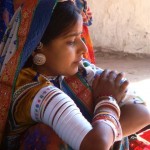
These people belong to the Gujarati and Rajasthani families – Cherry thinks the woman pictured above is from the Ahir tribe. The bangles would have been gifted to her during the girl’s wedding – they do marry very young. The pastoral tribes cover their entire hand with broad plain bangles made of bone. The unmarried wear them only from the wrist to the elbow whereas the married wear them from the elbow upwards as far up as the underarm. Since these tribes are nomadic and they cannot keep their assets under safe keeping, they wear their saving in the form of jewellery on their person.
Epilog
From the above, it is quite evident that there is some symbology associated with bangles and marital status. But we still need to find the exact match for the hypothesis to stick.
Can you all help me uncover this? Please pass this to people that are familiar with folk/tribal customs in North Western India. Thanks in advance. Whoever helps me, i will acknowledge them in the paper formally.
Enter the Dragon
Filed in General Interest, August 19, 2009, 7:00 pm by Priya Raju TweetI presume every self-respecting English speaker out there has seen the Back to the Future trilogy. I know I’ve seen it. A few times. Alright, alright – Many times. Don’t tell me you haven’t. After years of sedentary living, my flaccid arteries can’t handle that shock. I might simply choke & keel over. Just haul your butt off that couch, rent the DVD & enrich your brain.
The hero, Marty McFly, is the only normal, sane character in the movie. Everyone else is quirky, eccentric or plain weird. Now Marty’s all ship-shape till someone utters the “C” word. “What are you, Chicken?”. A Double-Doggy Dare. That’s all it takes for Marty to unravel. “What did you say?” he demands swerving, beady-eyed & foaming in the mouth.
Each of us has a trigger, a set-point. If that’s breached, we all become as wild as a Bronco with a fly in its ear. We prance around whinnying till the madness passes over. I don’t dig horses: they look dumb. They aren’t in the least terrifying. If its all the same to you, I’d prefer to morph into a savage creature with a fearsome aspect.
Insult me. And I transmogrify into a Fire Breathing Dragon. Sparks fly from my eyes, nostrils & assorted orifices. I cast aside the cloak of decency, daub my face with war-paint & become a primordial beast. Take a hint, drop the offensive & talk about the weather. If you can’t – or worse, won’t – stop bullying me because you’re glacially slow on the uptake: Get ready to tackle Ze Dragon.
It all started because of Shah Rukh Khan. He was en route to North America, but he was detained by US Immigration. For being a Muslim. The fact that Khan is more tolerant than most people in the world (his wife is a Hindu), that he has received death threats from Islamists for integrating with India’s fabric – was lost on them.
Racial profiling is galactically stupid. Roughly 23% of the people in the world are Muslims. What’s the grand plan of the Immigration officers – stop every 4th person that passes through? What, all of a sudden, traveling under an assumed name has become improbable? If you think US Immigration used a “process” to zero in on Khan, think again. Recently, they detained another Khan – Irfan Khan. The enormously talented actor was on his way to receive an award. Don’t forget Aamir Khan: He was strip-searched & interrogated.
So, sorry to bust your bubble. No glorious, air-tight, Space Shuttle-Worthy, Lunar Module algorithms developed by NASA are at work here.
Khan is an internationally well known artist. Measured by the prevailing (and astonishingly appalling) standards of Indian movie-goers, he has even attained eminence. He’s from India, a country well-known for promoting its kitsch to the wider world. I expect everyone to do their home-work & this includes US Immigration Officers. How can you not know famous people, that too from a prominent country, when your job is to patrol, safe-guard & secure your nation’s borders? At best, that’s sloppiness. At worst – I’ll come to that later.
I tweeted about this & all hell broke lose.
How dare I call the officers ignorant? Not knowing SRK isn’t ignorance! You naïve woman. How can you fill your lolling head with stinking tripe from the mass-media? So SRK was detained – Big deal! Ex-President Abdul Kalam was frisked in New Delhi & we never heard a peep from him! People with Hindu names have trouble with immigration, how about that? Stop blindly parroting the news channels. How can you assume the officers don’t have a process? Are you even reading my responses? Shut your trap, will you? Woman?
These knights in shining armor, defenders of the officers in distress, were not American. They were Indian. Tamil. I found the stridency in their responses interesting. I don’t have a problem with disagreements or heated debates. Discussions are enjoyable & educative when decorum is maintained. People verbally lash out when they can’t land a stinging slap on your face. Its par for course when sensitive topics – religion, God – are discussed. I’m amazed that this vehemence was manufactured while debating the detention of an actor.
My personal opinion? I didn’t lose any sleep over “King” Khan’s detention. I don’t particularly care about him. In fact, I don’t even like him. He over-emotes, which is a polished way of saying “bad actor”. He takes himself way too seriously. He seems to think he knows more about cricket than Sunil Gavaskar. He thinks he has already filled thespian Amitabh Bachchan’s over-sized shoes. I think he sports a brand of arrogance born out of ignorance. But, he was a harmless, essentially decent, innocent man on his way to an event.
And yet: “People with Hindu names are stopped routinely”. What of it? Can you spell “Racism”? Immigration Officers in most developed nations can. To be fair, some of them can’t tell Arabs & South Asians apart. They blindly target “Muslim Looking” people, which in their mind involves a brown skin. That’s superbly dim-witted. Arabs are not the only Muslims in the world. Turks for e.g. are Caucasian. Arabs from Lebanon or Syria can be very light skinned.
But some aren’t that innocent. To them, its a God-given opportunity to parade their Xenophobia. “Damn foreigner, setting foot in my country. I’ve taken an intense dislike to you without any basis because I’m a douche-bag. I have the power, so let me taunt you, play Cat & Mouse with you. What are you gonna do? Call a lawyer?!”. So it goes.
I don’t expect most Americans to know SRK: Only people who need to know, such as officers at the port of entry. He has a wax figure at Madame Tussaud’s in London. He was a presenter at the Golden Globe this year. I don’t expect them to know the who’s-who of Indian glitterati. Only those who have a global footprint.
India, China, Russia and Brazil are the emerging powers. Their citizens travel more to developed nations, so I merely want the immigration officers to have some General Knowledge on these countries. And I demand that they make at least a half-assed attempt to review the paper-work of the visitors.
Back to my bug-bears. In retrospect, I wonder how much of their nonchalance was attributable to their inability to identify with SRK. Let’s up the ante. Would they be this insouciant, if their people – whoever that is – were stopped? Or would they thrash & moan about the ignorance of America? Would they lament that the Indian Government was in cahoots with the enemies of the Tamil Cause? The answer is mired in our views of identity & clan behavior.
Maybe my views are all wrong & I’m a bungling idiot. Perhaps I’m a sock puppet manipulated by the media. But that’s irrelevant. Those are my views & I have a right to air them. Your discomfort over my views is not my problem. If my opinions irk you, don’t read them. Its that easy. Your disagreeing with me doesn’t give you the right to slam me. You can’t verbally abuse someone because they published their thoughts in a public forum. If you think you can, you have an Anger Management problem, coupled with Chronic Hostility. You need help.
Nasty people hide behind their Digital Avatars. They know fully well that they can’t diss you face-to-face, you’ll tear them apart & make ribbons out of their innards. But, what can the Dragon do about online meanness, in twitter? You can put your foot down. But if that doesn’t work – Its a good idea to take the high road & not stoop to their level. Oh, un-following & blocking are good too. Dragons don’t reconcile.
Jerks teach us a lot, if you’re willing to learn. They’ve taught me how not to treat people. So I let sleeping dragons, broncos & buzzards be. I try not to trip on their tails. Working them overtime just won’t do.
What do you think about Shah Rukh Khan’s detention & Dr Abdul Kalam’s frisking? Do you think racial profiling works? And how do you handle meanies online? Tell us!
How do we intend to keep our ‘tryst with destiny’?
Filed in General Interest, August 15, 2009, 11:30 pm by Abdul Fakhri TweetNo one could have put it better. It required the inimitable Jawaharlal Nehru to fire the first salvo of a free India and claim her rightful place in the comity of nations.
It’s time for another Independence Day and some symbolic gaiety …the tricolor pinned on our shirts, the flags hoisted and speeches at several places across the country and abroad. However, it is also time to ponder over the events of the past, the experience of the present and the nation as we anticipate it in the future.
This post does not seek to serve as a chronicle of historical events but more as a comment on the ‘times’ that revolve around independence as we understand it. For historians of modern India the conventional notion is that the freedom movement began with the Sepoy Mutiny or the battle of Independence in 1857. From there on until 1947, I shall categorize the interregnum as the period of sacrifice. The subsequent era between 1947 and 2008, I shall call the period of churning. And the period from 2009, I shall term the period of anticipation. This periodization is not mutually exclusive but just as a way of understanding what we value in each era.
It was a 90 year old march that ultimately culminated in Indian independence. In between there were numerous proclamations, acts, missions, movements, hartals and dharnas. Until about the end of the 19th century, there were small associations of Indians challenging the British and seeking freedom. There was a slow attempt by the British to enfranchise the Indians, giving them legislative power and greater role in education and bureaucracy. All this lasted well into the First World War when Mahatma Gandhi arrived on the scene and launched his famous Non-co-operation movement (1919-22), aligning it with the struggle for the Caliphate, making it a complete mass movement.
In this march towards independence, numerous freedom fighters languished in prison just because they had accepted the call to join the freedom movement. Gandhi had given the call for satyagraha (non-violent resistance). Even the top leadership was not spared including Gandhi , Nehru, Rajaji, Moulana Azad, Sardar Patel and several others. This period I term the period of sacrifice because of the enormous suffering that the preceding generations or the founding fathers underwent so that those who come after them may breathe in a free nation. Chief among the constitutional documents in the run-up to 1947, was the Government of India Act of 1935 that formed much of the basis of our later Constitution.
Independence from the British Raj came with its own set of challenges. The biggest crisis was on the economic front. Besides the concept of five- year plans, the idea of Green Revolution was developed to achieve self-sufficiency in food grains. There were of course other challenges such as the linguistic reorganization of states, couple of wars with our neighbors and very importantly the demise of Nehru and in a few years after that the passing away of Lal Bahadur Shastri as well who gave to us the poignant slogan ‘Jai Jawan, Jai Kisan.’ (Hail the soldier, Hail the farmer).
We are reminded of the twin of the celebration of the Independence Day which is the Republic Day ( the 26th January of each year) when we commemorate the declaration of India as a Republic and the day that we gave to ourselves our most precious and sacred document of the Indian Constitution. The Preamble to it declares the Union of India to be a sovereign, democratic republic, assuring its citizens of justice, equality, and liberty.
The democratic character of the young nation was proved repeatedly through several general elections since 1951 when the first election to the Lok Sabha was held. In subsequent elections, the halo and cheer of having won independence did not last long enough. Expectations were rising on the part of the masses. Basic issues of bread and butter, employment, electricity, water, health and education were taking centre stage. Further, the diverse castes and regions within the nation were also asserting themselves. Slowly, it was the turn of backward castes and Dalits to struggle for their rights and assert their dominance in political life. This period I call as the ‘period of churning.’ The struggle for Independence had achieved freedom from the British Raj but had not given to the people of India, in the true sense, their social, economic and political rights or the means to enforce those rights. This was and is a happening process. The Republic, its democratic and inclusive character over the years have indeed attained a state of maturity today (2009). The churning may continue but diverse social groups have found their languages of politics in which to make their reasonable claims in an arena where several others are also making their claims.
From here (2009) onwards, the question is staring at us in the face. How do we intend to maitain our ‘tryst with destiny?’ Until recently, development was one among the many key issues on which claims and counter-claims were made for electoral success. Now it has become THE central plank, almost like a one-point agenda and the masses are eager to know the outcome on this platform. The vocabulary in the public sphere increasingly refers to inclusiveness and care.
Nobel laureates like Amartya Sen have led from the front in championing the cause of social development, health, education and well-being of our people and their children. Gender inequality, undernourishment of children, starvation and debt among farmers etc have all become focus of attention. These are no longer routine issues but the stuff that politics is made of and will be in the days to come. These issues are centre-stage, they can no longer be kept on the margins.
As I have always maintained, perhaps we are moving to an era where we are visualizing ‘citizenship’ in ways stronger than we have before. Age, gender, class, caste, region, religion, language are less important. These may not go away. However, our tryst with destiny would be as a ‘caring’ and ‘inclusive’ nation. When that happens, the moment of anticipation is over and we have truly arrived!
Jai Hind!

 Entries