IVC Symbology – Bangles & Marital Status

IVC Symbology – Bangles & Marital Status

Updated 23 Aug 2009 2:50PM – added the Indus signs from Bryan Wells’ paper.

Updated 22 Aug 2009 11:55PM – found the image of the single/double bangle.

FTOTW [Fine Tastings of the Week]

Why we must focus on women for development – a brilliant/heart rending/uplifting article in NYT (Via Ganesh). Programmable Web – a great post on Google’s Pubsubhubub (via @raganesh ).

Prolog

As many of you know i started working on researching the IVC (Indus Valley Civilization), formally, a month or so back.  Since most researchers are concentrating on the script, i am focusing on the Symbology.

I am writing this post to collect the wisdom of the community  to make the hypothesis into a scientific proof which can pass muster with the research community.   In the Epilog,  I will explain, how you can all help me.

IVC Bangle Hypothesis

Here is my  hypothesis – unmarried women wore bangles only in one arm, whereas married women wore bangles in both arms. The iconography from the IVC is quite sparse but still there seems to be enough evidence for this hypothesis. The famous Dancing Girl of Mohenja Daro. You can see that the statuette has bangles only on one arm.

There is another piece of iconography where 2 men are having a fight ostensibly over the hand of a woman (wears bangles only on one arm).  In this piece, we have another woman, possibly mother goddess, wearing bangles on both arms.  Given that in the same piece of iconography both  bangles on one arm  and  bangles  on two arms are present, it is highly unlikey to be a scribal error [I am trying to find this image on the web for you all to review. Meanwhile Found the image below. Also take a look at the Fig Deity Seal at the bottom of this post - it has women wearing bangles in both arms].

Indus Bangle

There are some burials of women with shell  bangles on only the left arm [The authors of the book also seem to think that one-arm bangles signifies marital status (Via Priya Raju)  ].

I found another instance of this type of burial where the woman had bangles only on the left arm. Don’t know if they are both the same instance. I hope not.

Why does this bangle hypothesis matter?

In the inscriptions , there are several  which have a symbol of a man, having an implement in one arm or in both arms.  Sometimes the implement is seen on  one leg or both legs. For example, see page 71 [reproduced below, click on the pic to expand] of the Bryan Wells’ Indus Script Thesis [Caution: 12MB PDF]. My guess based on the bangle symbology, that having an instrument on one arm/leg signifies someone with less skills/expertise than the one who has it in both arms/legs.

Indus signs

How do we prove this hypothesis?

Even in modern day  India, bangles are an important part of a married women’s attire. The Shankha Pola tradition still continues in Bengal or the Valai Kappu ceremony which is still observed  in South India. However, given the distance in time and space from the IVC, we cannot use practices from modern India as proof. Additionally, we don’t have written records prior to 6th Century BCE, which leaves a gap of 1,000-1,200 years after the downfall of the IVC.

Assuming that tribals have been following their traditions for millennia, we need to find tribals in North Western India who have a similar bangle symbology.  That would be a good enough proof.

I found some tribals – Ekbahia and Ikbainha whose women wear bangles only in one arm. However, it does not seem to indicate marital status.

Thanks to Priya Raju, I found this practice amongst the Ahir Tribes:
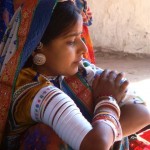
Ahir Woman

These people belong to the Gujarati and Rajasthani families – Cherry thinks the woman pictured above is from the Ahir tribe. The bangles would have been gifted to her during the girl’s wedding – they do marry very young. The pastoral tribes cover their entire hand with broad plain bangles made of bone. The unmarried wear them only from the wrist to the elbow whereas the married wear them from the elbow upwards as far up as the underarm. Since these tribes are nomadic and they cannot keep their assets under safe keeping, they wear their saving in the form of jewellery on their person.

Epilog

From the above, it is quite evident that there is some symbology associated with bangles and marital status. But we still need to find the exact match for the hypothesis to stick.

Can you all help me uncover this? Please pass this to people that are familiar with folk/tribal customs in North Western India. Thanks in advance. Whoever helps me, i will acknowledge them in the paper formally. 


Comments

  1. Quote

    Sukumar – I read that, IVC is where – for the 1st time – you see an explosion of a wide variety of bangles in use. Could you please correct me if I’m wrong?

    I’m thinking out loud here:

    Is it possible that associating bangles with marital status came later? When something’s new & abundant, wouldn’t everyone try to use it, instead of restrict it to some categories of women?

    I also read that in some tribes such as the Ahirs, bangles were sold in times of need. They were assets. So the number of bangles on a woman could have indicated social status – a richer woman had more bangles, possibly in both hands.

    Another reason this could be an indicator of social (not marital) status – it is customary (even now) for women to remove their bangles from the right hand while attending to chores. So, is it possible that the lower classes never wore bangles in their right hand? And if a woman had bangles in both hands – she was the gentry?

    Please let me know your thoughts.

  2. Quote
    Sukumar (subscribed) said August 22, 2009, 10:45 pm:

    Thanks Priya. I am not aware of the bangle traditions before Indus. In all likelihood, bangle traditions must have started with the IVC.

    Interesting thoughts on bangles as a class symbol as opposed to a marital symbol. What you are saying is quite possible.

    In that case, would you think that the man & implement symbols i talk about indicate economic status rather than skill levels?

  3. Quote

    Sukumar – I don’t know, its quiet possible that it showed a person’s social/economic status. Then again, as you say, maybe it showed their prowess in that area.

    I’ve read about the upper strata – the Zamindar, for e.g. – using a double-umbrella. Mere mortals like us use a single, normal umbrella. But someone “more equal” than us would probably use a double umbrella?

    I also wondered – knowing how Shamhat the Temple Prostitute is mentioned in Sumerian records – if bangles on both arms referred to a uber woman. In this case, either a mother or someone who was a symbol of fertility – the temple prostitute. Then again, I forget. No temple like structures were found in IVC. Szplug.

  4. Quote
    Sukumar (subscribed) said August 22, 2009, 11:20 pm:

    Priya,
    Thanks. Interesting thing about the 2 umbrellas for Zamindars. Can you please give me a citation?

    I suspect that married women were synonymous with mothers because fertility was an important thing.

    Yeah temple like structures were not found. But some people think the Great Bath and the Citadel did serve some ritualistic purposes as well. Now whether that means they had a temple prostitute, is difficult to find out.

  5. Quote
    Manikanda Pisharody (subscribed) said August 23, 2009, 12:08 am:

    The searches picked up on Google mainly connected this to Ahirs, Rabaris, Gonds, Bhils and a tribe called Dubla in Gujarat.

    The content also connected the characteristics to aspects of Vedic civilization related to nature worship for Bhil tribe and Dubla tribe.

    Have uploaded a file with the Links and material on tribes & bangles on twitter thru http://filesocial.com/kp5rkt

    Hope this helps a little bit for further follow ups..

  6. Quote

    I am not sure if you have already read this http://www.travel-himalayas.com/history-himalayas/indus-valley.html spills thought on bangles being a class symbol.

    Interesting post.

  7. Quote

    Very interesting post Sukumar.
    Another thing which I have noticed is the kind of bangles which are worn. Generally (and I might be wrong here) married women/single women wear glass bangles and widows are allowed to wear only metal bangles. But then again in Bengal the women are gifted an iron kada as a symbol of their marriage. So this might be a cultural thing but the material of the bangles is of significance.
    And I am sure that bangles are used to signify fertility in a woman because of the elaborate “valaikappu” ceremony which is held in the 7th month of pregnancy. Apparently the sound of the bangles clinking is supposed to be good for the baby and here again it is the norm to use only glass bangles.
    Will see if I can lay my hands on any books/links regarding this.

  8. Quote

    Mani,
    Wow! Thanks for the extensive compilation of bangle customs amongst the tribals. This is excellent. Maybe you can help me find the smoking gun – a tribal group whose unmarried women wear bangles only in one arm.

    Are you also interested in this field? How did you manage to dig up so much info? Did you do that after reading my post? Amazing. Thanks a lot.

  9. Quote

    Thanks Abinav. I had not come across that particular link. The link seems to support Priya’s view that the bangle was also a symbol of economic status. Very interesting.

  10. Quote

    Thanks Revs.

    Yes, the material of the bangles seems to also bear some significance. I have seen 2 major types of bangle depictions in the Indus inscriptions – one is a thicker size, which is probably the Kada variety you mention and the other is a regular bangle which in those days may have been made in Shell. I am sure they used other materials like clay, coconut shell, copper etc, but it is not clear if they managed to show those distinctions in the inscriptions.

    Yes Valaikappu ceremony is an important indicator of the Bangle tradition’s connection to fertility. Unfortunately, we are not able to trace that ritual back very far since we didn’t have written records.

    Since you are from Gujarat, maybe you know some people who research into the tribals over there. The Ahir Tribal group i referred to are from Gujarat.

    Look forward to your further help with this.

  11. Quote

    Interesting Post Sukumar. I think you are right on bangles and even now Sikh men wears a bangle on right hand, a symbol of brave and integrity. But i don’t know whether it is a connection from IVC. A long ago. I asked my grandmother out of curiosity, why “valaikappu” at 7th month of pregnancy, she said after 7th month pregnant lady should not sleep over on side ways, the both arms bangles helps her to sleep on back and bangles would make sounds if she try to sleep on sideways. As far as I know, Tamil culture we have very significance on bangles, we have “Kappukattu” for “Amman” and marriage “kappukattu” before real “thalikattu”. This all makes me think that, bangles are used to kind of “warning” thing, For Sikhs bangle reminded him that they have to obey the Sikh rules, For pregnant woman it reminded her to sleep on back, For Amman it reminded that festival season started etc…So i think your hypothesis about bangles is right and it is a symbol of warnings.

    The Bryan Wells thesis diagram reminded me the summer Olympics game symbol also. We used to show a symbol a head and hands for “Swimming” where hand is main source for swimming. The same for running where legs get more stress than others.

  12. Quote
    Sukumar (subscribed) said August 23, 2009, 9:46 pm:

    Thanks Subba. Interesting points on the Tamil bangle tradition. I didn’t know they wear bangles so that pregnant mothers will not sleep sideways. Very interesting. Wonder how they manage that in the West without the bangles?

    Good point on the Olympic pictograms.

  13. Quote

    Sukumar,

    If we are going to prove the hypothesis from today’s bangle culture, then we need to prove that the bangle culture is a cultural continuation of the IVC.. is there any such proof available?

  14. Quote

    On comment from smuthurangan:

    The bangle seems to indicate different things in different communities, and in different regions. The symbology for the bangles also varies due to this. Which one should are we going to take for the hypothesis?

  15. Quote

    Senthil,
    Proving this or any other hypothesis about the Indus is going to be very difficult. As i mentioned in the post, we cannot use modern day practices in India unless we can prove that they have been in use at least back to 6th-4th cent BCE when we had written records. The alternative as discussed in the post, is to find some tribal group in the North Western part of India/ And adjoining regions of Pakistan (which is the Indus region), which has a similar bangle tradition.

    To Subba’s point, i think he is just commenting in general about bangle traditions and not really offering proof, if i understood him correctly. Maybe Subba can clarify.

    As for which one should we take for proof, please see the first para of this comment.

  16. Quote

    @Senthil
    Yes, there are various usage of bangles but the overall goal is indicating some “status” or “warning” etc. So i think making this hypothesis is
    valid, but there is no proof for this as of now.

    Subba

  17. Quote

    Thanks a lot Subba.

  18. Quote

    Interesting to read the connection between bangles and marital status…..have not heard about it before though….But in my home they say that a gal should always wear bangles and also say that it is not good to see a gal without bangles on her hand…

  19. Quote

    Thanks Annapoorani. Yes, in the modern day, most women (both unmarried and married) wear bangles. Over time, customs change, right?

  20. Quote
    Manikanda Pisharody (subscribed) said August 25, 2009, 12:35 am:

    Just saw ur response, was glad it was of help..

    Did the digging after reading your post..

    Interested in ancient history overall, but knew nothing on this aspect of bangles prior to your post. :)

    Hope it helps take it forward in some small way.. If I find any clues on the specific point of interest, will keep u updated too..

  21. Quote

    Thanks a lot Mani. Please do let me know if you find anything more. Glad to hear that you are interested in ancient history as well.

  22. Quote

    Sukumar,

    Interesting hypothesis and comments/research (esp. by Manikanda). I do not have much to add to the topic itself. But I could not help but admire the innocence/charm of the tribal woman!!

  23. Quote

    Thanks Ganesh. Hope i am able to convert this from interesting to scientific proof.

    As for the tribal woman, i agree :)

  24. Quote
    Manikanda Pisharody (subscribed) said August 26, 2009, 1:28 am:

    Going thru secondary sources on Google, there does seem to tribes in Rajasthan/Gujarat, and another group of tribes in area of Ladakh, with characteristics matching to the bangle aspects in IVC. But not been able to get the exact tribe that matches in characteristics with IVC.

    a) in Rajasthan/Gujarat area – based on the special way the dancing girl wears it.
    b) in Ladakh area – shell bangles excavated at Harappan site matching with the type worn in Ladakh

    Books covering the tribals in these regions that i could dig out :

    Book covering Tribes of Rajasthan (including Bhil, Ahir and other tribes in Rajasthan/Gujarat)- People of India by K.S. Singh
    Book covering tribes of Ladakh -Amazing Land Ladakh by Sanjeev Kumar Bhasin.

    The links & related material on this on
    http://filesocial.eu.s3.amazonaws.com/hgyvig/ea026107c26ca8666ad38babbf0319e73faa90fb/update+on+bangles.docx

    Hope it helps others digging on this for further followups.

  25. Quote

    Thanks a lot Mani. Really appreciate your help. These are great links.

  26. Quote

    Sukumar,

    Thanks for sharing your research insights. It is an interesting topic to follow.

    I would like to throw open three thoughts:

    1. Child Marriage: This was prevalent in India for quite sometime. If IVC also had the practice of child marriage, then it will be interesting to see what bangles were shown on children

    2. Population: I’m not aware of the caste structure in IVC. I would be interested in seeing the total population in IVC. India predominantly lived in villages a few centuries back. The average population in villages was just a few hundred people. What then would be the population in IVC. What is the social hierarchy in villages, and how would the bangles be relevant in that context?

    3. Work: It is customory for women to remove their bangles when they do hand-work….like washing, cooking, grinding etc. They don’t want to damage their bangles. So, are the bangles represented in IVC on the left or right hand? Work-women might not have bangles on their right hand.

    Just a few thoughts that came to my mind.

  27. Quote

    Sairaj,
    Thanks for your thoughts.

    1. Good question. don’t know the answer.

    2. IVC was a urban culture – amongst the world’s oldest urban civilizations. There are various numbers bandied around anywhere from 0.5 to 1MM. Don’t know how correct those nbrs are. One thing that we can be certain is that each city must have accommodated a few thousands. What connection do you see with the social hierarchy? Priya and Abhinav have made the point about economic status already above.

    3. If you see the dancing girl or the other image i posted above, they wore the bangles in the left arm (the unmarried, if my hypothesis is correct. You can see the tiger goddess wearing bangles in both arms in the image i posted above). BTW, just because the women in the iconography are shown with bangles, does not mean they didn’t need to take it off when they were working, right? The question will be more important, when women are shown doing work. I have not seen any such iconography yet.

  28. Quote
    pk.karthik said August 27, 2009, 6:13 pm:

    Excellant Post Sukumar.This post is top search in google for any one looking out for Bangles annd IVC

    But I have couple of questions on the tribes of Western India being taken for reference.As West India has been in constant touch with the invaders as well other civilisations is there not a possibility that they could have had external influence ?

    Second can we base the study on some Dravdian tribe based on Proto Dravidian theory say comparing the bangle culture of Bhils or Gonds or say Thodas?

    I could be wrong here but it was just a question?

    And secondly the dancing girl seems to a have large bangle like object in her right hand ,i felt it was similar to shell bangles excavated in Harappa.

    http://www.imagesofasia.com/html/mohenjodaro/shell-bangles.html.

    Again I am not sure of any Silabam kind of ornament worn by IVC people if there was one we can try relating to our Sangam literature to find some evidence .

  29. Quote

    Thanks Karthik. Interesting that it made it to the top of Google results probably because not much material exists on this front in the public domain.

    yes Karthik. you are right about western india’s foreign influences. but i think it is possible to find tribes whose majority customs are still unaffected. For example, the Ahir tribe. It is unlikely that this custom would have come from elsewhere.

    yes we can find a proto dravidian custom and use it as proof. I am unable to find it. It will be of great help if you can. You are right that some proof of this from sangam-age literature would also work. Again i am unable to find it.

    I think there were many types of bangles but principally a few kinds – a kada type bracelet which apparently even some men wore. these were mostly made of metal. the other kind the shell or sometimes terracotta bangles were worn as a row or a set of bangles. It is this row of bangles i am talking about. What i think the Dancing Girl is wearing on her right arm is the Kada type ornament and not the row of bangles which she is wearing on her left arm. Hope that helps?

  30. Quote
    pk.karthik said August 28, 2009, 9:57 am:

    Sukumar,

    Sorry for playing the Devil’s advocate here but the image of woman in burial seems to have bangle sim ilar to Kada type shell bangles on her left hand(I am not able to get a better image here ) if its Kada type can we compare them?

  31. Quote

    Karthik,
    Please feel free to debate. After all, that is the main reason i posted it on the blog. From what i can see, she is wearing atleast 3 shell bangles in a row. The kada type bangles are usually worn in single and as i said Kadas are also typically in metal. The row bangles seem to be in terracotta, chank shell, lac, bones, and ivory from what i have seen so far.

  32. Quote

    Sukumar, very interesting hypothesis.

  33. Quote

    Thanks Vamsi.

  34. Quote
    Arun K (subscribed) said September 1, 2009, 6:30 pm:

    Great post.
    I think the economic angle to the iconography is very less likely. The economic/social status of any person is graded and not binary. The bangles, unless used some sort of colour coding, cannot be effectively used a socio-economic indicator.
    The symbology in the iconography can be inferred with a good degree of confidence, that it is a depiction of a suitor’s ceremony.
    Some reasons:
    1.The presence of the tiger goddess
    2.The symbology of the woman standing in between the men (I am safely assuming she would not be in between during the real fight)

    But, the following image shows a similar theme, where a woman with bangles on both her arms is separating two men from fighting with uprooted trees. Inferring, the men look like giants compared to the tree; I am wondering if these depictions show the mythology of the Indus valley people.
    http://www.suppressedhistories.net/Gallery/indus/md478.jpg

    In the following two pictures, the symbology shows some more variance. Here a woman, I presume wearing no bangles, is stopping a fight between two tigers. Well, she could have been the tiger goddess seen in the picture in the post.
    http://www.suppressedhistories.net/Gallery/indus/tigersrampant.jpg
    http://www.suppressedhistories.net/Gallery/indus/industablet2.jpg

    (Pictures Source: http://www.suppressedhistories.net/Gallery/indus/tigers.html)

    In the picture in the post, the woman does not appear to stop the fight, so I could very well be a suitor’s ceremony. But, all of this without the context of where exactly the iconography was found and what it was found with, we cannot make very conclusive guesses. :(

    “…My guess based on the bangle symbology, that having an instrument on one arm/leg signifies someone with less skills/expertise than the one who has it in both arms/legs…”
    With respect to the extending the logic as suggested above in the post, we need to know whether the symbol is a logograph or not; the same symbol could be used as a logograph or logo-syllable. Based on Bryan Wells’ construction of “great drummer” = “pariray”, I am thinking they would have a verb attached to the symbol to depict the lesser skill of a person than have a separate symbol.

  35. Quote

    interesting subject….just came across this post

  36. Quote

    Arun,
    Thanks a lot for your insightful comment.

    1. I also think that economic status would have been conveyed differently – based on what type of bangles one wore – bangles made of shell, metal, bones, ivory etc have been found.

    2. Yes, the presence of the goddess and the young girl with a contest motif shows that it is most likely a suitor’s ceremony.

    3. The one with the uprooted tree with a woman wearing bangles on both arms is likely a myth. In my view (i have no proof because there is only one specimen) this particular one is the “2 brothers myth” – it is a myth that has been found in many west asian cultures.

    4. The 2nd and 3rd iconographies you point to are men because they wear no bangles, there is no plaited hair. Men are usually shown with the double bun hair style as seen in the suitor’s ceremony seal. There are also men sometimes shown with 6 buns. I have my own theories of why there are 6 buns but it may seem far fetched at this time. If you look carefully at the pics you show the 3rd one has 5 buns visible and probably the 6th bun is missing. The 6 bunned hero fighting animals is there in Sumerian iconography also. BTW, i think that the animals are not actually fighting and it is another aspect of fertility iconography which again will take me some more time to write up in a cogent fashion.

    5. I don’t think we can be so strict about logographs etc. These are definitions we have arrived at post-facto after several thousand years. The point is, there are several signs with an instrument/implement in one arm vs. instrument in 2 arms (also one leg and two legs). What does that signify? I have hypothesized that it is a skill level. It could also be social status. For example, there are instances where Zamindars carried 2 umbrellas and regular folk were allowed to carry only one. It could have been that way too. The reason i think it is associated with skill is because the single-double symbology seems to be always associated with implements either in the arms or legs, which are in turn usually associated with doing or simply skills.

    Hope that helps. Thanks again for joining the discussion.

  37. Quote
    Siva Visveswaran said September 4, 2009, 7:50 am:

    Sukumar-I watched Randy Komisar’s video and then clicked on this post. It looks like you may have actually found “the” passion ;-) Best wishes with your sleuthing!

  38. Quote

    Thanks for the kind words Siva. I am curious how you went from Randy Komisar’s video to my IVC post?

  39. Quote

    Sukumar,

    Very thought-provoking post. Great discussion.

  40. Quote

    Thanks for your kind words Abdul.

  41. Quote

    Sukumar,

    My theory is this – it’s a slight variation from what you are saying. Bangle in single hand is a fertile woman. Bangle in both hands is a pregnant woman or a woman who has/had a baby.

    Valayal (bangle) – etymology of the word is proto-dravidian from root word Valai – some derivatives are a) to surround (valavu) b) enclosure (valaippu) c) valaivu (circle) d) valaiyam (ring, bangle) e) valaiyal (bangle) f) Valam (to circle)

    Clock-wise rotation was considered more auspicious (still is) because Sun was thought to be going around the earth clock-wise. Valampuri sangu (Conch shell with right concentric circle) is considered more rare and auspicious. I am sure the same pricinple applied in making bangles also.

    We also know from some of our earlier posts on this that the Sun was represented by a circle and Muruga was represented by 2 circles together (sun and earth copulating).

    When a woman comes of age, bangles are placed in one of her hands to indicate that she can have suitors or there can be a ‘Sun’ in her life.

    When a woman is pregnant or is a mother, both hands get bangles to denote the same symbology as muruga (two circles).

    A girl who is not yet fertile will not have any bangles.

  42. Quote

    I meant “some of YOUR earlier posts”, but the Y got missed out.

  43. Quote

    Interesting theory NK. What we need is proof at this time. BTW, the intersecting circles interpretation is given by Parpola (not me) and again it is without proof.

  44. Quote

    Sukumar,

    Just now, i came across this article about indus valley scripts.. the author is Dr. V.S. Ramachandran.. you might have known him already.. some of his interferences are similar to the one discussed in our earlier posts..

    http://cbc.ucsd.edu/indus_vlley.jpg

  45. Quote

    Interesting article from VSR. Thanks for sharing Senthil.

  46. Quote

    Seems like I am a bit late into this bandwagon (although I managed to create my own blog now, copy pasting some content from Cognizant Blogs).
    There are some excellant postes in here (thanks to one of my friends for the pointer). I always had an interest in history and this post is just excellant.

  47. Quote
    Sukumar (subscribed) said October 2, 2009, 3:15 pm:

    Thanks for the kind words Arunava. Look forward to your comments. Good luck with your blog. BTW, you can’t cut/paste content from ch1blogs because the content in ch1 belongs to our organization.

  48. Quote

    Thanks for pointing it out sukumar. Although I was copying just posts on general topics but I realize the implications. I have deleted the posts. Guess I need to start afresh :)

  49. Quote
    Anand M S said December 28, 2009, 8:35 am:

    For a pregnant women the bangles simulates hearing in the child, since the wrist is closest to womb. Thus we teach hearing to the child. Please refer valai kappu in Tamil Tradition.

  50. Quote

    Interesting to read the connection between bangles and marital status…..have not heard about it before though….But in my home they say that a gal should always wear bangles and also say that it is not good to see a gal without bangles on her hand…

    thanks for the information u have done good work

  51. Quote

    Great discussions, Sukumar..going through all the links here….The last time i read so much about IVC was in school; this makes a really great read!

    Once again congratulations on your paper getting selected for the classical Tamil conference, pls do share more details!

  52. Quote
    Sravya (subscribed) said March 18, 2010, 1:58 pm:

    That was an interesting read Sukumar. I always wondered about bangles. One place I read that the ‘Solah Singar’ – 16 ornaments that a woman can use to beautify herself can be made of any material irrespective of class and other site I read that the material matters as all these adornments are linked to the health of the woman.

    Many Congratulations on making it to the conference and good luck there :)

  53. Quote
    Sukumar (subscribed) said March 19, 2010, 11:11 am:

    Thanks Arvind & Sravya.

  54. Quote
    Srividya said March 19, 2010, 1:47 pm:

    Interesting. Have not heard before about this connecton between bangles and marital status.

    Being a brahmin, we are brought up in such way that girls should wear bangles all the time.

    Congrats on your paper getting selected for Tamil conference.

  55. Quote
    Sukumar (subscribed) said March 19, 2010, 2:19 pm:

    Thanks Sri.

Leave a Comment

(required)

(required)

Formatting Your Comment

The following XHTML tags are available for use:

<a href="" title=""> <abbr title=""> <acronym title=""> <b> <blockquote cite=""> <cite> <code> <del datetime=""> <em> <i> <q cite=""> <strike> <strong>

URLs are automatically converted to hyperlinks.