Another great essayist – Scott Berkun
Filed in Uncategorized, May 30, 2005, 7:53 pm by Sukumar TweetScott has written several essays and I managed to read a few. I landed on his site through his excellent essay on “how to give and receive criticism“. His essay on How to manage smart people is superb. There are many smart people who can do things well and there are many smart people who can write things well, but there are few smart people who can write well, things that they do well. Scott is one of those few people.
The Goal – Eli Goldratt’s Classic on Theory of Constraints
Filed in Uncategorized, May 29, 2005, 4:40 pm by Sukumar TweetB. Aravind had recommended this book to me during our Thanksgiving 1998 get-together. I bought the book subsequently and read about 30 pages and gave up on it after that. I was not expecting to read the Theory of Constraints in the form of a novel, I guess.
Last week, I picked it up again and this time, as I crossed 30 pages mark, the book impressed me so much that it became un-put-down-able. I finished it in a 48 hour window during one of my business trips.
The book is written so well that at times, you feel like jumping into the hero Alex Rogo’s life and fixing his problems. Of course, he does fix the problems later applying the Theory of Constraints. The theory produces counter-intuitive solutions and many experts think that it is similar to systems dynamics (read Peter Senge’s classic The Fifth Discipline for more on that). As I read the book, I could not help thinking about the famous Ayn Rand heroes Howard Roark and Hank Rearden.
If you develop starting trouble reading the book, I recommend you read the postword “My Saga” by Eli Goldratt and then start again.
Although, people say this is a must-read if you are in manufacturing, I think, anyone in management will find this book very useful.
In B. Aravind’s words, the book is “beautiful, beautiful, beautiful”.
Sage-like wisdom for start ups
Filed in Uncategorized, May 21, 2005, 7:04 pm by Sukumar TweetPaul Graham has written some superb essays about start ups. These are must-reads for people contemplating start-ups. Even for those in the corporate world, these essays will provide an idea or two about management.
1. How to start a start up. the segment on Google’s success is an eye-opener.
2. Why smart people like bad ideas.
Geoffrey Moore’s Crossing the Chasm is a lucidly written book that gives you a framework for how to market your product as it moves from a start-up niche to the broader market. (thanks Ganesh for the reference). I had heard about this book so much, but finally managed to read it a couple of weeks back. This book has become somewhat of a bible for start-ups and that position is a well-deserved one.
IEEE Spectrum carried this brilliant article by Nick Tredennick and Brion Shimamoto on how to work with VCs.
Ultimately, you still have to make that dreaded powerpoint presentation to the VCs and this superb article by Brad Feld gives you some key ideas.
PS. Paul Graham has written and continues to write several other thought provoking essays on other topics. It maybe a site worth keeping track of.
Wing blog at cross roads
Filed in General Interest, May 17, 2005, 10:54 am by sridhar TweetAn interesting article on blogging.- http://www.whatsnextonline.com/wno/newsletter040826.cfm
Bullet point 1 under blogging caveats could be a reason why Suku is the lone crusader of this effort. Here is my small contribution.
iPod SD – put an iPod into a zillion PDAs/Smartphones instantly
Filed in Uncategorized, May 15, 2005, 11:03 pm by Sukumar TweetUpdated Nov 26,2006 : This is the most popular post on this blog still and gets atleast 10 hits a week. This page shows most of the sites that have linked to this post.
Not a day passes without someone predicting the demise of Apple’s iPod. This week, however, Bill Gates gave an interview to a german newspaper saying that “iPod’s success is unsustainable in the long run”. Billg definitely knows a thing or two about creating enduring platfroms.
Interestingly, exactly one week prior to that, Robert Cringely of PBS came out with the theory that Apple will ultimately pull out of the iPod manufacturing business and start licensing clones. Again, students of competitive strategy know that 40%+ profit margins are unsustainable in the long run. So probably Robert could be onto something here.
Hadley Stern at Apple Matters, joined the dialog and supported parts of Billg’s claim about smartphones overtaking iPods. Hadley’s statement on Nextel, Verizon blocking the iTunes mobile version got me thinking – if the smartphone market is going to be so crucial, what can Apple do to bypass these wireless companies but still have a presence in the smartphone market ?
As many of have observed, Apple is slowly coming off the high horse and targeting the mass market with products like iPod Shuffle and Mac Mini. I started looking at the iPod Shuffle’s design closely. Thanks to IDC’s IdaRose Sylvester who opened up the iPod Shuffle and identified the key components – a Sigmatel STMP3550 chip
(costs $7.50 volume pricing) and a Samsung 512MB/1GB Flash memory chip. (costs $31 for 512MB volume pricing).
The Sigmatel is a MP3 Player on a chip and it has a lot more capabilities that Apple could put to use in later models. But the size of the chip caught my attention.
Jason Striegel at Hack A Day had dissected the iPod Shuffle and shown the innards clearly. However, this picture on a japanese site gave me the key idea and I started looking at the dimensions of the iPod Shuffle. About half the Shuffle is for the battery and the other half houses the entire MP3 player mechanism sandwich. Here are the dimensions in MM:
25 x 84 x 8.4 iPod Shuffle
20 X 12.4 X 1.2 Samsung Flash chip
22.20 X 22.20 X 1.2 Sigmatel STMP3550 Mp3 player Chip.
If you look at the MP3 player sandwich it is approximately 23X23X7.4 inside the casing. The primary idea I was trying to explore was to see if we could produce an iPod in the SD card form factor which is 24 X 32 X 2.1 MM.
I had seen SDIO devices from companies like Pretec that could be connected to smartphones. So I decided to create a picture of what a iPod SD could look like. I took the Shuffle’s Picture from Apple’s site, Cropped the middle part that houses the battery. I have given the resultant diagram below. for comparison, i added the SD Card in actual size. 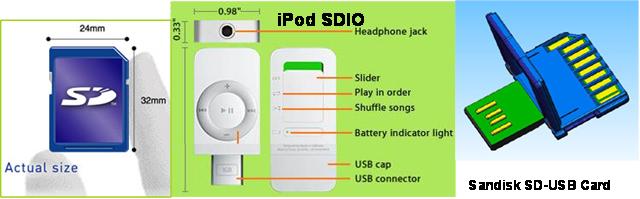
As you can see the modified iPod Shuffle is almost the size of the SD card except for the depth which can be handled by housing it like the Pretec SDIO devices. Also I figured Apple could use the Sandisk USB in SD design (pictured to the right) so that it could go from Smartphone to Computer without cables. The power of course would come from the cell phone’s battery. If the iPod SDIO really existed it could instantly be added to a Smartphone (based on Palm OS or PocketPC OS) with a SD slot with SDIO capability, and iTunes mobile software could take advantage of the GPRS/EDGE or EVDO services so that customers could directly access the iTunes store and download songs completely bypassing the wireless company but using the data service offered by the wireless company. Now wouldn’t that take the fight to the smartphone market?
Treo 650 has a measly 23MB of memory available. So adding 512MB or 1GB through this method would be cool. Also if the Smartphone is like the latest Samsung with 3GB storage (although Samsung uses Transflash slot, this idea could be extended), the iPod SDIO could use its internal flash chip just for buffering but store the tunes on the smartphone’s internal hard disk. the SDIO support in Palm OS and PocketPC OS has been around for a few years. So many PDAs now have SDIO slots – Sandisk has a pretty good list here.
Although this list is for SDWIFI, SDWIFI requires SDIO capability. This means that an entire class of PDAs now will have iPod SD. Most PDAs use a software based MP3 player (costing $15-20) and most legacy PDAs don’t have more than 64MB built-in. So by using iPod SD, these will get a hardware MP3 player and storage of 512MB/1GB.
Since Apple does not need a battery inside iPod SD, maybe they will sell these for $60-75. That would be one cool add-on for all iPod loving PDA owners. I think if Apple creates something like iPod SD, it will make iPods dramatically more ubiquitous making the platfform more sticky.
Of course, Apple will still have to open the API up for real stickiness, but this will be a start.

 Entries