Democracy In India – Part 1
Filed in General Interest, June 14, 2008, 9:29 am by Priya Raju TweetThe world is chock full of tiresome, litigious people. I fervently hope they won’t accuse me of pilfering this title from de Tocqueville’s “Democracy in America”. For the past few weeks, some over-sized issues are stewing in my under-sized brain. There’s no room for plagiarism, as it were. I’m not competent enough to steal, that’s my defense.
de Tocqueville was a French Historian who had a nagging question – How did democracy succeed in America? Many countries struggle to implement democracy in Circa 2008. Which begs the question – What is different about America that democracy succeeded? So, in the 1830s, de Tocqueville toured America to find germane answers. And out of it came the book “Democracy in America” – an insightful, seminal work on Sociology. Its brilliant – and a bit too long. You can’t expect a guy named Alexis-Charles-Henri Clérel de Tocqueville to be the beacon of brevity.
But, my post is not about America. Ever since I started reading this book – for which I paid a princely sum of $5 in a flea market – I’ve been thinking about India. Has democracy succeeded in India?
Back to the French bloke. What are the pre-conditions for democracy to work? A balanced mix of equality & liberty. You can’t create an egalitarian society by passing a law. As Aristotle said, Balance of Power = Balance of Property. America was a virgin territory & any one could stake their claim on vast tracts of land. Poverty was booted out to a great extent. This also rendered the Class differences between the Aristocrats & the Peasants meaningless. When everyone could make money, who gives a rat’s ass about pedigree? Thus, America became anti-elitist, as money served as a great equalizer.
Equality is a pipe dream in a country where 50-60% of the people are poor – as in India. But, Indian economy has improved & we are inching upwards on many human development indices. There is a glimmer of light at the end of the tunnel. Money has made pre-existing caste & class differences redundant, at least in the cities. So has that brought about a sense of equality at least in the burgeoning middle class?
Equality manifests itself as liberty. Liberty to express oneself. Liberty to pull up the elected representatives. Liberty to assert one’s rights without fear of a backlash. So, are we free? We have a megalithic, crumbling bureaucracy. Corruption is endemic. Discontent is simmering. Yet, we keep mum. Most people are too apathetic to be outraged, even when a Central Minister literally got away with murder. Even when Party Leaders make a mockery of elections by rigging polling booths. Even when rulers anoint their scions as the heir-apparents & Regents.
Then how the bloody hell will democracy work? A nation’s constitution isn’t worth the piece of paper it is written on, if its people don’t play an active role in implementing it. So, what is it about India that stymies democracy? To answer that, I turned to Geert Hofstede’s book, “Cultures and Organizations”. Hofstede is a scientist in IBM & he spent 25 years studying what gives every country a certain cultural ethos. In plain language, he attempted to understand why IBM employees in 53 countries behaved differently. He realized that every culture has 5 indices that govern behavior, especially group behavior. One of them is the Power Distance Index.
The Power Distance Index (PDI) is a measure of inequality in a society. In countries where PDI is high, people with more money or status expect subservient behavior from others. In an organization, this translates to bosses being malignantly autocratic at worst or benignly paternal at best. Subordinates are told what to do. Brown-nosing, flattery and deference to one’s superiors is the norm. The PDI for Scandinavian countries is low. Denmark for e.g., has a PDI of 18. US & Canada have a PDI of 40 & 39 respectively. India has a PDI of 77. In countries with a high PDI, people are discouraged from voicing their opinions to their betters. Confrontation is frowned upon & people grin & bear unspeakable treatment from those that are more powerful.
A child is expected to obey what the elders say. A woman is expected to sublimate her desires and accept those of her in-laws. I accept that women have started fighting back these days, but you get the general idea. We are wired for a high PDI culture. Which is why in India, miscreants can go scot-free. People are terrified of opposing others who just may be more powerful than them. They wait for someone else to take charge of the battering ram. They wait for a critical mass of brave souls to rally around a cause. Then, and only then, is it safe for them to voice their opinions. Till that point, the enlightened few let their wounds fester. The rest don’t even realize that they got a raw deal, that things could be better.
Doesn’t anyone object? Actually, the poorer strata of India have started slamming their opinions down the throats of others. They are vociferous & they intend to be heard. Which would be good, were it not for the solution they seek. They expect the government to solve their problems – more pay, better healthcare, more subsidies, better schools, free housing, loan waivers – in short, they want Socialism. Which is precisely the antiquarian ideology that led us where we are.
de Tocqueville says that democracy will succeed only when an over-whelming majority of citizens have similar needs. Poor people want socialism & everyone else wants capitalism. Governments get confused signals from people, make half-assed attempts at capitalism & end up doling out freebies in a desperate bid for votes. After all, the motley crew of “everyone else” hardly votes, so why should anyone cater to their whimsies?
In such countries, journalists should steamroller errant administrators. They should goad people to action, by spreading awareness. I’m utterly disappointed by the lack-luster performance of mainstream media. Most news channels & magazines are condemned acolytes of Indian Cinema & all things flaky. They content themselves with ersatz reporting on sensational murders, amorous adventures of cricketers and wannabe starlets necking Mafia Dons.
How do we snap out of this? I think the Free Market shares close family ties with Democracy. One can learn to be a responsible citizen by being an assertive consumer. More on that in my next serving – “Democracy in India – Part 2”.
Thirukadaiyur – A fascinating super efficient shared services model
Filed in General Interest, June 8, 2008, 11:30 am by Sukumar TweetUpdated June 9, 2008: Rachel Laudan linked to this post and would like more information on how this whole thing works? I will try to find out. Thanks Rachel. On your question on private facility vs. temple. The 100+ events i mentioned happen in a temple on a shared services model. As Ganesh points out, there is also an option to do the whole event in a private facility in the same city without the shared services.
Prolog
On friday, my uncle celebrated his 60th birthday at Thirukadaiyur, a small temple town near Kumbakonam. For the benefit of non-Hindus reading this post, 60th birthday and 80th birthday are celebrated slightly differently. During these 2 events, the man exchanges his marriage vows again with his wife. The place Thirukadaiyur is special because legend has it that Markandeyan achieved immortality here. Additionally, Abirami Battar’s devotion made Goddess Abirami convert a new moon day into a full moon day. The temple at which these events took place is the Amirthakadeswarar Temple (Shiva Temple) and is the place where the birthday events are conducted. My Uncle’s 60th birthday event was done near Goddess Abirami’s sanctum sanctorum. Even some Christians celebrate their 60th/80th birthdays here!
Shared Services Model
Over 100 such events take place in a single day in this temple. If you know the typical scale and size of a Hindu wedding, you can understand the scale required for conducting 100 of them simultaneously. To give everyone a feel, each event attracts 100-200 people on an average. And some of the celebrations are 2 day events like my uncle’s. Each family is allocated a small area where the rituals are performed. One of my cousins remarked about the shared services model being adopted here and that is when i started taking note of the various things going on and i became fascinated by the efficiency.
Per the Hindu system, each event has a certain auspicious period – approximately 1 hour during which the exchanging of the vows happen. Immediately preceding and succeeding it are various rituals like elephant worship, cow worship, ritual baths for the couple etc. In total, all the rituals take around 3-4 hours. There is only one elephant, only one cow, only one music band, only a few videographers and photographers and only a few priests. But somehow, magically, all of these services are coordinated with clock work precision moving between the various families without a single hitch.
Interestingly, even the food arrangements are shared. When we went to have the lunch, we found ourselves eating with the attendees of some other family’s events. I was even a bit worried about whether we are eating at the right place! For the eco-conscious, this system probably avoids the large quantities of food typically wasted during Hindu weddings.
No advance no nothing
My Uncle’s daughters who live in Hyderabad, arranged the whole thing by talking to the master contractor via the phone. They didn’t have to send any advance or anything like that. They told me that, even after the event, nobody called them for the payment etc as is typically expected. They went on their own to the Master Contractor and settled the accounts. The whole system works on trust and works quite admirably.
Nary a news item
For this post, I tried to find some news article on Thirukadaiyur and i couldn’t find a pip-squeak on this unique enterprise. As my cousin remarked, this could easily become a case study in some B-School, if someone did a serious analysis.
Epilog
Have any of you come across such things in other places in India? or elsewhere in the world?
Retail Therapy, Indian “Ishtyle”
Filed in General Interest,Humor, May 30, 2008, 8:31 am by Priya Raju TweetMany years ago, in the City of Madras, there lived a woman called Priya. In that bygone & mercifully forgotten era, India was still a Socialist State. It meant putting up with lousy Customer Service. Now this woman had a very short fuse, so she spontaneously combusted whenever she encountered Stupid Shopkeepers: Thrice a week, to be precise. She got blooming tired of this routine, so she mounted her trusted steed & went clippety-clop to a foreign land.
Actually, I boarded a flight to the US.
After many years, we returned to India. From a “Non Aligned” nation – euphemism for aligning with the Russians really – India is now in bed with the US. Sound bites on the “Free Market” and “Foreign Direct Investment” impinge on your ear drums every nano-second. But, has Customer Experience improved at all? Here are my highly arbitrary findings, for those of you that have nothing better to do.
Man can live by bread alone. Woman can’t. To cover the delta, she shops. If she doesn’t, that’s only because she’s either stone broke or was run over by a truck (on her way to the mall). I love shopping – my undying ardor is reserved for Plumbing! Concealed Diverters! Granite Slabs! Wooden Planks! Hardware! When I grow up & become a big girl, I’ll treat myself to a Power Drill & a Chain Saw. No, I’m not sharing that with you.
All that is now. Back when I was 21 – flush with money from my 1st job, I went crazy over clothes. Forgive my lunacy, Oh Lord. I was just a greenhorn. Young, Inexperienced. And Slim. I remember going once – and never again – to “Flora”, a Clothing Store.
The Shop Girl was a waspish woman. Her baleful eyes viewed me with deep suspicion. Flora’s Management probably rated “Irritability” as a highly desirable factor in their staff. And this one cleared that test in flying colors. I tried a dress on & opened the fitting room door – And I thought I heard thunder, but it was only Miss Congeniality’s Clarion call for war. “Where do you think you are going?” she snapped. “You haven’t paid for the dress. You can’t traipse all over the store wearing it!!” she boomed. I was furious – “I’m still in the fitting room! What did I do – put one toe over some magical line visible only to you??” I threw the dress on her face – I wasn’t wearing it then – and marched out of the store.
Fast Forward to the present. I recently went to “Health & Glow”, a leading Cosmetic chain in Chennai. The place was swarming – with Sales Men & Women. They outnumbered the customers 3 to 1. They were all smiling, flashing their pearly whites. And my, were the staff helpful? They were altogether too helpful. I had to rudely shove a few of them out of my way to get near a bottle of conditioner. “Would you like to try some Apricot Scrub, Madam?” tooted a voice near my right ear. “What about bath beads, Madam?” – this was my left ear. “Some alcohol-free astringent is the very thing for your oily face, Madam” – said a disembodied voice somewhere near my scalp. Jeepers Creepers!! They just wouldn’t leave me alone. Don’t go there when you feel emotionally fragile, OK?
Customers hate high-pressure sales tactics. Nobody wants to walk a gauntlet of touts, just to buy after-shave.
I’m an indifferent dresser. Purely out of inertia, I shop at neighborhood stores – like the ubiquitous “Naidu Hall”. If you ever plan to visit Chennai, watch closely when you are about to enter the store. Not that any effort is required – its not a subtle, nuanced point. We don’t do subtlety in my motherland. Anyhoo, there are 2 people who stand by the door – One of each gender. Ostensibly, the guy is the doorman and the lady is the usher. Both of them will pounce on you like eager Labrador puppies. “Madam, How can I help you?”. Jeez! Its a small shop – probably 2000 square feet in all! And has a grand total of 4 sections – Kids, Under Garments, Indian & “Western” gear (as in West of India: Pants, Shirts & Skirts – not Western as in Buffalo Bill). One would think the possibility of the customer getting hopelessly lost in such a small shop is slim. But, the “Naidu Hall” Management isn’t taking any chances.
I’m glad that Sales People are friendly & helpful these days. But, I wish they’ll keep their distance. Many Indians don’t have a concept of Personal Space. Living with 1.2 Billion people probably has something to do with that. In “Naidu Hall” for e.g. – a Sales Woman will follow you closely. Very closely. You don’t have to look helpless or touristy – they’ll instinctively imprint on you & follow you around, like baby ducks trotting after their mothers. I get very stressed out when someone stands so close to me that they can smell my armpit. When that happens, I just want to leave – to hell with shopping. One day I’d had enough – I swerved around abruptly & addressed my dogged pursuer: “Tell me, do I bear a striking resemblance to a known shop-lifter? If not, could you please detach yourself from my backside?” I heard a scared squeak & the woman scurried away. Peace, at last!
Why do shops in India have so many employees?? Do they get these people in some Discount Barn for employees – “Hire 2, Get 20 Free!!!” – Is that what’s going on? Most businesses apply skewed logic: They think following people around like bloodhounds is Customer Service. I think Book Shops have hit the right balance. There are people around, should you need help. Otherwise, they leave you alone. I wish other businesses would borrow a leaf & follow suit.
Don’t get me wrong. I do think shopping experience in India has vastly improved in the past 15 years. There’s more variety, competitive prices, attractive displays, well-appointed stores and better customer service . The Summum Bonum would be a peaceful, pleasurable shopping experience. People would really appreciate that. Till that happens, stores can keep brown paper-bags handy for stressed out, hyper-ventillating customers.
Can passion be taught? – part 3 – the key is producing
Filed in Management, May 24, 2008, 3:45 am by Sukumar Tweet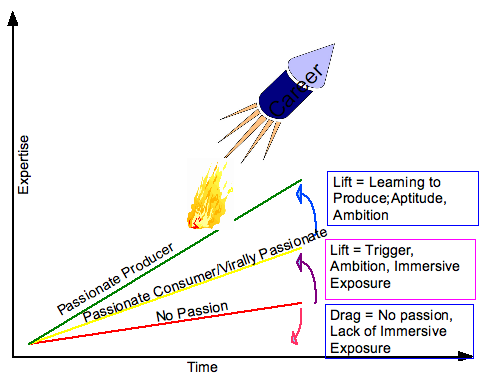
Updated Oct 10, 2008 – Nirmala, a KM professional joined the conversation with several insights on her blog. Thanks for the link Nirmala.
Prolog:
Teaching passion is one of my favorite areas. I started thinking about this again because i felt we have not been able to package the superb discussion that this topic has generated. Lots of people contributed to the discussion, but the main sparks were – Larzini’s Viral Passion idea, Milind Sathe’s Trigger, Sujatha’s 3 categories of people, Priya Raju’s Big Picture , Ganesh’s Learnt Vs. Taught and finally Archana Raghuram’s passive passion.
That insightful comment of hers has been ringing in my head for a while now. A few days ago, the proverbial light bulb went off in my head.
3 levels of passion
Where does being passionate about something lead you? It makes you better in that chosen area and depending on the degree of passion you have, you can truly become a world-class expert in that area over time. The light bulb moment occurred to me, when i realized the connection between expertise and passion.
1. No passion – you just like music or cricket or dance or whatever, but the liking is not strong enough to even be at the passive passion level. In this case, the expertise over time grows at a snail’s pace. This is the lower most trajectory in the diagram above.
2. Passionate Consumer – you are passionate about something – you have a strong/distinct liking for the topic. You start gaining expertise. This is the second trajectory in the middle. Expertise grows more rapidly over time compared to the no-passion category. For instance, i am passionate about music, and due to that i know a bit about music. I could not call myself an expert, but i know enough to separate the wheat from the chaff.
From Larzini’s comment, you can say that people that are virally passionate are also at this level. They are passionate about something, they do produce, but not yet that passionate – thanks to the infectious passion of the leader or a friend or a trigger or a powerful goal/vision.
3. Passionate Producer – You are so passionate about something, that you actually start producing/practicing. If you are passionate about paintings you start painting etc. The act of doing something/producing something that can either be self-critiqued or critiqued by others creates a powerful feedback loop in your brain pushing you to a greater and greater degree of excellence in that topic. This is the third trajectory in the diagram above which shows expertise growing much more rapidly.
How to become passionate?
If you integrate all the 3 categories, you can see that exposure to new topics can help build passion, immersing yourself in that activity can increase the passion to the 2nd level and starting to produce can take the passion to the next level.
Ambition can provide the fuel for passion. In the corporate context, setting a powerful goal or creating a powerful vision can be that fuel to create viral passion. In all 3 levels, associating oneself with passionate people can have a great impact. Even if you are an expert, associating with other passionate experts can increase your expertise further.
A sense of competition can help create powerful goals/visions. As long as the competition is healthy, competition is a great driving force.
Although, technically you can become an expert in anything you choose to apply your passion to, making sure you have the aptitude for the topic, is important. Again a wide-ranging exposure may help you determine the things that you have the natural flair for.
Career
Recently we did some surveys inside our company and we found that passionate bloggers and passionate musicians (our Euphony band that i talked about) are top performers in the company. Once you are a passionate producer in something, that rubs off on everything you do including your job. If you look at it from another point of view, you have figured out how to build world class expertise. So you can apply that ability to gaine expertise to your career. Career progresses when your expertise in the job improves.
If you are a leader, you can use this insight to make your team passionate about any type of producing activity (may not be business related) and then transfer that passion onto the company’s business. Aside from this, also explain the big picture, ambitious goals/vision to light the fire.
It is this fire that can launch the rocket ship as indicated in the diagram above.
Conclusion
In sum, passion can be taught, scratch that, it can be learnt. And once you are passionate, success follows.
Epilog:
I am sure there are some gaps in this. What do you think?
Notes & References:
1. The diagram above is an attempt to summarize this post – inspired by Kathy Sierra – Creating Passionate Users.
3. Why effort/practice is more important than talent.
4. Are you an expert? – Charlie Munger’s wisdom on the topic.
5. For a neuroscientific rationale for why feedback improves performance/expertise – ABC Theory.
6. To be accurate, each of the 3 lines in the above diagram should be an S Curve. I chose straight lines for making the diagram simpler.
Confessions of a Concert Hater
Filed in General Interest, May 16, 2008, 5:50 am by Priya Raju TweetI hate concerts. I have a rather visceral reaction to them. You can try to pigeon-hole me with Aurangazeb & other infamous music haters. But, you’ll be sorely mistaken. I’m a music lover. Which is precisely why I hate concerts. That begs an addendum: I. Hate. Concerts. In. Chennai.
A love-crazed Orsino exclaims in The Twelfth Night – “If music be the food of love – Play on”. I’m not Orsino. For me, Music is the food of life, my life-blood. My love for music is embarrassingly intense. When I hear Raga Hindolam (Malkauns), I think it originated in the electric bursts of my brain, sewn together with axons from my heart. Dash it all, that Raga is my alter ego. It is bold, proud, serene, unrelenting, out-spoken, androgynous. No pathos like Shiva Ranjani. No pandering to the masses like Pantuvarali. No piety like Sri. No aloofness like Shudha Dhanyasi. No begging like Desh. No fluttery eyed prettiness of Hamsanandi. You get the basic idea.
So what’s with concerts and me?
First of all, I can’t stand most live performances. There’s always someone singing off-key. Shruti – singing on-key – is of paramount importance. Only rigorous training and discipline can ensure this. I remember this Super Bowl performance by The Black Eyed Peas – yeah, they are no Sting. But, they do churn out catchy songs. The Peas were particularly awful that day – they couldn’t hold a single note on-key. And the crowds went berserk, applauding till their hands shriveled off. For Pete’s Sake!
Some call this crowd behavior “Euphoria” – I call it “Mob Hysteria”. I find it grating. A true lover of any art form is discerning. They don’t give a standing ovation to pure cacophony. They don’t start screaming their heads off at the opening bars of a particularly bad song, where the band & the singer have missed the scale by a mile!
I also find the seating arrangements in concerts absurd. I feel strait-jacketed – For no offense other than carrying a dumb ticket stub. I mean, they expect you to sit in an uncomfortable chair for 3 hours, all dressed to the nines. Me a very fidgety creature. I like walking around. Lying down in my sofa. With legs dangling on my coffee table. Dressed in my favorite Jammies – Powder Blue Tommy Hilfiger, with Red & White Apples printed all over, for those of you that are dying to know.
I like deciding what I hear. I like a bit of surprise from time to time, but a concert sort of wrenches the choice totally from you. You can’t even mumble a word of protest if you don’t like the song. I’m sort of like the food critic Anton Ego in Ratatouille. He spits out what he doesn’t like. I squelch my speakers if I don’t like what I hear.
And then, I have a pretty eclectic taste. I crave variety. I maybe in the mood for some Rai wailing from Cheb Mami – and 10 minutes later, need a dose of Gregorian chants. As if rubbing salt into wounds, in most concerts, you are doomed to hear the same genre of music, monotonously in the same voice for 3 hours. I can’t handle that tedium. I’ll feel bound & gagged.
Imagine listening to 3 hours of Indian Classical music – which in its purer forms is an acquired taste. Many people find the syncopated rhythms of Filmy Music more appealing, for a reason. In a traditional Carnatic Cutchery, my ears will be assaulted by supra-pure renditions, generally sans the benefits of a big band. In the end, I’ll be a blubbering cretin in a stupor. I’ll be too flummoxed to tell the difference between Todi & Kalyani.
Added to that is a new wrinkle. How in the Lords name can anyone do 1 thing – in this case, listening to music – non-stop for 3 hours? Sweet Jumping Jehovah. That’s a large scale sensory invasion. Gourmandizing. I can’t do anything for 30 minutes at a stretch. I become restless. I even have to read at least 3 books at the same time, so that I don’t feel constrained.
And last but not the least – Like most connoisseurs of music, noise nauseates me. And not just figuratively. There’s no “fine line” separating music and noise – there’s a yawning inter-galactic space between the 2. And if you can’t tell the difference, you have no business making or purveying music. Decibel level (dB) is a main differentiator. Normal conversation is 60 – 70 dB. Any sound – even if its Mel Torme’s delectable scatting – ceases to be pleasing beyond 85 dB.
When was the last time you attended a concert in Chennai? I have the sad duty of telling you that I went to a Fusion Concert of Ganesh & Kumaresh. I had a sinking feeling in the pit of my stomach the minute I saw the monstrous speakers. There was nothing wrong with the mellifluous rendering of the Violin Duo. But the damn speakers were hollering so loudly that I could feel my cochlear fluid oozing out. I had to endure a horrendous migraine & vomiting for the next 18 hours. Noise affects me physically.
Which is why I avoid the Cinema Halls in Chennai. I once went to a multiplex (Satyam Cinemas) to watch “Casino Royale”. Not that I love “Bond. James Bond” – but I was curious to see how beefcake Daniel Craig would measure up. Loved him, but after 1 hour, the noise got to me. I was totally disoriented by the ruckus. I feebly squeaked to the Homo sapiens next to me – by some luck it was my husband – that I needed fresh air. And collapsed. He dragged me by my legs to the nearest exit. My Hero.
A decent concert hall needs good acoustics, not a brazen speaker system. “Good” and “More” are not synonyms.
Which brings me to the general tendency of neophytes in Chennai. Of late, “More” seems to be their Mantra of choice. Sweets? Add MORE Sugar. So much sugar, that every sweet is indistinguishable from another. Clothes? MORE color, patterns and embroidery. So much that you’ll win a Harlequin look-alike contest. Music? MORE volume. So much volume that it assaults & tears your ear-drums. What happened to all the tasteful people in Chennai? I have a feeling they are all aestivating in the extreme heat. Wish they’ll wake up soon & rescue me from the clutches of the vulgarians.
Till that day of deliverance, I’m steering clear of Cinema & Concert halls. At least in Chennai.

 Entries