The world we lived in..
Filed in Fiction,General Interest, August 29, 2010, 2:18 pm by Kumaran TweetMy entire family rejoiced my birth. Our family is one big united with all uncles, aunts, grandparents living together. We are a simple living group. We do what is needed for bare survival. We are not greedy and do not have a luxurious lifestyle. We are a colony now going about lives.
We are what others call a Eusocial group.This means that we are a very social group.We are not individualists or selfish ones.We believe in helping each other with specific members of our community doing what suits the group best.We are not taught team work.We are born team members and die team members.It is in our DNA, trust me!!. Our team or colony is usually in hundreds at a minimum if not more. We also have colonies with several million individuals.
We also have a natural talent for science and engineering.I would not be boasting if I said we build some coolest architectures without any training the world has seen.In fact when we make our structures to ensure there is proper air-conditioning to all parts without use of any energy. We also sometimes have gardens in which we grow food for our consumption inside our structures.We have some natural mechanisms built to protect ours selves from predators with some smart techniques to cover our tracks.We could definitely take a class or two to the espionage agencies all over the world.As I said above some classify our society as casteist with many being assigned to do only those jobs.But let me tell we have our benefits and reasons for doing the same.
For such a big colony with many members we are mostly vegetarian.We are also very conscious in our preferences of food.There is hardly any living plant that we eat.Most of the time we eat and live off dead plants.There hardly has been a case of we cutting trees for our survival or comfort.The plants that we eat are only for hunger they are neither for comfort or taste.We do this just for our basic survival.I repeat again it mostly dead plants.We do not kill living plants also for our food.
We were leading our lives in a peaceful manner when the fateful dark day arrived.It was a day as usual we were going about our work them suddenly we hear a big hissing sound from the skies above
us.We looked up to see a shower or rain to descend on us.This was with a cloud forming fast.We were bracing our selves for rain when the rain drops started hitting our skins.There was a distinct smell which began to cause irritation to our eyes and ears.It started burning our skins.It dawned on us that the chemical war was declared on us.We realized that the aliens had started this attack.We do not know why they are doing this to us.They are attacking us unprovoked.But we are not strong enough to fight them.I see my family choking and dying in front of me.Everybody is running all over the place trying o cover.But the gases are so powerful that they are sneaking into our underground tunnels.Alas!! we have no defense against the aliens.My eyes are beginning to darken and am losing consciousness.
The only thought running in my mind as I breathe my last breadth -“Why us, my family what harm have we done to others other than living our life the way we were supposed too…………”
“OK, maam the job is done.Those termites are gone you don’t have to worry about your leather TV couch anymore”-the terminator said with a big smile on his victorious face to his customer as he walked away from the couch towards the main door.
Please do see this http://www.youtube.com/watch?v=xGaT0B__2DM by Sir David Attenborough.
Signature Foods
Filed in Food,Travel, August 22, 2010, 4:24 pm by Sukumar TweetProlog
I started my career in Mumbai in what seems like eons back. The city will always be seared in my memory for teaching the basic tenet of being a professional – being dependable. Mumbaikars will go to office in such pouring rain, that in any other city would be considered an emergency flood situation. But that is not why I remember Mumbai fondly.
Signature Foods
During one particularly lazy weekend, one of my friends told me that i have to go eat Bhel Puri at Vithal’s Bhel Puri shop near VT – considered to be foundational to the chat phenomenon that has taken over the country. Then the list extended slowly over time to Sardar Pav Bhaji, Haji Ali Juice Center, Karjat Vada Pav, Parsi Dairy Kulfi and so on..
Ever since, i have been on a quest to discover the “Signature Food” of every city of the world i visit. Once i went to Madurai (in Tamilnadu) and discovered Raja Barley’s Macroons – they have been making that stuff for 100 years now per the shop keeper. I was surprised to later find that many of my relatives who hail from Madurai had never heard of Raja Barley!
When we were in New Jersey, myself and my wife Priya Raju used to hunt down the signature foods whenever we could – H&R Bagels’ signature bagels, Lombardi’s Pizza…
What started this particular Signature Food trip down memory lane, was my recent visit to Pune where i made sure i brought a huge package of Chitale’s Bakarwadi. I also had a chance recently to visit Hyderabad and got the famous Karachi Biscuits for my family. Yummy stuff.
Googling
As is customary, i did some research to see if someone has talked about Signature Foods in detail. I found this excellent quiz on Signature Foods of various American Cities. I also chanced upon this nice article on the qualities of a Signature Food. On the whole, it appears, from the somewhat sparse Google results compared to other popular topics, Signature Foods aren’t top of the mind for people.
“Social” Signature Foods
As a passionate Social media advocate, i was thinking about how Social Media could make the quest for Signature Foods easier. Maybe one of the hot location startups like Foursquare, could introduce a new “Signature Food” feature, which will notify you of the city’s signature food(s) as soon as you check-in to any location in that city. Wouldn’t that be cool?
Epilog
What are your thoughts? What are your favorite signature foods? Which cities are those from? Please chime in.
Net Neutrality – The future ahead
Filed in Strategy & Business Models,Technology, August 6, 2010, 10:54 am by RK TweetOne of the reasons we – the consumers or the end-users of the internet – are relatively unaware of the meaning of Net Neutrality (NN) is that, we have always had it good and took NN for granted. We were not aware of internet being any other way.
But now the moment has come when you have to necessarily know the meaning of NN. Because you have the rights to know what information you have access to and what information you are deprived off as an information consumer. Because we risk somebody else altering what we experience on the internet. The current attempts to fiddle with NN – if successful – will be another demonstration of American capitalism.
So let’s get on – what is Net Neutrality (NN)?
NN simply means the contents on the WWW are delivered to the end-user by a straight-forward, unfiltered, unprioritized, unbiased transaction from the content provider to the user. There is nobody altering the contents delivered to you. For example, if we both are from the same geographical area, and google a search term, we will (and should) get the same results. And that is a simplistic definition of NN.
Who can take NN away from the end-user?
There are two key players – the content provider and the internet provider. Take search for example. In my case, Google would be the content provider and Comcast will be the internet provider. Lack of NN, these two parties can decide what I will see on my computer, based on my profiling. My profiling could be based on a number of factors, but in this context mainly based on how much I pay.
What would it mean to not have NN?
Think of China. Think of many of the pan-Islamic countries. They don’t have NN. But their neutrality is defined based on government policies. And at least, all residents of the country have access to same content. But in American context, it is purely commercial and is likely to give different internet experience to different people.
Will this affect countries other than USA?
I think it will. If they get away with NN, content providers (a vast majority of who are in the US) are likely to charge tiered access rates to international internet providers also. This means, whether you are in Bangalore or Baltimore or Budapest, this will likely affect you in some way.
Can we do something about it?
Though the internet is certainly larger than any number of corporations, the steering wheels are in the hands of few large corporates. Besides, NN is largely a gentlemen’s agreement and laws supporting NN are weak and manipulatable.
Are reasons why the NN killers might be right?
Content providers and internet providers cite many reasons – such as improving quality of content, prevent identity theft and internet related attacks etc…, but I think we are risking by putting control into the hands of few people.
Why is this news now?
As you may have read, Google and Verizon are working on clearing their way to a new business model, which would effectively betray NN. This is a developing news and you may see the stories are constantly evolving.
Open discussion
If you can think of good reasons to abolish NN or have ideas on how to prevent the efforts to kill NN, please comment.
Nigeria/Cross River State/Calabar Trip Report
Filed in Uncategorized, August 1, 2010, 3:47 am by Ganesh Vaideeswaran TweetAs part of IBM CSC program, I travelled to the city of Calabar which is located in Cross River State, Nigeria. Cross River State is located in South East Nigeria and Calabar was once a major slave trade port between 17th and 19th century. The CSC program is one of a kind where IBM sends its employees to help a community address some of its problems. IBM works with NGOs in identifying assignments and sends a group of 10-15 people to handle the projects. The tasks do not have to be necessarily technical. Each team is further sub divided into a smaller size to undertake multiple projects within an assignment. For example, I worked with another IBM’er to help Department of Public Transportation of Cross River state to enhance the skill sets of the organization and get a Document Management system setup. Ten other people who were part of the assignment worked on 5 other projects for the state. IBM also typically sends more than one team (in a sequential fashion) to the same community/city/state to keep up the continuity and ensure that projects are being sustained. This program is part of IBM’s corporate citizen portfolio program and one of the ways IBM fulfills its social responsibility. And each assignment typically lasts a month. I was privileged to be allowed to participate in one of the assignments.
Cross River State is named after “Cross River” that runs through the state. Weather is tropical and it was rainy season when I was there. The rains managed to cool down the temperature. It was still very humid though and at times I would sweat just standing. The state itself is very green, though Nigeria as a country has suffered tremendous deforestation. Calabar, the city where I stayed and worked for a month seemed a lot like a town in Kerala – lots of greenery with homes topped by triangular shaped tin roofs. Main highways and major streets in and around Calabar seemed well maintained with 2 lanes on each side with a divider. Interior areas of the city is lacking in good roads (like village roads in India), but cars do manage to get in somehow. The sewer system in the city was good enough to prevent flooding even with prolonged stint of rain.
Motor bikes have been recently banned in the city of Calabar (a brave move by the Department of Public Transportation) to primarily reduce accident rates. Motorbikes were also used as taxis to commute citizens from areas where cars cannot go. The government has since then subsidized purchase of cars to enable a smoother transition for these motorbike taxi owners. However, this has led to more congestion during peak times. I am ambivalent about this ban, but government is convinced this was the right move.
During such trips, I prefer mingling with the local people, talking to them and getting to know them rather than the canned tours. One the highlights of my trip were a 3 hour walk in and around the market area with few of my IBM colleagues. Most of the local people were extremely nice and would not hesitate to talk to us even though we may be annoying them with touristy questions. A few of the folks, particularly the older generation, were very averse to photos being taken. The aversion I believe is due to the fear of being exploited (perhaps via magazines etc. that highlights the poor conditions of the people). Once, we explained that we had no such intentions, they seemed OK. However, I made sure I got the permission of parents before I took pictures of their children.


Fish (found in Watt Market)

I visited a small museum which is all about slave trade and the suffering the slaves underwent as they were shipped from Africa to other countries. It was a pretty graphic experience with life sized models, scenarios and audio that reminded one of the gruesome cruelty suffered by Africans. During the museum visit was when we realized why the “N” word is so despised by current generation African Americans. Obviously it is derived from Nigeria (or Niger) and probably reminds them of horrific times their ancestors had as slaves.

- Slave Museum
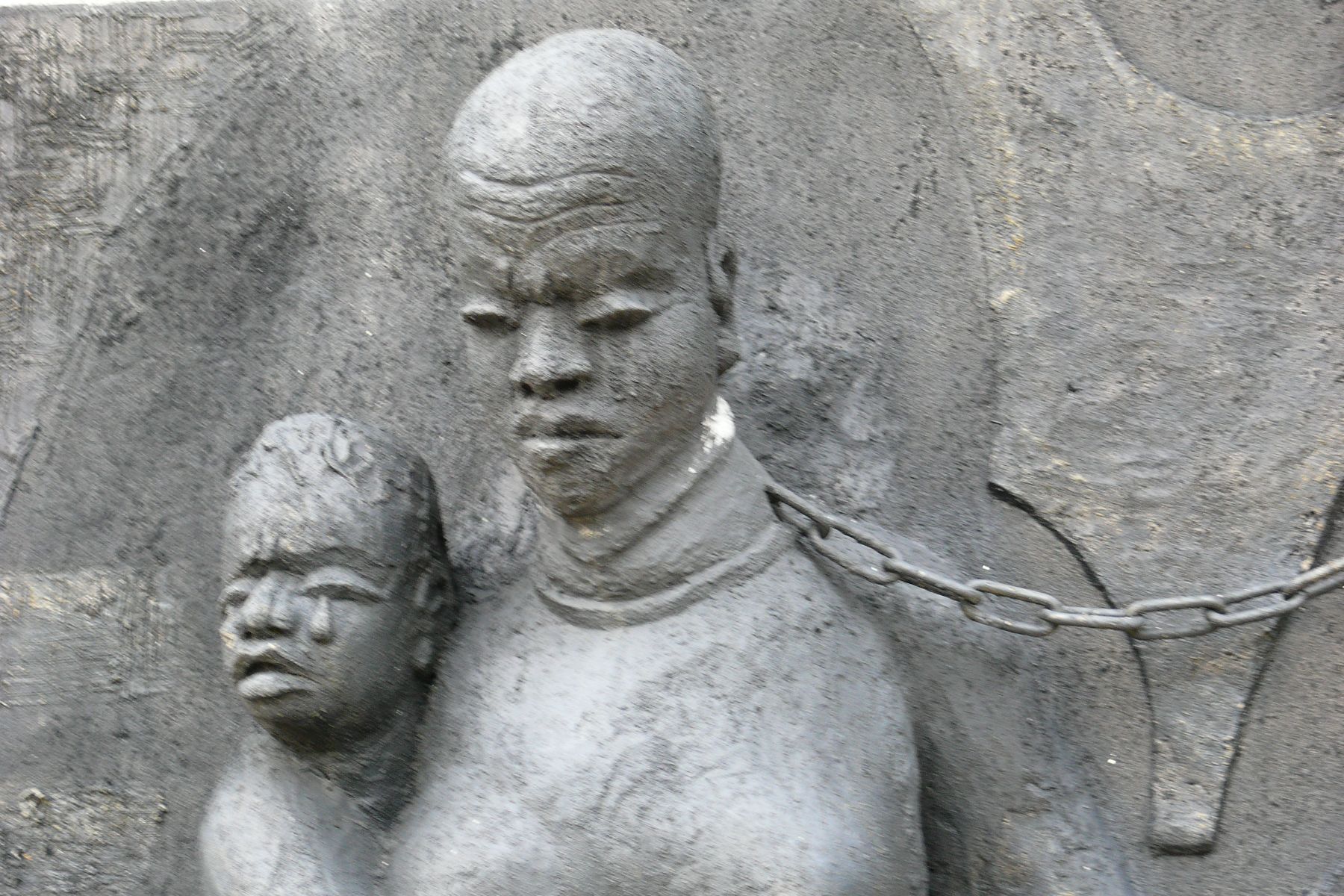
Another place we visited was Obudu – a scenic mountain resort (about 1500 meters above sea level) that boasts the longest cable car in the world. The ride down from Obudu in this cable car is heavenly and it feels like you float in the clouds at times. On the way back from Obudu, visited the Drill Ranch situated in the Afi mountains and is a place dedicated to protecting the endangered drill monkey and chimps. This is a selfless effort founded by 2 Americans Peter Jenkins and Liza Gadsby who have dedicated their life to rehabilitating the drills. Bush meat is coveted by certain section of the population in Nigeria and the government has not been able to protect the chimps and drills from being killed. Thus, the eventual goal of sending these animals back into the wild has not been realized. Irrespective, the work of the 2 Americans is inspiring. The walk to see the animals (safeguarded in a huge enclosure) is through a section of the forest in Afi Mountains. This forest also boasts a canopy walkway made of 8 bridges and the walk across these bridges while enjoying nature at its best was a wonderful experience. Even though the visit to Obudu and Drill ranch was short, I am thankful for the effort made by Cross River state to take us on this tour (they provided us with the vehicle and security).

Canopy in Afi Mountain

Liza Gadbsy

Drill Monkey

Cable car (in Obudu)
The state of Calabar and IBM made sure our stay was safe and secure and the people in Nigeria made us feel absolutely welcome. It has been more than 10 days since I left Nigeria, and I still recall the good times we had at least few times a day.
In the next post, I will try and cover a bit more about politics (whatever little I know), religion, people, language, food and the project itself.
References:
Articles related to Motor cycle ban:
http://thenationonlineng.net/web2/articles/28404/1/Cross-River-Okada-bad-taxis-good/Page1.html
About Peter Jenkins and Liza Gadsby – http://afp.google.com/article/ALeqM5j9OJQ5l6b1-QYA6L9QGJy01GrPcA
Drill ranch and Afi Mountain: http://www.pandrillus.org/projects/drill-ranch/visitor-information/
Cross River state government web site: http://www.crossriverstate.gov.ng/
Department of Public Transportation web site (Department I worked with): http://www.transport.crs.gov.ng/
Other photos:

Hotel (dedicated to God)!!

Land not for sale!!
World Classical Tamil Conference – A Perspective
Filed in Anthropology, June 27, 2010, 3:17 pm by Sukumar TweetUpdated 27 June 2010 6:45PM – The 78 page conference schedule is online at the wctc2010 site for those that want to use data to test MSS Pandian’s assertions that i refer below.
Updated 27 June 2010 6:45PM: Several people asked me how much time it took to do the research. The hypothesis was published on this blog as a post . I had formulated the hypothesis a few months before publishing. It took me nearly a year from then to collect the evidences needed, although the paper is only 5 pages long.
—–
My paper presentation
It was a great honor for me to present at this conference. My presentation was alongside Asko Parpola, the man who won the Classical Tamil award from the government. I presented my paper on 25th June 2010 at the conference. As it turned out, the prior track in the same room was delayed by 20-30 min and i got allotted 10-12 min by Session Chair Dr. Iravatham Mahadevan. Fortunately, i had prepared the previous night to deliver it in 10 min anticipating such schedule issues. On the day i managed to finish it in 9 min 30 seconds.
I had recorded my talk and have uploaded the slides with audio to slideshare and it is embedded below.
Session Chairman’s comments
Mahadevan Sir mentioned in his closing comments that as a 81 year old he was passing the baton to young researchers like me, which made me swell with pride. Another proud moment – later after we got down from the dais, he said “we have been looking at the seal for 40+ years and you are the first one to find the differences in the bangle in the same seal”.
Thank you all
A thank you to all my colleagues and twitter pals and my family for encouraging me every step of the way in the conduct of my research. As a newbie researcher into the IVC (just over 2 years), it is a huge honor for me that my paper was selected for the conference amongst the 1000s of papers that were submitted.
Responding to Right Wing Criticisms Hurled at the Conference
Before i begin, i want to make sure you all know that i have no political connections to the DMK party or its members.
The first set of criticisms come from the right wing Hindutva folks for whom any linguistic pride in anything other than Sanskrit or Hindi is Chauvinism. This is pure unadulaterated bullshit. That India should speak one language and have one religion is based upon very very outdated theories on nation-building. One would think that with the demise of the Soviet Union that such outdated theories will be in the dustbin. Not so for our right wing which still wants to cling to it.
Obviously due to the fact that the conference is about Tamil’s antiquity, several paeans to Tamil was sung. Any one with a half a brain engaged in research can easily tell that Tamil’s antiquity is well-supported by incontrovertible evidence. And that the Dravidian language family is likely older than Sanskrit and Indo Aryan Languages in the Indian Subcontinent. There is enough evidence to support this claim as well for those who will look with an open mind.
Responding to Scholarly Criticism
Some scholars that i respect have also criticized the conference. This article by MSS Pandian of N Delhi is an example. Some of his criticism about the extravagance is probably reasonable. In all fairness to the TN Govt, any event of such scale where several lakhs of people attended, is bound to raise questions of extravagance. But we expect more from a scholar like Pandian. Let us look at this statement from his article:
The academic sessions, which are going to be intellectually enervating, have no less than 20 papers on Karunanidhi and five on his daughter Kanimozhi. If Karunanidhi has claimed that about 5000 scholars from all over India are participating in the conference, he has his own standards of scholarship.
I doubt if Pandian even cared to look at the conference agenda. I have the agenda with me and i looked through it. There were approximately 1200 papers and i could count 6 or 7 papers dealing with MK’s and Kanimozhi’s literary works [Not to mention that MK is a serious and legit Tamil scholar]. Let us give the benefit of doubt to Pandian and assume it is 25 papers. 25 out 0f 1200 comes to 2%. I personally attended several paper presentations and the amount and the high quality of research being discussed is just mind-boggling. To dismiss all the 1200 papers because 25 are potentially tainted is ridiculous. We expect better from people like Pandian.
My Own Impresions
There were 2 parts to the conference – the public part and the research part. The public part drew several lakh people and was chaotic much like any tourist trade fair. The agenda was also quite political to further the interests of the DMK party. The research part is where i spent most of my time. It was a spectacular conference with all the arrangements nearly flawless. Students from local colleges were the volunteer force and they did a very good job of running the conference. the food/sanitation arrangements were extremely good. The CODISSIA hall is world class. I hope all of the facilities are not temporary. It doesn’t look like they were but i wasn’t sure. On the whole, i think the TN Govt must be congratulated for putting up such a grand event. Wonder why such a research conference doesn’t take place atleast once in 2 years.
Conclusion
I believe that India’s strength is its diversity. Language is a key element of that diversity. I wish all the major languages of India hold such research conferences and encourage true research in the respective languages so that we don’t lose the priceless heritage available in every language.
Additional Notes & References:
1. Asko Parpola’s acceptance speech. The Hindu has uploaded his entire dissertation online.
2. Asko Parpola presented his theory on the Wild Ass just before my presentation. It was a brilliant presentation with the depth of research that is stupendous. You can read Parpola’s Op Ed on the subject in The Hindu.
2. Madhan Karky has uploaded some pictures from the event.
3. You can read the coverage of the event on twitter by several people including myself at the hashtag #WCTC.

 Entries