Would I do it?
Filed in Management,Sport,Strategy & Business Models, March 13, 2011, 9:03 am by Kumaran TweetYesterday’s world cup match and the last over given to Nehra by Dhoni.
Personally I am disappointed at what happened yesterday. Lot of us would say the last over should have been given to Bhajji because:
1.He a tried and tested bowler.
2.He is the in bowler in form with wickets in the match.
Let me think for Dhoni (obviously speculating here.):
1.As a leader he thinks differently and wants to back his team players. He did give Jakati a chance in World Cup T20 finals who came out with flying colours.
2.Does not mind losing the battle (match) to win the war(World Cup). He wanted to try out his option and willing to take a chance. Imagine Nehra coming out with flying colours we could have had a strike bowler at death for the Super8 stage.
3. Give your struggling team member a chance and bet on him to do it for you.Really believing in him. In my arrogant opinion I don’t think he is stupid. 🙂
The question that comes to my mind is “As a leader would I be able to take a chance than play safe?”
Full disclosure :
I do have a personal bias to Dhoni as a person I like him for the following reasons:
1.He came up in cricket without god fathers. He used to ask his room mates to drop him at Ranji stadium for matches as he did not have a bike. He was working as a train ticket examiner at that time.
2.He will take his 2000 CC bike for a spin early in the morning (his passion bikes )and not wake his body gaurds as he did not want to disturb their sleep for his personal wishes.
3.He does a victory huddle with team ( Chennai Super kings lost in finals to Rajasthan Royals ) after “losing” to celebrate the team efforts.
4.Plays music on DVD for marriage no fan fare whereas he could have had stars performing live bands – Humility.
Turkey Travelog – Part 5 – Cappadocia
Filed in Travel, March 1, 2011, 10:17 pm by Priya Raju TweetHere’s a link to the previous post in this series, on the Topkapi Palace.
A visit to Turkey is incomplete if you don’t check out Cappadocia. Its name is derived from Katpatuka – “Land of the beautiful horses” – in Hittite language.
Cappadocia has an unusual landscape that cannot be explained in words. Craters, rock columns and fairy chimneys dot it – the result of Mount Erciyes erupting 50 Million years ago. Since then, there have been many volcanic eruptions that spewed volcanic tuff. Centuries of erosion shaped the tuff. The Peribacalar (fairy chimneys) formed when erosion wiped out the lava covering the tuff, exposing isolated pinnacles. The Red River – Kizilirmak – runs through it with pink tinted waters.
Even though Cappadocia is famed as the land of the Hittites, people have used the caves as dwelling for several centuries. People dug into the soft tuff to create cave dwellings, monasteries, churches – and even massive underground cities. Nowadays, most of these dwellings have been converted into upscale hotels.
The star attractions in Cappadocia are the underground cities. We visited the Kaymakli city complex. Underground cellars were used in the Hittite period to store wine, since the temperature of the cellars was at an optimum 50 – 60 degrees Fahrenheit.
In the 6th and 7th centuries, when Persians and Arabs invaded Cappadocia, Christians were persecuted for their religious beliefs. They escaped into these secret underground cities.
An underground city is a huge subterranean space for living, worshipping, wine making, cooking and cattle rearing. It has more than 8 levels (or floors). The richest people lived closest to the surface, where the air was the freshest.
Providing fresh air was a problem. Cunningly devised shafts disguised as wells circulated air into the living complex. Invaders would poison the “wells” to contaminate the water supply.
How do we know which rooms were used as the kitchen? Well, the smoke from the fires blackened the ceilings – so the kitchens are fairly easy to identify. In addition to that, some rock tools for pounding spices have been found in these rooms. There was no danger of the enemies detecting the smoke from the kitchens, since the soft rock absorbed the smoke.
We were really curious about the bathrooms. Apparently, they were in the lowest level & visitors aren’t permitted to those levels. Imagine running post-haste from the 1st level to the 8th level, in case of “emergencies” 😉
Sometimes people stayed for months together in underground cities. Many would have needed a therapist, luckily one was at hand at all times – Wine. They made wine by stomping on grapes with their bare feet. One look at the stomping pit & my desire to taste Turkish wine disappeared.
More than 10,000 people lived in Kaymakli. 37 such cities have been found so far & at least a 100 more remain, undiscovered. I was warned that I might be claustrophobic while visiting the 3rd and 4th levels, but the caves were well lit & I didn’t feel a thing.
The tops of the “cliffs” have dovecotes (pigeon houses) to collect droppings. The land is so infertile that the only way a farmer can coax plants to germinate is through pigeon guano (used as a fertilizer). A man without a pigeon house had little chances of wooing a wife 🙂
Apart from the underground cities, a visit to the Göreme open-air museum is a must. A profusion of churches in the rock-cut caves welcome the visitors. Most of these churches have seccos painted on them. A fresco is painted when the plastering of the wall is still wet. This way, the paints are embedded into the structure of the wall. A secco is painted by moistening the already plastered wall. Thus, seccos peel off easily, but are easier to paint.
Many of the churches have images of saints battling and killing dragons or snakes, both symbols of the pagan religion. Most of the seccos are badly damaged. Monks decorated the churches using plant-based dyes and mineral paints. The most spectacular color used is blue – derived from Lapis Lazuli, probably from India.
Some of the churches have mere daubs of color, but no secco. During the iconoclastic period, images couldn’t be depicted. So daubs of red ochre was splashed on the walls instead of painting saints or animals.
The church of “St Onuphrius” is the most interesting. According to legend, Onuphria was a beautiful young woman. She had many suitors, but a wealthy – and uncouth – merchant was dying to marry her. Since he promised a fat dowry, Onuphria’s parents agreed to give her in marriage to him. Depressed at the thought of marrying a clumsy man, Onuphria prayed to the Gods on the eve of her betrothal. They blessed her with a long beard. The next day, Onuphria drew back her veil & revealed her rich beard. This so repelled the merchant that he stormed away from the ceremony. The girl was chased out of her house, accused of dalliance with the devil. She burned all her clothes and lived buck-naked in a cave for 12 years, meditating. She lived the rest of her life as a man, as St Onuphrius.
In the churches, St Onuphrius is featured with a long beard and a strategically positioned fig leaf 😉
Sukumar will follow this post with a photo blog of Cappadocia and the Hot-air Balloon ride that he took there.
Turkey Travelog – Part 4 – Topkapı Palace
Filed in Travel, January 11, 2011, 3:31 pm by Priya Raju TweetHere’s a link to the previous post in this series, a photo blog from Sukumar, in case you missed it.
Turkey offers many culinary delights, but none so unusual as the “Kumpir”. The insipid baked potato is elevated to an object of gastronomic delight by stuffing it with sour cream, vegetables, meat, herbs and pickles. You can tailor your Kumpir to your taste and make a hearty meal out of it.
On a very cold day with nothing to do, we found ourselves in Istanbul’s Cevahir Mall, “one of the largest malls in Europe”. “Since when is Turkey a European nation?” I asked myself, gnashing my teeth. That apart, its uncanny how much Cevahir resembles the “Express Avenue” mall in Chennai. But the resemblance is superficial. Cevahir is frequented by Turks, it has many stores that sell goods that the middle class can afford. It’s a mall with a soul, not a show-piece that’s at odds with its surroundings.
I’m yet to meet an Indian that dislikes Son Papdi. This sweet was introduced to India by the Moghuls by way of Persia. You can buy delicious Pismaniye, a close cousin of Son Papdi in the numerous sweet shops that permeate Turkey. Also called “Floss Halva” and “Candy Floss Halva”, Pismaniye is delicious. Says Sukumar who was fortunate enough to not be on a diet.
A visit to the Topkapı Palace is essential, if you want to understand the splendor of the Ottoman period. At its height, it was home to 5000 people. Spread out over 4 courts, the palace is enormous. It even has a circumcision room where princes recuperated after the, ah, surgery. It has a superb balcony where the Sultan broke the Ramadan feast. And it has a special fountain where the executioner cleaned his hands and the sword – Lest we forget the brutality of the period.
I wanted to see the kitchen that cooked for 5000 people and its famed Celadon collection. Make it kitchens – there were 4 of them, one of them called the Helvahane just to make sweets. The Chinese made (Alas, China had an edge over India in the manufacturing sector even back then) porcelain allegedly changed its color if the Sultan was served poisoned food. The Sultans were very paranoid – justifiably. “Ibrahim the Mad” went mad after being imprisoned by his own brother Murat, for 22 years. Filial piety was not in vogue back then.
The Sultan also eaves-dropped on his team of ministers. Set high in the ceiling of the Divan Salonu – where the ministers met – is a grill. Which opens into the Harem, conveniently near the quarters of the Sultan himself.
Suleiman the Magnificent is credited with introducing the Mezze platter – small servings of many items served in a plate as an appetizer or as a meal – to Turkey. The Sultan got this idea after visiting Persia. Taste slaves were asked to eat the Mezze before the Sultan had his dinner. So if anyone intended to poison the Sultan, there would be an “early warning system”.
Unfortunately, the kitchen was closed for renovation.
In the Ottoman empire, the mother of the Sultan held special powers. Called the Valide Sultan, she could even pass orders to the Grand Vizier (Prime Minister). She administered royal estates, ruled the Harem and held enormous sway over the Sultan.
Contrary to what many people think, a Harem is not a collection of wives – it simply means “private” or the family quarters of the Sultan. The Sultan, under the rules of Islam, could have 4 wives – and as many concubines that he could support. The Harem housed many slaves, all of them foreign, since Islam forbids enslaving Muslims. Girls were either bought as received as gifts. They were then taught comportment, Islam, Turkish language, make-up, music etc. And if they were lucky – or Caucasian – they usually found themselves in the bedchamber of the Sultan, as his concubine.
Interestingly enough, the Ottomans did not follow primogeniture – the 1st born son did not automatically become the Sultan. Any imperial son in theory could become the Sultan. This started malevolent power struggles in the Harem, as the mother of the Sultan would become the new Valide Sultan. After all, Roxelana, the powerful consort of Suleiman the Maginificent, started out as his concubine.
The highlight of the visit to the Topkapı palace is the Treasury. The Ottomans owned diamonds and emeralds roughly the size of Hershey’s kisses. They seemed to have as many emeralds, diamonds and rubies as there are pebbles in our front lawn. The most famous jewel in their collection is the 86 carat “Spoonmaker’s Diamond”. This lustrous gem was found in a rubbish heap and was bought for 3 steel spoons. We got goose bumps when we saw the sword of Suleiman the Magnificent.
The Sultans had different thrones for different occasions. The jewel encrusted “Nadir Shah” throne was the most spectacular. We also saw the famous “Topkapı Dagger”, set with emeralds and a watch. Seriously – a watch in a dagger? To what earthly purpose?
The Ottomans lived in Tokapi during their prime. Later on, as their power waned, they moved to European style palaces such as Dohlmabace and Ciragan. The latter is a hotel for the rich and famous now. During our Bosphorus Cruise, we saw visitors to the Ciragan Palace alighting from a helicopter. “See? That’s the hotel we should have stayed in!” said Sukumar. The hotel was on the Bosphorus. It looked ridiculously pricy. Hell, it airdrops its patrons. I silently gnashed my teeth, the characteristic (and impotent) gesture of women with expensive husbands.
Here is my next post in this series, on Cappadocia.
Turkey Travelog – Part 3 – Photo Essay
Filed in Travel, January 8, 2011, 9:35 pm by Sukumar TweetHappy new year everyone. This is my first post of the year on this blog.
Hope you all are enjoying Priya Raju’s updates in her inimitable style. In case you missed, here is part2 of this series. I got delayed with my photo essay, sorry about that.
Our tour in started at the Hagia Sophia. You should read Priya’s description of it.

Next, the incomparable Blue mosque (Sultanahmet), considered to be the pinnacle of architectural accomplishment of the Ottomans.

The Grand Bazaar – it did trap us tourists 🙂

We loved eating the Mezze Platter at the roadside eateries. Here is Priya Raju glancing at the Menu to pick out Mezze Platter for the Nth time 🙂

The Dondurma from Mado beats any ice cream in the world, including my prior best Italian Gelato from Rome. I never put Orchid and Juice together before 🙂 Here is self enjoying Sahlep – the delicious drink made from Orchids at a Mado store in the Cevahir Mall.

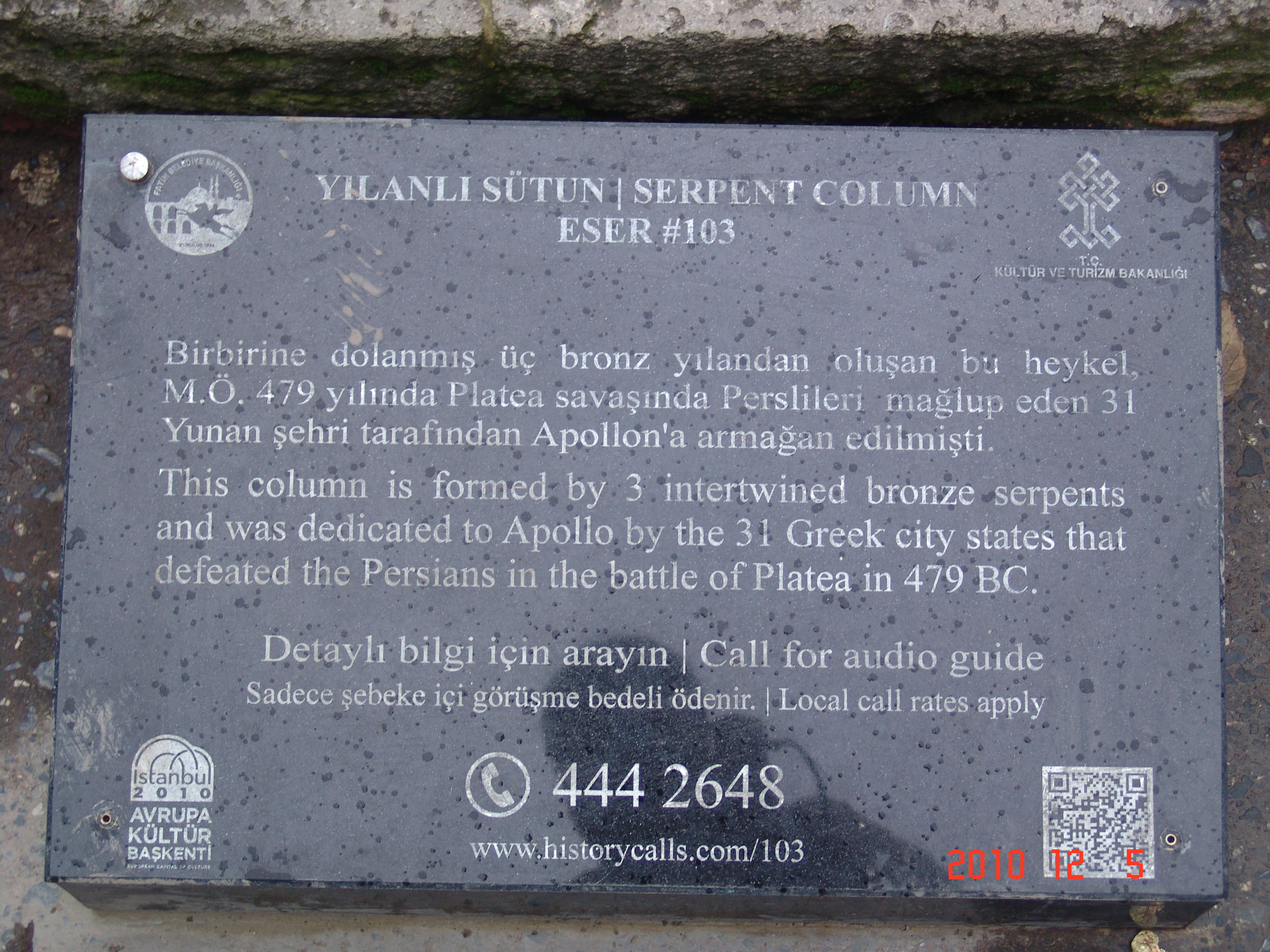
The next picture has the oldest object in Istanbul. The description of the monument follows in the next picture.

Battle of Platea changed the history of Europe forever. The technologically minded may be able to notice the qrcode in one corner of the next picture.
The reason for the Blue in the Blue Mosque can be seen in the next picture. Cameras, especially wielded by incompetent photographers like me, can never capture the beauty of Sultan Ahmet’s interior. Nevertheless, here it is:

Next up you can see the grill using which the Sultan eavesdropped on his ministers in the Topkapi Palace (Priya will explain this in her next post).

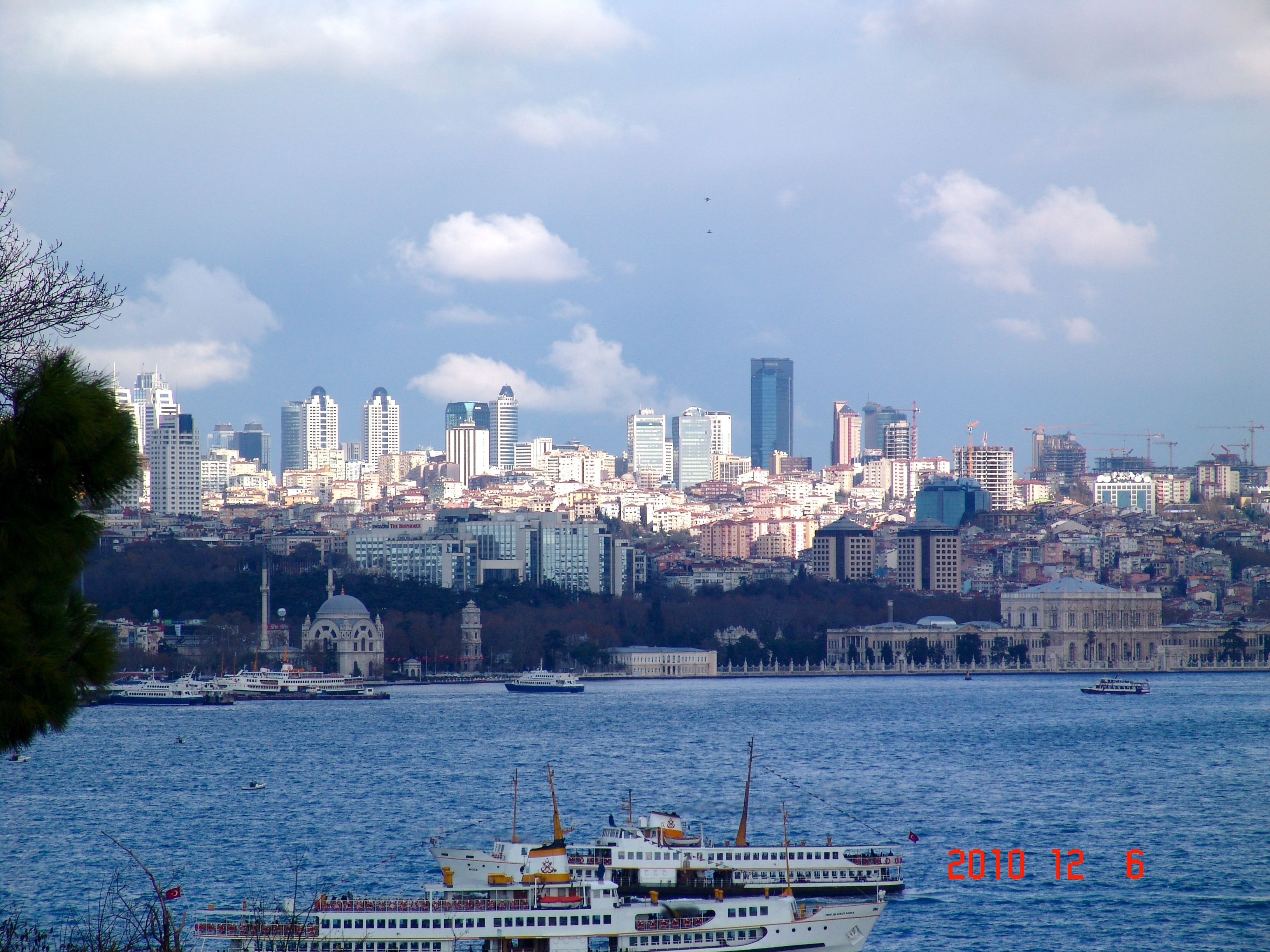
Spectacular view of the Istanbul skyline taken from the Cafe at Topkapi – well worth the 17 Lira they charged per cup of coffee against the usual 3 Lira 🙂
Priya Raju, the Crow Lover, will beat with me a stick if i don’t include a picture of a Crow. Just kidding 🙂 We thought the Turkish Crow looked kind of different.

Sun set on the Bosphorus from the Bosphorus cruise.

Priya and I were curious how the Sultan “did” his thing at the Topkapi. In case you have similar levels of curiosity 🙂

I believe that Indus (IVC) symbols like the “unicorn” and “swastika” spread all over the ancient world. Here is an example of “unicorn” from the Istanbul Museum.

We went to Cappadoccia next. The ancients had built more than 100 underground cities where they would hide to escape invaders. One of them is below – a circular door to close the entrance from the inside to protect themselves, they had carved the door also from the same material that forms the city, built by carving into the volcanic rock which is softer than regular rock. One of the most amazing things i have seen. It took them decades/centuries of work to manually carve and create these underground cities.

If you all liked my photo essay, i can do one more with the unique landscape of Cappadoccia as seen from a hot air balloon (one of my life’s all time great experiences) and a photosynth of Istanbul as seen from the Galatta Tower. What say?
In the meantime, this here is the next post in this series.
Turkey Travelog – Part 2 – Istanbul Redux
Filed in Travel, January 4, 2011, 7:00 am by Priya Raju TweetContinuing the travelog of Turkey. Here’s a link to the 1st post in the thread.
If I were to list the Top-10 things to do in Istanbul, eating pistachios from Osmanlioglu in the Spice Bazaar will feature prominently. Nowhere else in the world will you find such perfectly roasted, mildly salted, impeccably flavored pistachios. The Spice Bazaar is popularly called the “Mısr Çarşısı” (Egyptian Bazaar), since it originally featured spices from Egypt. The small bazaar is an obstacle course. Warding off a store clerk’s assiduous efforts to sell me Turkish Viagra (“Very effective, madam” he assured me), I picked up a bottle of an intriguing amber colored liquid – “Grape Syrup”. Istanbullus swear by this concoction and use it instead of jam or sugar. It was cloyingly sweet, more like an extract of raisins than grapes.
The star attraction in Turkey is the Hagia Sophia (Aya Sofya in Turkish) – or the Church of Divine Wisdom. This is a 1,500 year old church, built by Emperor Justinian. The church is massive – it must have been quiet a sight back in its days. The interior of the church is beautifully decorated with thousands of tiny gold tesserae (mosaic tiles) and varicolored granite and marble. Sadly, most of the mosaics are badly damaged and painstaking restoration is ongoing. The large central dome of the church appears unsupported – though its cunningly supported by hidden columns built into the walls.
Compared to the stunning interior, the exterior is almost drab. This is in keeping with the Byzantine tradition of keeping the exteriors simple, while lavishing all the attention of the interior. So breathtaking is the interior of Aya Sofya, that 1000 years later, it was proclaimed a mosque by the Ottoman Sultans. Nowadays, its mostly viewed as a museum.
We checked out the “Weeping Column”. It’s a simple column with a worn-out copper plating and a hole. The faithful believe that if you insert your finger into the hole & it returns moist, your ailments will be healed. Hence it was a sad day for me when my finger emerged dry as Sahara.
When in Turkey, eat like the Turks. Missing Dondurma must be the 8th deadly sin. This Turkish version of ice cream beats all other versions hands down. In addition to the usual ingredients, it has Mastic and Sahlep, the milk from orchid bulbs grown exclusively in Turkey. If you are in Turkey, try one of the ubiquitous “Mado” ice cream bars. Their ice creams are thicker, stretchier and sinfully tasty – probably because they feed their cows the same orchid bulbs that goes into making the ice-cream. Since I’m on a diet, I watched Sukumar stuff himself with scoop after tantalizing scoop of Mado ice creams.
The 2nd most popular attraction in Istanbul is the “Blue Mosque” or the Sultanahmet Mosue. What’s blue about the Blue Mosque? Nothing in the exterior, but the inside – especially around the domes – is lined with thousands of beautiful blue Iznik tiles. This splendid mosque, with 6 minarets, is a photographer’s delight. It was built by the Ottomans, as Islam’s answer to Aya Sofya. No effort was spared to make the Blue Mosque more breathtaking than Aya Sofya. Our tour guide told us that when the mosque was built, it caused a lot of consternation – since the only other mosque with 6 minarets is in Mecca.
Sultanhmet Square, the locus of tourist spots, is full of small, interesting cafeterias. For a few Turkish Liras, you can have your fill of strong, miniscule cups of muddy – albeit flavorful – Turkish coffee and smoke the Nargileh (water pipe for tobacco). Being non-smokers, we gave the Nargileh a wide berth, while all around us, Turks smoked like chimneys. Turkish tea is for the masochist in you. I didn’t know what to make of the inky brew. Or the equally weird tasting Apple Tea (Elma Chai) that beaming carpet salesmen ply on tourists. It tasted like a watered down version of “Mott’s Apple Juice”.
Nobody lures tourists like the salesmen and women in the 500 year old Grand Bazaar (Kapalıçarşı, or Covered Bazaar). This charming and almost medieval, shopper’s delight offers everything Turkish you ever wanted to buy, even items you never knew you wanted. We bought some souvenirs (read: junk), seduced by the sweet-talking shopkeepers. Prominently displayed are the blue and white Nazar (Eye) symbols, which Turks believe wards off the evil eye.
Say “Turkey” and your mind conjures up images of “Rahat Lokum” or Turkish Delight. This delicious sweet is Turkey’s answer to the Indian Halwa, sans the butter and ghee. I’ve done Turkey a great disservice if I don’t agree that Lokum – the precursor of Halwa – was invented by Ali Muhiddin Hacı Bekir, a Turk. Legend has it that sweets were mostly hard candies till Hacı Bekir invented the soft lokum. He offered it to the Sultan, who fell in love with it at the first bite. Sukumar OD-ed on Findik and Fistik lokum (Hazelnut and Pistachio) from Hacı Bekir’s shop in the happening street, Istiklal Caddesi – while I – watched him wolf it all down.
I must say that the Anatolian Civilizations Museum in Ankara was a major let-down. We had hoped to gain more insights on the Neolithic and Chalcolithic civilizations in Turkey, but the museum needs a better curator and more “steals”. There weren’t many star attractions – crowning glories – in the museum’s possession. Those that they had wasn’t documented and displayed to its advantage. We were surprised to learn that this was an award winning museum. The Istanbul Archaeological museum was better – but more about that in another post.
Sukumar’s photo blog is next, so stay with us.

 Entries