Back to India – Will you find your favorite products? (1 missing so far)
Filed in General Interest,Reviews, May 30, 2006, 10:00 am by Sukumar Tweet Updated: Desipundit linked to this post. Thanks Kaps. It is close to 5 months since we moved back to India after 10 years in the USA. Like everyone, I did worry about whether i will find some of my favorite products/brands in India. So i decided to do a small study on brand penetration in India for the benefit of everyone that is contemplating the big move. There is 1 product that I like (and I know many people in the US like it) is not available. Hold on to that thought – just to create some suspense. Overall out of the Top 100 brands, 84 of them are already in India. 4 of them are in coming soon category (Starbucks, Armani, Nissan, Harley-Davidson). Only 12 of the Top 100 are not here yet – Budweiser, Kleenex, Tiffany & Co., Hermès, Amazon.com, Gap, Zara, Ikea, Danone (Dannon in US), Disney, Nintendo, Volkswagen. I also created a color coded brand penetration chart for the Top 100 (green means available, amber is coming soon and red is not available). We definitely do use several products that don’t figure in the Top 100. Here is a run down of typical ones by product segment: 1. Food – Bagels not available in Chennai (iam a big fan of bagels). But available in Bangalore at Bagels & Bakes – Phone: 2351-6103 and Oberoi’s 2. All of these available in a decent supermarket:
Personal Care – Gillette’s shaving systems (Mach3..), Deos, After Shaves, Listerine mouthwash and usual breath mints like Mintos, Tic Tacs etc. Many options for Diapers and feminine care products. Locally branded toilet and kitchen tissues are available. 4. Household products – Dranex, liquid plumr, 3M scotchbrite, lysol, pinesol. Non-branded items like can openers, typical varieties of mops are available as well. 3. Restaurants – the more common ethnic cuisines are all available – Thai, Japanese, Lebanese, Malaysian, Chinese, Korean, Italian. Rare ones like Ethiopian etc. are not there or are harder to find. There is no Ethiopian in Chennai yet. 4. Telecommunications – Broadband DSL as well as Cable Modem can be had for anywhere from Rs. 250 per month for 250Kbps to Rs. 1000 per month for 1Mbps and beyond. Wireless routers like Netgear are available as well. 5. Sport – a number of good gyms around. squash, bowling, snooker are available as well. 6. Entertainment – Theme parks, cinema complexes, Chennai (Abirami Theater Complex) and Hyderabad both have Snow World where they are creating snow and you are given winter gear to play in it. Neat idea. The Abirami version is perennially crowded but I am told the Hyderabad version is the happening place for cool people. On the TV Channels front, Priya Raju is a bit upset that her favorite channel A&E is not available here. MTV, VH1, Discover, HBO etc are available. 7. Pharmaceuticals – most of them are available. If you use some rare medicine, please ask someone to check availability for you. 8. Automotive – All the major players are there. If you are used to automatic shift (as opposed to manual stick shift), you have plenty of options. 9. Household goods – Several options for DVD players, microwaves, home theaters, flat panels and the prices have become more reasonable. 100% clothes dryers were not available earlier. Now IFB Bosch is selling one. So you can get rid of the clothes line! Dishwashers are also available – multiple options. 10. Shopping – excellent malls are there everywhere. Spencer’s Plaza – the much talked about one in Chennai is too chaotic for my taste. There are too many shops and by the time you figure out how to go from one shop to the one you are looking for, your head starts spinning. There are shops in every nook and cranny of the mall. I wonder how anyone locates their favorite shop when they need to – especially the ones that are tucked into one of the corners. My favorite is the newly opened Chennai Citicenter Mall on Radhakrishnan Road. The Lifestyles shop inside there, complete with escalators inside the shop, is almost like any Macy’s or Bloomingdale’s store in the US. The mall is less crowded, at least for now. 11. Beverages & Snacks – Typical Soda brands are Coke, Pepsi, 7up, Mirinda etc. are available. Lay’s potato chips available in all flavors including some local variants. Now for the missing entry – It is Tropicana juice (the-not-from-concentrate version). The made-from-concentrate version of Tropicana is available in plenty in all supermarkets. Not just Tropicana, no other brand (like Odwalla) that sells tetrapak-based fresh juices is available in India. My curiosity got piqued and I investigated this further to understand why this is the case. It turns out that Tropicana uses an innovative technology called Flash Pasteurization to pasteurize fresh juice and pack it into aseptic containers like Tetrapak. Flash Pasteurization helps maintain the flavor of the juice. Conventional pasteurization technology is said to destroy the taste. Incidentally, Tropicana invented this flash pasteurization technique in 1954 and ever since USA has had the luxury of having fresh packaged juice and India is still waiting. By the time, Flash Pasteurization is introduced in India, another more advanced technology is taking shape. A new technique called Shockwave Pasteurization is being developed. New Scientist reported that Shockwave Pasteurization promises to further reduce the damage to the flavor:
The process is being developed by Achim Loske and colleagues at the
Autonomous University of Mexico’s Centre for Applied Physics and
Advanced Technology in Querétaro. Loske subjected vials of bacteria to
shock waves in a device called an electrohydraulic generator, which
generates shocks with pressures of up to 1000 atmospheres, accompanied by intense flashes of visible and ultraviolet light.This combination, Loske says, killed bacteria in the vial. “A possible
advantage of the treatment is that, as far as we know, shock waves
don’t change the taste of the food,” he says.
Hope, at least, flash pasteurization comes to India soon. References:
1. Tropicana invented Flash Pasteurization in 1954! 2. Odwalla : Freshology 3. Good description of pasteurization
Flashback:
1. Observations from my first 2 weeks in India.
 Technorati Tags: Brand Penetration, India, Flash Pasteurization, Shockwave Pasteurization
Tournament Theory of Executive Compensation
Filed in Uncategorized, May 25, 2006, 12:29 am by Sukumar TweetThe recent post on “rank and yank” produced a great comment and a link to a brilliant article from Ganesh which is worth reading to gather some insights on this subject. Meanwhile, i received a link to a superb article in the Forbes Magazine “the tournament theory of executive compensation” <Via Vijayakumar Hariraj> which throws more light on how compensation systems are designed. Excerpt:
The economists Edward Lazear (recently appointed to chair the Council
of Economic Advisors) and the late Sherwin Rosen argued, in a hugely
influential paper published 25 years ago, that tournaments are an
integral and often invisible part of the workplace. Workers are
frequently ranked relative to each other and promoted not for being
good at their jobs but for being better than their rivals. It is a
natural response to the difficulty of true performance pay.
Overall, the compensation and promotion systems at corporations are designed to create a highly competitive environment whose effects only time can tell. Without realizing the impact of these systems, we run program after program trying to improve collaboration and then lament the lack of collaboration! Technorati Tags: tournament theory, performance management
Ocean Thermal Energy Conversion may have finally arrived as a serious alternative energy contender
Filed in Uncategorized, May 22, 2006, 12:53 pm by Sukumar TweetUpdated Again May 22,2006: This post has been featured in Scian Melt#19. Also OTEC technology is now available in Chennai! details below. Updated May 8,2006: Toronto has been using this technology using Lake Ontario’s cool water to aircondition downtown areas since 2004. Project executed by Enwave. See below for more details. Almost a year ago, I had read an intriguing article in the Wired Magazine with a provocative title “The Mad Genius from the Bottom of the Sea“. It talked about the usage of Ocean Thermal Energy Conversion (OTEC) with a hard-to-believe sub title:
And take this, anti-aging:
All this is enough to justify the title of the article and also to turn your sceptic antennae to full strength. Anyway, almost a year later, I was browsing India Today’s May 2006 Spice Magazine supplement and I see a blurb on Page 8:
This system has been built by Makai Ocean Engineering (Makai means “towards the sea” in Hawaiian). It doesn’t look like Makai has any connection to John Pina Craven, the mad genius.
Apparently, OTEC has been studied since 1975. This page on Makai’s site explains the system with excellent flash-animated pictures. It also says that the electricity costs are 1/10th of a regular air-conditioning operation. However, its not clear how you can pump the water from such depths without expending a lot of energy? Cornell University may have the answer. It has been running a Lake Source Cooling Project operational since July 2000 that serves as the air-conditioning plant for the Cornell University’s Ithaca Campus. It uses the same OTEC principle but it uses Lake water instead of Ocean Water. It boasts some impressive results:
LSC has reduced associated emissions of greenhouse gasses by up to 37 tons/year of SO2, 16 tons/year of NOx, and 11,000 tons/year of CO2
LSC is a model for sustainability and has become an invaluable community outreach and educational tool.
Data collected in association with LSC have been invaluable for regional and local watershed planning efforts.
The chilled campus water is pumped up to the campus to cool equipment and buildings via a closed-loop system, and because heat flows naturally from hot to cold, no extra energy is required beyond that needed to move the water through the pipes.
Its still not clear, but the last line above seems to indicate that the energy required to pump the water from the depths is not that much. It will be helpful if someone can provide the exact calculations. If indeed, the energy for the pump is the main expense, I started wondering if in places like India, where we have sunshine throughout the year, we could make the pump solar-powered giving us a completely renewable energy-based air-conditioning system. Enter, a company called Sea Solar Power International (Via Treehugger) which combines OTEC and Solar Power for creating desalination plants! Given that commercial establishments like Intercontinental Hotel have started using this technology, its usage is going to expand further making it a serious contender in the alternative energy marketplace. Update: Enwave‘s project in downtown Toronto has a capacity of 75,000 tons of refrigeration. This is enough capacity to air condition 100 office towers, or 3.2 million square metres of office space, 6,800 homes. <Via Alternate Energy blog> Update2: Aswin of Neosagredo has featured this post in Scian Melt#19 – a carnival of science blog posts. Thanks Aswin. I also learnt recently that National Institute of Ocean Technology based in Chennai is proposing a 1MW floating power plant using OTEC off Tamilnadu’s coast. Its not clear what stage the project is in? But isn’t it cool to finally trace something back to your own town!
Notes & References:
1. The first documented reference to the use of ocean temperature differences to produce electricity is found in Jules Verne’s “Twenty Thousand Leagues Under the Sea” published in 1870. Brilliant isn’t it? <Via OTEC Paper by Dr. L.A. Vega> 2. OTEC invented in 1881 (yes, 1881) by Arsene D’Arsonval, a French Scientist. (Via Dr. L.A.Vega’s paper above) 2. Heat Exchanger at the Wikipedia.This is the key component of an OTEC. Also see the link Heat Exchangers in Nature for how whales use this principle to keep themselves warm. 3. Japan is considering installing a OTEC system in the Okinotorishimo Atoll. Technorati Tags – Ocean Thermal Energy Conversion, Alternative Energy
Why the WIMP User Interface is Dead? (for information retrieval)
Filed in Uncategorized, May 21, 2006, 3:28 am by Sukumar TweetUpdated: Nick Carr featured this post in his Sunday Links post. Thanks Nick.
Context: This is a follow-on to my “Thanks to Google – WIMP user interface is dead” post. Please read that post for links to Nick Carr’s original post and rejoinder, Sadagopan’s rejoinder and Ganesh’s and Vinnie’s comments on Nick’s blog. The innovative Ajax Office contender Zoho joined the debate as well – review Sridhar Vembu’s comments and also Arvind Natarajan’s post.
Prologue:
There are 2 main objections that came up which I want to address and also provide some theoretical foundation for my argument: 1. Ganesh’s high context, high semantics argument. His comment on Nick’s blog is more explanatory. He asks how does Onebox service a query “Give me all invoices processed by John Smith and reviewed by John Doe after 08/11/2004”. Short answer: It may not, directly. Long answer: coming up. 2. Sadagopan says (Emphasis provided by Sadagopan):
Enterprise Information architecture is far more complex than what it seems to suggest ( generally speaking enterprise level rollouts are lot more sophisticated than consumer centric rollouts)–
I have sat through/chaired numerous exercises/workshops/walkthroughs of taxanomy development inside large enterprises – several times getting
to accept a common taxonomical structure itself could be elusive. I
know of organizations (which are rated amongst top 3 best knowledge
management organization in the world repeatedly) struggling to even
converge on a common taxanomy framework – they are using three –four different frameworks (all in use simultaneously). The search/synthesis needs of large enterprises using multiple information
repositories are best addressed through better information architecture frameworks and not on any technological standardized bruteforce approaches.
Short answer: Sadagopan is correct. But I am not advocating Search as a panacea. Long answer: Coming up.
Theory:
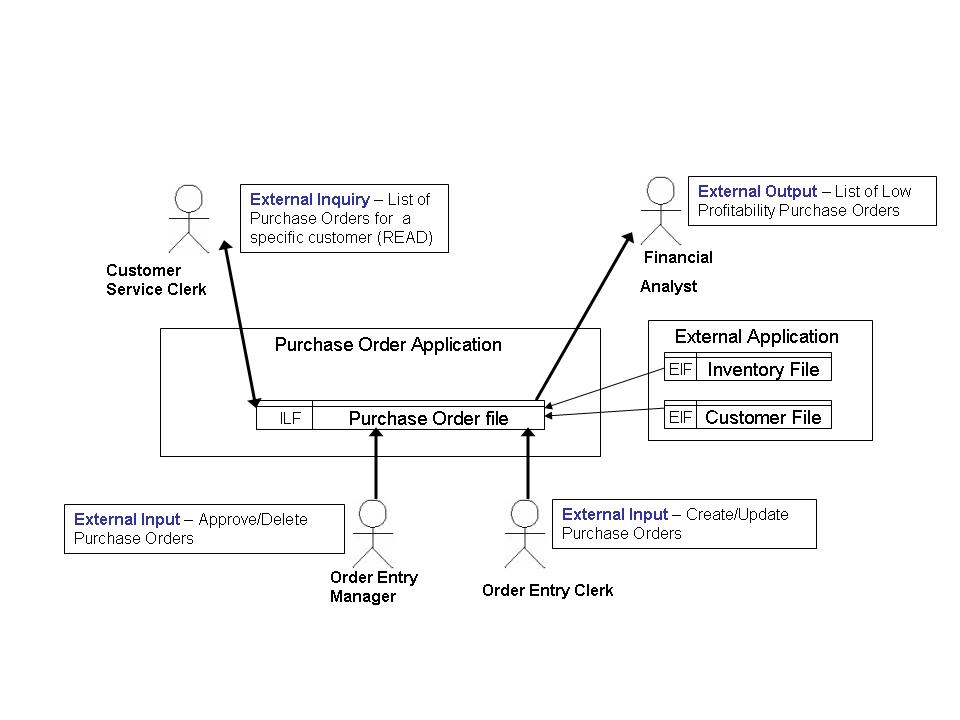
Having used it since 1990, I am a firm believer in the Function Point Analysis (FPA) method of effort estimation invented by IBM’s Allan Albrecht in 1979. While the relevance of FPA may not be entirely obvious, please bear with me, as I explain how I used FPA to develop the theory for this strategy. FPA is quite involved and providing a detailed explanation of it is outside the scope of this discussion. I explain as much is necessary to understand the overall strategy I alluded to in my previous post. Albrecht based FPA on an utterly brilliant revelation that all OLTP applications have a similar structure. You can think of this as a uber-pattern (long before design patterns were made popular by the Gang of Four in the software industry). Let me explain the pattern using the diagram below:

Its a simple Purchase Order application which has 4 functions:
1. create/update purchase orders executed by Order Entry Clerk,
2. approve/delete purchase orders executed by Order Entry Manager,
3. list purchase orders for a specific customer executed by Customer Service Clerk
4. list of low profitability purchase orders executed by Financial Analyst. It stores the information in an internal Purchase Order file and refers external files Inventory File and Customer File.
Per FPA, all OLTP applications have 5 parts to them:
1. External Inputs (EI) – which take information from outside the application and modify the data in the application. These inputs typically come via human operators but does not preclude feeds from other systems. For example, the Create/Update and Approve/Delete purchase orders functions in this sample app.
2. External Outputs (EO) – which applies some amount of complex processing to the information and sends it outside the application. For example, the list low profitability purchase orders in this sample app. You can see that calculating profitability would involve some complexity.
3. External Inquiries (EQ)- which spit out information from inside the application without much processing based on criteria input from the outside. For example, the list purchase orders for a specific customer in this sample app. Here the specific customer name or number is an input and the simple output is a list of purchase orders. I had referred to EQs as the READ part of OLTP applications in my previous post, which I guess created some confusion.
4. Internal Logical Files (ILF)- these are the storehouses of information for the application. For example, the Purchase Order File in this sample app. Additionally, External Inputs, Outputs and Inquiries process/maintain these files.
5. External Interface Files (EIF) – these are storehouses of information that are used by the application but are maintained outside the application. For example, the inventory file and customer file in this sample app. FPA is technology neutral and if you try to correlate this pattern with OLTP applications that you are familiar, you will see how closely this pattern applies.
In my 15 years experience with this tool, I can say that it is uncannily accurate.
Now, onto my main argument – If you look at the External Inquiries (EQ), you can see that these are simple queries on the underlying database which can easily be serviced by SQL. Every OLTP application develops these EQs because these are important to service the basic information needs of the users of the application.
In this sample app, the customer service clerk just wants to know which are the purchase orders that have been raised for a given customer. Now quite obviously, you tend to house these EQs in the same WIMP interface that services all the users of the system and they are forced to navigate the featuritis-plagued WIMP interface that has been designed for the more complex EIs and EOs.
Given that there are a ton of legacy apps, there are still several mainframe applications, whose green screen UIs you have to contend with, as a EQ user with a simple information need. Overall, in the Enterprise context, there is no easy way to get at simple information without having to understand the UIs of the various applications littered around within the Enterprise.
In this situation, if you had a Onebox interface using Search, you can easily imagine the simple purchase order hooked into it and the Customer Service clerk servicing the “list the purchase orders for a given customer” using the Onebox search. Back to Ganesh’s and Sadagopan’s points – I think a lot of fragmentation of taxonomy happens in the Enterprise because all OLTP apps have become silos or islands of information or fiefdoms because the users of these apps have to come to the app for extracting information.
Now if you adopt the Onebox Search metaphor as a unifying approach, i believe that the individual OLTP fiefdoms will be more motivated to adhere to a common taxonomy atleast for EQs. Let’s look at the same purchase order app, you enter “Purchase Order” followed by “Customer Name ” and hit enter and out pops the list of purchase orders.
Now time series is an important retrieval criterion that it ought to be built into all Search Results pages. For example, see how Google’s Blogsearch builds this in. Click on this link. I have added the resulting image below for your convenience. 
If you look at the frame on the left hand side (picture above), you see the whole time series, which can be used to subset the results based on time series easily. Additionally, you can include the key attributes of the Purchase Order or any other Business Entity and use it in an Advanced Search page. This will allow you to also unify the taxonomy and the UI for basic retrieval needs even if you have disparate Purchase Order systems.
The Advanced Search for Purchase Order could include the attributes Approved-by and Created by. That would allow Ganesh to hit the Advanced Search button, input John Doe in Approved-By and John Smith in Created-By fields and hit enter. I hope this explanation helps you see how this Onebox Search method would work inside the Enterprise for simple information needs.
Notes & References:
1. I call this strategy, Function Point View, after the FPA method. Especially, in legacy transformation, I have seen that this approach helps produce a robust transformation strategy for the application, by allowing you to treat the EIs, EOs, EQs using different technologies. The typical approach of rewriting the legacy application in, whatever is the most, modern technology just replicates the same problems that the legacy app had in the new technology world – classic case of old wine in new bottle.
2. I think building a Function Point View for every OLTP application you build is important and it will be in compliance with IEEE 1471 Recommended Practice for Architecture, which recommends the creation of different viewpoints for different stakeholders. Again, I have used this a lot and is very useful to address the concerns of different stakeholders. Function Point View could be an important Viewpoint to develop.
3. Sridhar Vembu points to an interesting SQLone app from Adventnet that hooks together the different databases using SQL. As I said before, EQs can be easily handled using this approach. Adventnet is not the only one in this space. Endeca is another one that has been building some momentum in this space and they call it “Guided Navigation“. IBM has had for a while now, what it calls Information Integrator that solves this problem.
4. Firefox has already implemented this onebox idea in the search plugin. You can add engines for Amazon, Wikpedia and others directly from Firefox and get the results without having to go to the site in question if your needs are simple. For instance, see how I find the “good to great” book in Amazon right from Firefox below: 
5. A brief introduction to FPA. this will give you an orientation to the topic. FPA is quite involved and adds a lot of value. Some people vehemently oppose FPA as well. Please be aware of that.
Technorati Tags: onebox google search, usability, user interface design
Beginning of the end of rank and yank?
Filed in Uncategorized, May 20, 2006, 12:27 pm by Sukumar TweetMicrosoft announced a lot of changes in their May 18th town hall meeting. Included amongst those changes is the elimination of stack ranking, otherwise known as rank-and-yank. Force fitting employee performance onto a bell curve, made famous by GE, Microsoft and other biggies, has so far been the favored performance review system. Now, with Microsoft dismantling this system, this system may soon lose steam. Also read mini-microsoft for more details. Lots of comments in there to add color to this tectonic event.
Technorati Tags: bell curve, rank and yank, stack ranking, employee performance

 Entries