How the Pocket PC beat the Palm – Lessons for Apple iPod
Filed in Uncategorized, June 4, 2006, 12:32 pm by Sukumar TweetUpdated: This post featured in Pocket PC thoughts. Thanks Ed Hansberry. This post also is being discussed on Mobility Today. Thanks JN Gold.
Updated Again (June 9): Palmaddict featured this post. Thanks Jennifer Chappell. ClieUK features this post. Thanks Shaun. He thinks I am biased.
Carnival of the Mobility #31 at Allaboutsymbian featured this post. Thanks Rafe Blandford
Update 3 (June 10): Palminfocenter discusses this post. Thanks Kris Keilhack. He calls it thought provoking. The other comments you must read.
——————————————-
This is a follow-on to my “Could Apple mess up again with the iPod” post from last week. As I said last week, the real challenge will come from Microsoft. I think MS will model its strategy after its successful Pocket PC campaign.
Pocket Pc Wins the War
Let us first look at Microsoft brilliantly outflanked Palm to the extent that Palm capitulated entirely and released a Treo with a Windows Mobile OS. Interestingly, as I pointed out last week, Palm did use the much-talked-about license-your-OS strategy advocated by Clayton Christensen. It licensed the OS to several partners (Sony, Garmin, Tapwave, Handspring, Handera…) and for some time it did seem like the Palm was winning the battle.
Microsoft, meanwhile, made quite a few attempts (remember the brick-sized clamshell Jornada with a full-keyboard, anyone?) and finally hit a home run with the Compaq iPaq which used a similar stylus-based UI pioneered by Palm. iPaq was introduced in 2000, a full four years after the Palm Pilot debuted in 1996.
In the interim, MS has also done another important thing which will help it in the year 2002, as we will see – it built the OS as a general purpose one capable of running on multiple types of processors including the more powerful Intel ARM-based XScale processors. From the beginning Palm OS was running on 33MHz Dragonball processors and it persisted with that architecture by saying that it was focusing on simplicity. Palm released the Palm OS 5 capable of running on more powerful processors only in June 2002. Interestingly, Palm actually boasted in Feb 1999 at the release of the chic Palm V with the following : “The sleek, modern Palm™ V handheld redefines the handheld industry with a new icon…a product that strategically had zero additional features from its predecessor. Message: style matters.” [emphasis added by me].
In my opinion, the real inflection point for Pocket PC came with 2 near simultaneous events – FedEx and UPS, both deciding to use PocketPC for their next generation handheld devices for their field force – a very key application for both companies. At that time, when I heard about this, it intrigued me that they did not chose Palm. But i was not armed with the hindsight that I have now. Remember, both these projects were worth $100MM or above. So this was a very big deal for PocketPC.
Palm had reached a milestone of 10,000 applications for its platform by May 2001. But one wonders how many of them are mission-critical ones of the type Fedex and UPS deployed. By now, i think my drift must be clear – Microsoft cleverly spotted a big gap in Palm’s strategy – the enterprise. It leveraged its strengths to mount a challenge from the enterprise side, while Palm kept much of its focus on the consumer side.
MS had solid tools for developers like VC++ Embedded and VB Embedded building on their familiarity with these tools, chose a more powerful hardware platform which allowed developers to build richer applications. Palm meanwhile could not let go of its simplicity mantra and failed to detect the fact that the basis of competition had been shifted to the enterprise, where Palm could not win easily (we will see why later).
Even today, Palm is still focused on making cool devices like Treo, but clearly the platform war has been lost. It has gone from the category-killer to an also-ran. It is sad to see an icon like Palm suffer. But at this point, what do we learn from Palm’s experience? You can’t deny that the parallels with the Apple iPod are eery – iPod is also focused on simplicity, user experience etc.
Crossing the Firewall
For the technology product to be enduring, it must become a platform and for it to be a immensely successful platform it must straddle both the enterprise and consumer side (as MS DOS or MS Windows has done). Unfortunately, when it comes to technology products, it doesn’t appear that you can focus exclusively on the consumer or enterprise, because as we have seen, you leave the other open for competition to come in. For a platform to be built, we must understand how technology diffusion occurs.
For that, let us turn to Geoffrey Moore’s groundbreaking Crossing the Chasm technology adoption model. Moore brilliantly adapted Everett Roger’s innovation diffusion model by adding the concept of a chasm as seen in the diagram below. He theorized that the chasm must be crossed by companies that plan to move their products from the Early Adopters to the Early Majority – a key constituency that has to be penetrated for your product to be successful. 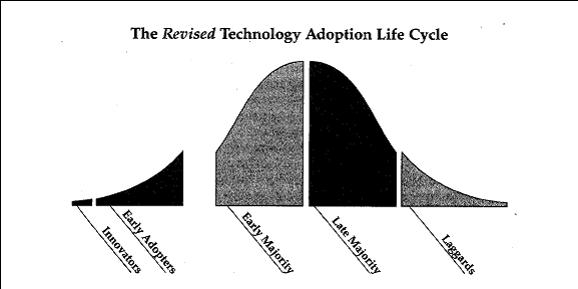
If the company is purely focused on the consumer market, the adoption proceeds further (perhaps without the chasm introduced by Moore) along the lines that Everett Rogers predicted. Additionally, the product reaches maturity and dies and gets replaced by newer products (contextual example will be Palm replacing the myriad electronic organizers like Casio BOSS that came before it). Let us look at Moore’s definition of the Early Majority:
The Early Majority are pragmatists… they care about the company they are buying from, the quality of the product they are buying, the infrastructure of supporting products and system interfaces, and the reliability of the service they are going to get…
Further Moore says (p42):
Fortune 2000 MIS Community, as a group, is largely pragmatist in orientation.
If you want an enduring technology platform, you need to be able to sell to this community because a platform not pervasive in the Fortune 2000 is not likely to be successful. My point is that, if you created a consumer product, such as the Palm or iPod, you use the consumers, in the innovators/early adopters space of Moore’s model above, as the testing ground to perfect your product and then tackle the Early Majority to enter the enterprise and be deployed within it. I decided to call this “Crossing the Firewall”, firewall symbolically standing for the boundary between the enterprise and the outer world. The techniques that Moore advocates for Crossing the Chasm are enlightening:
1. Target the point of attack – Target a specific market niche and focus all your resources on it.
2. Assemble an invasion force – by thinking through your customer’s problems and solutions in their entirety.
3. Define the battle – frame it in such a way you look differentiated from your competitor.
4. Launch the invasion – Use a direct sales force with a central consultative salesperson who works with the client in needs analysis and orchestrates an entire solution around your product for the client. Direct sales is the best channel for crossing the chasm.
The last point is telling. In the Palm Vs. PocketPC, it is Microsoft that has, having spent a long time selling to the Enterprise, a large direct sales force. Additionally, the sales force is complemented well by its consulting and ISV (Independent Software Vendor) partners, armed with Microsoft development tools and product knowledge.
Little wonder, Microsoft was able to capture FedEx and UPS to establish a major beachhead in the enterprise market. Since Palm was not paying that much attention to this market, it obviously did not (I think it will be true even today) have a enterprise-focused direct sales force, which is a crucial weapon in Crossing the Firewall.
How does the Apple iPod stack up
If you look at the Apple iPod, it clearly lacks the enterprise-focused consultative direct sales force to be able to help sell into the pragmatist Fortune 2000 MIS marketplace. What do pragmatists look for in new platforms (Via Gokubi):
Additionally, Gokubi says that the community around the platform should:
Suffice it to say, iPod has a long way to go in each of these except in the case of the Hardware platform, where it has hit a home run by creating an array of third party products. In contrast, Windows Media is well penetrated in the larger market, Windows Mobile is becoming more and more dominant in the Smartphone market.
Microsoft may make a play for the enterprise using Windows Mobile. As Podcasting gains further traction in the Enterprise market, CIOs may look to leverage their existing Smartphone deployments by adding Podcasting as an added feature. They may also use podcasting as a justification for additional Smartphone deployments. Its not likely that they are likely to invest in iPods for all their employees just to listen to podcasts.
In the Enterprise market, MP3 player is likely to be seen more as a compelling feature than a justification for an entire device. Even if the iPod were to be successfully sold to the Enterprise as a separate device, it would need the ability to manage the iPod as an enterprise asset complete with security, confidentiality protection etc. I rest my case. Notes &
References:
1. History has atleast one ominous example:
AOL IM, a popular IM application with a huge installed base amongst consumers, is an example of a popular consumer product that didn’t cross the firewall and ended up ceding the space to others. Instead Microsoft with its Live Communication Server and IBM with its Lotus Sametime are set to dominate that space.
2. History has atleast one exception:
Intuit’s Quicken is one consumer product that Microsoft tried very hard to beat but has not been able to succeed. Interestingly, Quicken being a consumer-only application, it did not need to cross the firewall. May be, that is the reason Microsoft has not able to beat Intuit’s Quicken. Its possible that Apple may have concluded that the iPod is only a consumer platform and that is sufficient to dominate the market.
3. An interesting interview with Donna Dubinsky (Sep 1998) where she claims victory over Microsoft but fails to utter the word Enterprise.
4. The Washington Post’s recent article on Windows Mobile Vs. Palm
5. Last week MS formed a coalition to fight the iPod.
Flashback:
1. We reviewed how Microsoft is attacking RIM Blackberry’s business model on 3 fronts.
2. We reviewed how Microsoft beat Lotus and Wordperfect with its Office strategy.
The Real Deal at Deal Architect
Filed in General Interest, June 2, 2006, 11:57 pm by Sukumar TweetUpdate: Desipundit linked to my guest column. Thanks Kaps.
Vinnie Mirchandani features guest bloggers from the industry in his Real Deal feature. Lots of insights here. This week, my article “Reverse Immigration Shock” has been featured. Thanks Vinnie.
DNA Fingerprinting enters the kitchen!
Filed in Uncategorized, , 11:48 pm by Sukumar TweetRead an interesting report recently in ET, about using DNA fingerprinting for certifying the Basmati Rice variety. ITC Hotels says in this report:
Seems like an ingenious application of DNA fingerprinting technology to solve a peculiar kitchen problem. ITC hotels buys over 200 tons of Basmati every year, so this technology is a godsend for them. Technology supplied by renowned Tilda Basmati.
Excellent interview with Amazon’s CTO
Filed in Management,Strategy & Business Models,Technology, , 12:18 am by Sukumar TweetACM Queue has published an excellent interview with Werner Vogels. Interviewer is Jim Gray. If you are in IT and work in SOA-type areas, this is a must read. (Via Sajith Sankar) Key takeaways (some of them are recurring themes in this type of software development)
1. Smaller teams who have a strong sense of ownership
2. Assembling features which consume backend services (loosely coupled)
3. Rapid prototyping and iterative development
4. Freedom for developers to use the tools they want but subject them to some overall standards (the notion of developers as artists is brilliant).
5. An interesting new feature on Amazon – Statistically Improbable Phrases. Need to check that out.
Technorati Tags: SOA, Software Engineering
Kudos, Mr President on Office of Profit Issue
Filed in General Interest, June 1, 2006, 1:34 am by Sibu TweetHon. President Mr. Kalam has made a wise move by sending back the bill ‘Office of Profit’. Even though, the President is believed to be a rubber stamp in India, Kalam is proving again that he is different.
Although the bill may eventually be passed, as that is what the constitution dictates – it is another ugly face of democracy where the politicians are making a law for themselves. Just look at the amount of time, effort, media attention spent on this issue so far – for nothing but a selfish motive of the MPs to remain in power as well as hold on to other positions. All this could have been used for some other rightful cause. Only if our leaders were so passionate about the country.
On politics, heard about some IIT-ians forming a political party in Chennai – please comment if anyone has an update on the same.

 Entries