The Soul of Success Part 2
Filed in General Interest,Strategy & Business Models, March 15, 2009, 6:49 pm by Sukumar TweetProlog
Please read the first part before reading this one. What can i say about the comments? Thank you all. Wow! We are blessed to have such a wise community collected here, right? [On a side note, the post brought Kannan Nagarajan, a SAST wingee other than self and Ganesh, to the blog after a long time] As i said, this question has been jostling in my head for a long time. However, in late Nov 2008, i decided to tweet the question . Within minutes both Priya Raju and Vivekananthan came out with a brilliant response. Ganesh came up with the same brilliant response in the last post – money/fame are just byproducts of success. Having either as goals will highly likely lead us astray. Although this answer nails an important aspect of goal setting, it didn’t quite nail it for me, which is why i wrote it as a blog post.
Wisdom of the Community
I decided to analyze the received wisdom from the previous post to show where we as a group stand.

Malcolm Gladwell’s Take on Success
I have tried to read on this subject quite a bit and as we have seen in this blog before, everyone talks about building expertise, being passionate etc. Malcolm Gladwell in his most recent book Outliers analyzes success in his trademark style – lots of anecdotes. The book is a good read but comes up short. If i were to summarize his book in one line – you need to spend a lot of focused effort and hope that you are born at the right time. He proves this with anecdote after anecdote. You can read this summary that captures the essence of Outliers quite well [If you all want to know why i disagree with Gladwell, please comment. i can do a separate post].
Black Swan
Although the book is not technically about success, Nassim Nicholas Taleb (NNT)’s brilliant book Black Swan gave me some crucial pointers. It is a hard to read book, but may well be worth your time. i have already read it twice, but can’t say i have completely grasped it. In that book, NNT outlines a major insight – the world of work is of 2 types – mediocristan and extremistan. Mediocristan professions are the routine ones like accounting, medicine etc. Extremistan professions are the non-routine ones like Arts, Media, Professional Sports etc. He gives lots of mathematical reasoning using Gaussian Curves, Mandelbrotian curves to prove his point. I tried to rephrase his thesis into this:
If what you do for a living has a recipe (a proven How To ), highly likely you are in a Mediocristan profession. On the other hand, if what you are doing does not have a recipe, you are highly likely in an Extremistan profession.
Goal or Journey ?
With that context, we are ready to tackle our core topic. To reemphasize, we can’t have money or fame as goals because they are byproducts of success.
Let me take my famous example of this blog’s goal. By the definition above, blogging is an extremistan profession because the recipe of how to become a top blog on the internet doesn’t exist. Yes, i am aware of the various How Tos and i have to tell you those don’t cut it, because i have tried following them.
In an extremistan profession, if you want to rise to the top, you do need an ambitious goal, and you have to firmly believe in that goal with as much attachment as possible. Given that the failure rate is very high, you have to have an appetite for high risk, to try extremistan professions. If you succeed, money and/or fame are highly likely to follow. To illustrate, to play for the Indian Cricket XI maybe a great goal, but recognize that several million players are in the fray and only 13 players make it. The recipe for making it to the Indian XI is not known. It is a high risk high reward scenario. You can’t succeed in cricket, if you are trying to make it a profession, by aspiring to play for the third division league!
In a mediocristan profession, by contrast, since the recipe is well known, lot of people are in it already. I would say most people that serve as an employee of a company are in the mediocristan professions [with some exceptions like startups or executive management]. In these professions, being passionate, focusing on the journey and doing your best may be the best way. Lots of money/fame may not follow, but a reasonable level of success can be achieved. Generic goals work best in the mediocristan profession. One should also not be too attached to the goal and perhaps recalibrate over time.
Where I disagree with NNT is that, all is not lost if you are in Mediocristan. If you are in a mediocristan profession, you can try to develop a new recipe to change the rules of the game. For instance, Dr. Christian Barnard developed a procedure to do heart transplants. He definitely achieved fame (and money i hope). Steve Jobs changed the rules of the game by introducing design-thinking led products in the Technology marketplace to win big.
Epilog
I am not completely convinced with what i have said above. What do you all think?
Slumdog Millionaire – Epilog
Filed in General Interest, February 26, 2009, 12:22 pm by Sibu TweetFinally got to watch the movie – This is by no means a film critique. Nor I am writing for/against the merit of the movie or whether it is award worthy.
While I am not surprised at the reaction from some Indian filmmakers, couldnt let it go that easily. Again, this is not about the comments on the quality of the movie in a literary sense. But my reaction to the comments like ‘intentional exploitation of India’ by Priyadarshan.
Fact is Danny Boyle has shown the murky underbelly quite visibly. But then, we should be appreciating the fact that someone did it. Yes, the story itself may not be great; it feels like an old Hindi movie at times; but somewhere there is an element of reality which we’ve rarely seen in any Hindi movies.
Back to Priyan’s comment, he is equally free to make a movie that shows UK/US and its underbelly. No, Priyan is comfortable sitting back and remaking malayalam movies into Hindi with very minimal changes. Arent you exploiting the talented Mally writers & directors? So, I just dont think the comment about exploitation of India is appropriate.
(BTW, I do thoroughly enjoy & appreciate Priyan’s own original mallu movies..)
For once, cant we just appreciate something? Let us welcome the focus on India. Yes, I very much want it to be good PR and about the bright side, but then there is always two sides to the coin and lets not fool ourselves by covering it up or acting to be ignorant.
Secondly & More importantly, the slum scenes in the movie reminded me of my own experience when I had the chance to see dharavi closely. If the situation is the same today, whatever portrayed in the movie is very true. (Ever since those days, every time I land at the mumbai airport, my heart sinks for a moment. But it is quickly morphed into anger/hatred at the very sight of greedy police & security folks at the gates. )
Made me wonder about the level of charity in our country. In general, there seems to be very little Charity activity in India especially compared to US. And I am talking about relative comparison, not absolute comparison. The perception one builds if you’ve lived in both places is that there is a focused effort and recognition for Charitable causes and spending in US. Here is the list of most charitable countries as a % of GDP, India is no where in the list where as even South Africa has found a spot.
Why is there such low level of Charity activity in India? Of course, it can be just perception and a lot is ‘undocumented’ in India where as it is probably deliberately advertised in US. There was even a comparison somewhere on the charitable cotributions b/w the presidential candidates based on their public tax returns. I can only dream of a day when I can see this in India (both the transparency and the charity)
BigB, even you wrote about the murky underbelly. What have you/the bollywood industry done in all these years for the slum dwellers? Why isnt there a focused activity or campaign or organization after all these years to do something so that the infamous slum in mumbai is done with? Take US and even for the slightest cause, there seems to be a non-profit organization with necessary campaigns, events, activities and a celebrity to support the same.
Maybe I am wrong and there is a very healthy charitable contribution made by India’s rich.If anything, SD movie should make us think & act on these lines. Let us appreciate Danny Boyle & crew atleast for that.
Jai Ho!
The Soul of Success
Filed in General Interest,Strategy & Business Models, February 22, 2009, 4:27 pm by Sukumar TweetUpdated 18 March 2009: Please visit part 2 of this post for more info.
—-
We have had several discussions on this blog about Expertise, Passion , Talent , S Curve etc – what i would call Meta-Lifehacks. Although, these topics give us some ideas on what it takes to succeed, there is one aspect of success that has had me tortured for years (italicized for effect):
How we think about our goals seem to make a big difference to whether we succeed or not.
For example, when i started this blog i set out with the ambitious goal of becoming one of the top blogs on the Internet. Today, it sounds ridiculous to me that i thought about our blog in that way. God knows what i was smoking 🙂 Highly likely this blog will never achieve that goal. And hence i did not succeed. However, this blog has helped me in many ways beyond my wildest imagination. It has taught me things that i would not have learnt in a million years and has had a significant impact on my career. Still, per my goal i didn’t succeed.
How many times have we seen people that set out to make a lot of money but end up with a lot less money than they hoped?
In the same way, i am sure we can all point to people that we know who wanted to become famous, but never achieved their goal.
Does this mean that we should not have ambitious goals? For example, had i decided i want to be just another blog on the Internet, i would clearly have succeeded magnificently.
Our ancient wisdom doesn’t seem to help either. If I turn to the famous shloka from the Bhagavad Gita (One of Ancient India’s most cited religious scripture):

Same shloka transliterated for those that can’t read Sanskrit:

Translated into English:

In other words, your actions cannot be dependent upon expected results. If the results don’t motivate us, what does?
Does that mean that we should not have goals? How can we do something without any goals?
I am happy to say I have found some answers to these questions and I will cover it in part 2 of this post.
Meanwhile, i want to know what you all think?
Deadly Justice – Part 4
Filed in General Interest, February 18, 2009, 7:00 am by Priya Raju TweetMy previous post outlined some of the harsh realities of the Death Penalty. That was more than 2 weeks back. So, let’s plunge neck-deep into this post right away. There’s nothing like starting a post with a bitter, divisive issue. Does Death Penalty deter Murder?
The idea of gauging a punishment on its merit as a deterrent – is rooted in the Utilitarian Justice system. Here’s the essence: The threat of the Death Penalty looming large, along with a few highly publicized executions (Example Killings) should reduce the number of gruesome murders. As a supporter of the Retributive Justice system, I do not buy this – but let’s pursue the Utilitarian line of thinking further.
Many people – law-makers among them – believe that the Death Penalty is effete. By Utilitarian norms, it has outlived its usefulness & hence, should be disbanded. What is this belief rooted on? Has Operant Conditioning failed, where Capital Punishment is concerned?
Compare these Homicide Rates per 100,000 Citizens: (Source: FBI, Uniform Crime Reports. Year – 2007)

It may seem that Capital Punishment has failed to curb murder – The fallacy of statistics with a small sample. Shall we increase the sample size?

What about Michigan? It outlawed the Death Penalty 150 years back. Its Homicide Rate is well above Texas, Florida & the US Average. Not to mention Washington DC. Its Homicide Rate knocked the wind off my sails!
Let’s view this globally. Abolitionists use Sweden as an example. What about a few counter-examples?
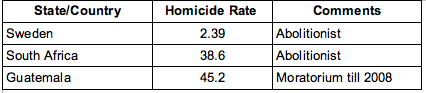
South Africa has one of the worst crime rates in the world. And BTW, it abolished the Death Penalty in 1997. Its citizens are wondering if Capital Punishment should be reinstated. Guatemala had a Moratorium on Death Penalty since 2000. Its Homicide Rate has been steadily on the rise. In 2008, Guatemala announced its intention to resume executions.
All I’m saying is, some countries & states are peace-loving – like Sweden & North Dakota – and crime rates are traditionally low. Homicide Rate is dependent on several parameters – Death Penalty is only one of them. Unemployment, Narcotics, Gun Control, Policing – are a few of the several other variables involved. Tying Homicide Rates solely to the Death Penalty is unscientific & shows a poor grasp of Statistics & Curve Fitting.
Implications of the 8th Amendment
In most discussions on the Death Penalty, the 8th amendment of the US Constitution is cited. What then is the 8th amendment? The US Constitution has a list of amendments included in its “Bill of Rights”. The 8th amendment expressly prohibits Excessive Bonds, Imposing Excessive Fines & Inflicting Cruel & Unusual Punishment. Abolitionists state that the Death Penalty is cruel & unusual & it should be rejected under the statutes of the 8th amendment.
As an Engineer, I personally find most legal clauses loose, subjective & ambiguous, for our Specifications are precise, clear & avoid the use of adjectives. What punishment could be termed “Cruel & Unusual”? For that, we should understand the penal systems of 1791, when the 8th amendment was ratified in the US. Or 1689, when United Kingdom enacted similar provisions to its Bill of Rights:
People were burnt alive, Disemboweled, Torn into 4 pieces by horses, Drowned by Dunking or Had their hands cut-off.
Such punishments seem horrid & repulsive now, but they were common 200 – 300 years back. The intent of the 8th amendment was to prevent such barbaric punishments from being meted out.
Of late, I’ve realized that the fluidity of the law shows the foresight of our founding fathers. For the laws to stand the test of time, it should be open to interpretation. To quote US Supreme Court Justice Sandra Day O’Connor:
The 8th amendment prohibits punishments that were prohibited historically as well as those that run counter to evolving standards of decency that mark the progress of a maturing society.
Most of us abjure harsh punishments. But, a lot depends on our definition of “Harsh”. Nigeria is harsh. If a woman commits adultery, she is stoned. Singapore is harsh. Vandalism is punishable by caning. The common modes of Capital Punishment around the world – Lethal Injection, Electric Chair, Hanging, Firing Squad, Gas Chamber – are they harsh?
It is important to distinguish between a Punishment & its Mode. We may find Gas Chambers reminiscent of Nazi Germany & hence reprehensible. But that’s an indictment of the mode, not the punishment of death itself. The mode of capital punishment has changed over the years. Latin “Caput” from which the word “Capital” is derived, means “Head”. In centuries past, capital punishments meant cutting off the offender’s head – a practice that is found abhorrent today, a mode we would denounce as repugnant & harsh.
How Evolved is our Decency?
Extrapolating Justice O’Connor, the penal system of a land should balance not only its “Evolving Standards of Decency”, but those of humanity. Several exceptions have already been made to accommodate our sense of decency. To cite an example, the International Covenant on Civil and Political Rights (ICCPR) prohibits the execution of pregnant women. To unilaterally abolish the Death Penalty, enough people around the world, or at least in the specific country that’s mulling over the matter, should find the very act of the State killing a murderer, however gentle the means may be, grossly indecent. Overpowering public opinion, not the moral indignation of a few.
I do not think, at the time in which this post is written, that there’s an overwhelming opposition to the Death Penalty in the world. As of 2008, out of the world’s 207+ countries, 94 had abolished the death penalty & 35 others had issued temporary bans. The gentler neighbor of the US & the 2nd largest country in the world – Canada, has abolished the Death Penalty. The Charter of Fundamental Rights of the European Union forbids Capital Punishment.
Yet, I do not think the above statistics contradict my view. Consider this: The 4 most populous countries of the World – China, India, US & Indonesia – routinely kill murderers. Just these 4 make up about 50% of the world’s population. The populations of Luxembourg or Sweden, that have abolished the Death Penalty, are mere round-off errors in comparison. A Worldwide Gallup poll in 2000 concluded that 52% of the people favored the Death Penalty. Gallup further found in 2008 that 64% of the Americans supported the Death Penalty. None of that sounds like a resounding endorsement for the abolitionists, to me.
Incredibly, while the European Union has outlawed the Death Penalty, public support for reinstating it has been increasing steadily in United Kingdom. UK abolished Capital Punishment in 1973, but large swathes of her Citizens are clamoring for its reinstatement now. And UK is just the tip of the iceberg.
Summing Up
And what of the hand-wringing, that harsh punishments make us coarse? “Make us Coarse”? We are born coarse! Civilization is the tussle between the Ruthless Reptile, the Nurturing Mammal & the Thinking Human in all of us. One can’t force humanity to take the high road. As a die-hard fan of Star Trek, I can’t resist quoting from it. In “First Contact”, Captain Picard says:
The economics of the future is somewhat different. You see, money doesn’t exist in the 24th century. The acquisition of wealth is no longer the driving force in our lives. We work to better ourselves and the rest of Humanity.
A wonderful goal to aspire for. In a similar fashion, one day, some day, in the distant future, we can aspire to rise above needing Capital Punishment. Only, we have miles to go. I rest my case.
The ‘Love’ Triangle in Human Society : Evolution, Biology & Psychology
Filed in General Interest, February 14, 2009, 7:00 am by sultana TweetWhere, is this ‘Love’ business on the ladder of Evolution? – The Biology
As most physiological processes are driven, emotions begin in the command center of our physiologies : The Brain. Or at least, that portion of which biologists call the ‘Limbic System’ and the ‘Neocortex’.
I strongly feel that our Original Ancestor truly was that last reptile which morphed into the first mammal, walking on ‘terra firma’ with the first mammalian limbs. From this reptile we inherited the reptilian brain formed over the millennia and from the mammal came the rat-like true mammal which is our predecessor on the long ladder of Biological Evolution : which was different from the reptilian stream of the animal kingdom in that it had ‘evolved’ another layer to its brain : The Neocortex – the seat of ‘higher learning’ so far known to our species.
Given this, isn’t it uniquely strange that it is the heart that is flaunted on Valentine’s day and not the brain? Strange creatures, we the Homo sapiens!
When began this ‘Love’ business ? – The Psychology
It was a milestone when the first paleo brain was developed well-enough – to make the first turtle burying its eggs under sand to hide them from predators, the first mother-bird hunting for food for its chicks and the first mother-mouse that fed it’s young one on its milk. In short parental care, arising out of a ‘nurturing’ tendency – making a new beginning in an era where the dominant custom was starkly ‘reptilian’ : an era where the extreme went up to prenatal cannibalization. As in sharks, for example – one of the young ate up its siblings before they were born. Or the mother snake swallowed up many of her young as soon as they hatched. And in the honey bee colonies where the queen killed her young sisters to become the sole ruler.
Evolution and genes, of course go hand in hand. How far we have come, where from we came is clearly mapped in our genes. Till date the theory that the entire human race was descended from one woman – nicknamed Mitochondrial Eve , from Africa and one man called Y-chromosomal Adam holds good! And so the next question comes up…..
Is Love in our DNA?
As much as ‘rage’ is in our DNA, emanating from that part of our brains called the ‘reptilian brain’, (lower part of the brain), so is Love part of our genetic make-up.
Ma Evolution skillfully designed complex behavioral patterns which ensured that!
A healthy male peacock with a diffuse colorful tail is ‘loved’, albeit through sheer physical attraction mode, by peahens. A lion with the blackest and thickest mane is in ‘demand’…. Godmother Nature has been an excellent matchmaker through the millennia in which higher life forms evolved!
Evolutionary psychologists are of the strong viewpoint that many behavioral traits, are influenced by the genes that our ancestors passed on to us – which were shaped as we see them today – as a result of millions of years of natural selection placing the emphasis on their ‘survival value’. However, we the human race have mastered the ability not to let only the genes rule us : We let the ‘rational’ brain / Moral training take over and therefore make conscious choices when it comes to ‘equal adults’ , ‘mate preferences / partners’, and the young ones we bear.
Where to from here on? Will we love Robots or vice-versa? – The Evolution
Intra-species love has been by far rated the best of survival value by the rule of natural selection. Hence a human being loves another human being when it comes to pair-bonding. Surely its only Puck Goodfellow’s magic juice squeezed on your eyelids that can cause you to fall in love with a donkey.
However, the love that a human organism has towards his fellow animal counterparts, be they in the domestic context of cattle, household pets, concern for wild animal species etc though has overtones of symbiosis, is different from that towards our own kind.
Thus, so far summed up is the biology and psychology of Love as per today’s Human Society. But the future of Humanity might not be entirely ‘Human’. It might to a certain degree or large extent be ‘Post Human’, or even become Cyborgs? If we were to have household, para-human robots……..how would that shape the interaction between them and us ? Would that trigger the formation of another ‘society’?. Would this be a triangle of para-human, human and post-human love?
The fourth Dimension – Spirituality?
As much as I believe in Darwin, I’m a staunch believer of Spiritual Evolution. My musings on Love would be incomplete without this dimension. Though I’m not clear as to where an Animal ‘spirit’ stands and where a human stands on the ladder of Spiritual Evolution, I certainly can grade this within our own species tilting the scales across the spectrum of Altruism, right down to extreme mercenary behaviors.
What would be the ‘Love’ pattern of such personalities and would there be a dichotomy of natures within that future organism…….? For, though we are descended from very ‘biological’ principles, we have ‘evolved’ differently from the rest of the animal kingdom – the proof being culture and language and software. And war and holocausts, not to forget! We also have our saints, sufis and priests whose perception of ‘evolution’ is very different from the scientist’s.
What would be the next level of ‘Neocortex’ that we would develop? Would be it be bio-physical , or would it be psycho-genetic? When integrated, what would the Love-form that humanity would adopt? Or as many Enlightened Ones say, lose those shackling emotions once and for all and stand as a Supreme Ocean of consciousness where Emotions are just the small waves lapping on the shore, unmatched with the intriguing depth and Majesty that is the Ocean itself?

 Entries