Our Iceberg Is Melting: Changing and Succeeding Under Any Conditions
Filed in Management,Reviews, December 26, 2007, 1:00 pm by Ganesh Vaideeswaran TweetIf you liked “Who moved my cheese”, you would probably enjoy “Our Iceberg Is Melting” as well. The author’s explain how change can be effected in an organization via the story of a group of penguins that is forced to relocate because their current iceberg of residence is melting. The story is about how a group of “leader” penguins determine if relocation is needed, and once the answer is determined to be a YES, form a team to come up with the plan to effect the change – which includes selling the need for the change (relocation) to larger penguin population, forming sub-teams to figure out the new location and associated logistics, motivating the teams on a constant basis to not lose focus and then aiding in the relocation. Once this is done the first time, the need to keep moving and find stable iceberg on a constant basis is enforced into the population, implying that the only thing that is constant is change itself.I did not feel that there was anything particularly eye-opening/new insights with respect to “Change Management” itself. It involves the typical –
- Leaders need to determine if the particular change is actually needed. Collect and analyze appropriate data before buying into it
- Once you think it is needed, form an appropriate team that can look at the facts and come up with a plan to effect the change
- Lead (and do not necessarily coerce) the team to come up with the plan. Prod the teams at appropriate times to keep them focused at the task at hand. (This can be delegated as needed).
- Next is the important task of selling the change to general population or team(s) affected. Change is always tough to digest and the purpose needs to be explained in a manner that appeals and makes sense to the population. If necessary dispose “change agents” to specific populations to communicate the change on a constant basis in a consistent manner.
- Once there is buy-in from the general population, then the change needs to be effected by appropriate teams. All the while, the need for the change and the pain associated with it may have to be explained/re-enforced multiple times.
- Of course, you would have to constantly evaluate how the plan is going and make adjustments as needed (not mentioned in the book)
- Finally, prepare the population for future change(s)
Of course, there will be variations to the above process depending on the organization.
There were 2 important lessons related to “Change Management” that was re-enforced for me from this book. It is a very tentative/shy and inquisitive but not a leader penguin that determines something is wrong in the environment they are living and that iceberg in fact could be melting. The shy penguin brings this information up to one of the leader penguins that is known to be receptive to new information and does not pooh-pooh them. Here is what I got out of it –
- One (and leaders in particular) has to have their eyes and ears open to suggestions from anyone in the organization.
- If you feel that change is needed and is not in a position to affect it directly, understand the organization hierarchy, culture and personalities and use it as necessary to percolate information/data up the management chain. Always go with data that can be digested in an easy manner by the leaders which is easier said that done.
Ganesh
Egypt & Shopping – Straight, No Chaser
Filed in General Interest, , 11:52 am by Priya Raju TweetHere is my sequel on “Shopping in Egypt”. I’ll scrawl my account on “Women in Egypt” later – The current post will get too long otherwise. And you know how I hate to gas away for more than 2 pages. At any rate, you know now.
Let me begin at the very beginning, always a good place to begin. I own 4 watches that don’t work & 2 cheap watches that do. If you search my locker, you will find 2 more watches that don’t work. The watch that my brother gifted me from his first salary (a “Titan”). An old watch of indeterminate make & a fluorescent pink strap that will make your eyes water – a hand-me-down from my mother. I’m married to a man who thinks that – if you buy watches cheaper than a “Citizen” or a “Seiko”, you must be below the poverty line. He firmly believes that if something doesn’t work, it must be in the garbage bin, not the locker.
As you can see, I think spending too much money in shopping sprees ranks right next to “Original Sin”. My husband is a serial sinner. I took this man shopping in Egypt. I’ve been trying to lose a few pounds around my hips – I haven’t lost any, but my purse lost lots in that trip.
Before we started for Egypt, we were told that bargaining was a way of life there. I inwardly cringed – I hate bargaining. It simply drains me. My tendency is to chicken out & look for “Fixed Price” shops everywhere. I specifically don’t bargain with poor people: A few pounds more or less makes no difference to me. We needn’t have worried so much. True, most of the products don’t have a Price Label in Egypt. Still, contrary to what we were told, we didn’t face any problems while buying essentials like Food, Mineral Water, Toiletries or Medicines in Egypt. As long as we avoided the road-side vendors, we found the prices very reasonable.
You will most likely be cheated on the price & quality of curios – that’s part & parcel of being a tourist, so take that with a shrug & a smile. What got my goat was this – there’s no price listed even on the books! For crying out loud! It felt weird, negotiating the price of “The Life & Times of Rameses II – 3rd Edition”. After a couple of days, we were negotiating like native Arabs – with gusto & know-how (I hope). The shop-keepers are friendly & they really love bargaining. Its a battle of wits! Some of the shop-keepers thanked us for being friendly & went out of their way to help us, give us discounts or show us their best wares. A little politeness went a long way in Egypt.
Egypt will be a disappointment for the inveterate & discerning shopper. There are plenty of tourist traps that sell you cheap, tacky stuff. But, there are very few good buys – “steals” – to be had. The path to historical sites is paved with shops selling knick-knacks. And the tourists have to walk the gauntlet, braving touts who woo them with ardor. All these shops from Cairo to Alexandria to Luxor to Aswan sell the same kind of stuff, uniting Upper & Lower Egypt in a way Narmer never imagined. Scarabs, Imitation Beads, Key Chains, Glass Pyramids, Heads/Statues of Gods, Ash Trays, Vases, Boxes. Even Khan El Khalili was a major letdown. I had these fantastic visions of the Khan as a thriving Souq: And verily it pulsates with – tourists and apocrypha.
While making our way to the “El Fishawy” Coffee House in the Khan, we found a nice looking figure of Bastet, the Cat Goddess. The shop keeper sauntered to me & said with a knowing wink, “Lady, its made of Aponis”. Dim realization dawned on us that he meant “Ebony”. Ebony, my ass. It was made of plywood coated with plastic & painted black. Anyhoo, we bought the “Aponis” Bastet.
Serious shoppers can buy Alabaster, Papyrus, Essential Oils, Carved Wood, Carpets, Spices, Glass, Silver-ware & Brass-ware. All these are of exceptional quality & hence cost a neat packet of money – so be prepared to spend your $$$. We decided not to buy anything bulky, so we had to give carpets a pass. And please – my eyes are about to go blind from the tasteless overuse of Wood, Silver & Brass in India. If I had a choice of either that or a cup of Hemlock – Thank you, I’ll take the Hemlock with 2 cubes of sugar. That left Alabaster, Papyrus & Essential Oils. Alabaster is either machine-cut or hand-made. MC Alabaster looks depressingly & suspiciously glossy, as if it had ODed on cheap varnish. Hand-made Alabaster looks nice, provided you know how to look for damages.
So we settled for Papyrus & Essential Oils. And plenty of kitschy stuff that we hated at first, second & third sights. We didn’t want to hurt the feelings of the Egyptian shop keepers. “You don’t like ANYTHING in my shop??” “Ooh, no no – We love your shop. We’ll take the fluorescent green cup with “CLEOPATRA” emblazoned in Red!” Travel is fraught with such dangers.
A parting shot: I wish the tour guides would stick to guiding & refrain from touting. Some of our guides were more interested in taking us to a “very nice shop that sells Egyptian Cotton” than in explaining Nefertari’s legacy to us. The more enterprising ones wanted to sell us “a nice CD with photos because we were historical people” – hope the guide was alluding to our interest in history, not our age. It becomes very uncomfortable when your guide can’t put a lid on his/her sales pitches & you want to be left alone with the priceless legacy of Pharaonic Egypt.
Next Up – Will be a piece of fiction from me. Hang in there.
The Beauty Premium?
Filed in General Interest,Management, December 23, 2007, 12:00 pm by Sukumar TweetUpdated Dec 26, 2007: Ganesh brilliantly connects this with Gladwell’s Warren Harding Error in his book Blink.
Today we got the latest issue of Economist dubbed as the special christmas double issue. The article with the biblical sounding “To those that have, shall be given” caught my attention.
The first para hooked me completely:
IMAGINE you have two candidates for a job. They are both of the same sex—and that sex is the one your own proclivities incline you to find attractive. Their CVs are equally good, and they both give good interview. You cannot help noticing, though, that one is pug-ugly and the other is handsome. Are you swayed by their appearance?
The article covers research on whether being beautiful/handsome is correlated with financial success relative to the not-so-beautiful/handsome category. The article presents several pieces of research with the focus mainly on Dr. Hamermesh’s research. He has proved with several studies that beautiful people are economically successful and even goes on to calculate what he calls a beauty premium – the premium beautiful/handsome people can expect to gain and also a penalty if one is ugly. He conducted his research in USA, Canada, UK and China. Before you jump into any conclusions, the researchers looked primarily at professions in which beauty wouldn’t be a requirement. I have plotted the data from the article into a table below for better readability:
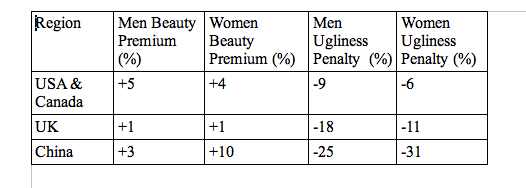
Essentially, if you are a beautiful woman in China you can expect a whopping 10% premium! I guess it really pays to be beautiful and at the sametime, ugliness in women can set one back by a even bigger 31% in China.
The article also touches upon previous research that shows that across the animal kingdom (including humans) beauty is essentially a function of how symmetrical your body is which in turn indicates how good a set of genes you have, the health you have and take this – your intelligence level as well.
Do you agree with this research? Think about it and click the continue-reading link below if you want to know what my conclusions are?
A Thousand Splendid Suns
Filed in Reviews, December 19, 2007, 1:40 am by Ganesh Vaideeswaran TweetJust finished reading Khaled Hosseini ‘s second novel “A Thousand Splendid Suns”. While reading the book, I could not help but compare this novel with the author’s first novel “The Kite Runner” – which I thought was glorious. I understand that the comparison may not be fair, but it is inevitable.
Writing (or some would say prose) in this one, just like the author’s first novel is first rate. There is *much* more sadness in this novel and very few light-hearted/humorous moments though. There are some really heart warming and gut wrenching moments throughout the novel.
The story is about these 2 women in Afghanistan – Mariam and Laila and how their lives become intertwined inextricably. The story tracks their life through the modern history of Afghanistan – starting with the fall of Zahir Shah to the times when Afghanistan is freed from the reigns of Taliban. It vividly captures the indignity, both physical and mental, that women had to endure during vicious times in Afghanistan.
There are not too many twists in this novel and it is very linearly written in terms of chronology. It takes half the novel before the 2 heroines get to interact and from then on it is one incident after another where they have to endure various degrees of pain – both mental and physical. Towards the end, the kindness that Mariam extends towards Laila is enormous.
I think it is primarily a story of survival – what the human soul is willing to endure during inhumane times – how the mind starts to give in and tolerate vicious treatment , perhaps temporarily just to pull through, but always with the hope that things will get better – if not for themselves at least for their children. As much as the two women’s dignity and self-esteem is forcibly snatched, they seem to accept what fate has dealt to them, perhaps just to survive another day. But their core beliefs and humaneness still remains intact.
Compared to KiteRunner, I felt that the tightness in terms of plot was missing in this novel. I wished there was an alternate way that Mariam’s choice towards the end could have been handled or maybe it was just my wishful thinking.
Just as in KiteRunner, the ending was extremely poignant especially Laila’s visit to Mariam’s childhood home. Laila coming back to Afghanistan to start an orphanage and give back to her country, even though her country had not given her much except perhaps some positive childhood memories was a fitting end to the novel.
Through Laila’s father and Tariq – Laila’s lover, the author has managed to not paint a broad stroke that all men were evil during the vicious times in Afghanistan. Thus as much as the novel is about the two women and their survival spirit and the tribulations they undergo primarily at the hands of men, through these two men (Laila’s father and Tariq), the author has shown that one can maintain his/her sense of decency even if one is afforded the luxury to not exercise it.
Ganesh
One billion customers
Filed in Books,Reviews, December 18, 2007, 2:49 pm by Sukumar TweetIt is James McGregor’s absorbing account of his tenure in China as Dow Jones’s China boss. I am fascinated by China and its rapid rise and I have been wanting to read this book for a while now. The book is littered with insights about China and its culture. I picked out some of insights that intrigued me the most in the first chapter:
1. [P10-11] While the West in built on a guilt-based foundation where eternal damnation or sinning curbs bad behavior, China is built on a Shame-based foundation. It is the fear of exposure and resultant shame that is a problem. So Chinese can do anything as long as they don’t get caught. China has adopted the civil law philosophy of Japan and Germany, unlike India which has adopted the common law philosophy of the UK and USA.
2. [P15] McGregor talks of how Hong Kong has been surpassed by mainland China and quotes a chinese proverb “Fu Bu Guo San Dai” meaning “Wealth can’t last more than 3 generations”.
At the end of every chapter McGregor gives a neat summary of the insights in what he calls the Little Red Book of Business that serves an excellent summary of that chapter.
McGregor goes onto give a brief but well written synopsis on China’s history to explain why Chinese are extraordinarily suspicious of foreigners.
Morgan Stanley’s Debacle: The next chapter [Chapter 2] discusses the audacious marriage of Morgan Stanley and the Chinese government controlled China Construction Bank to create China’s first investment bank which ultimately unravels after years of struggles between the 2 partners thanks to the clash between western and chinese styles. The chapter is summed up nicely with a chinese proverb “Tong Chuang Yi Meng” meaning “Two people sleeping in the same bed having different dreams”. But interestingly, Morgan Stanley though badly bruised and battered by the joint venture, laughed all the way to the bank with a 50% share of Chinese IPOs.
Corruption is Endemic: Chapter 3 chronicles the spectacular rise and the equally spectacular fall of a peasant turned wheeler dealer. Indians will find eery similarities with the descriptions of endemic corruption involving the police, military, smuggling nexus with graft from the businessmen to get preferential treatment. McGregor also gives some recipes for succeeding in China without selling your soul – emulate GE by training Chinese executives at their famed crotonville center. Or create opportunities for Chinese to work in your company for temporary periods to learn. It all seems to boil down to Know How. This is the biggest thing the Chinese are looking for. If you can give that to them you can succeed without having to be corrupt.
Click the continue-reading link below for more insights from the book.

 Entries