The Real History of India - Part 4: A new IVC Symbology for better decipherment
Updated Feb 16, 2008: Priya Raju suggested 2 more dimensions - food and attire to the framework. I have added them below.
Prolog:
I pointed to a seal in my previous post with a link to Parpola’s interpretation. He interpreted the lower part brilliantly as the Seven Sisters (Sapta Kannika) which is the “Pleaides”. And I think he is also correct in that the Vernal Equinox - when the Sun enters Pleiaides - is the New Year. He also correctly references the myth where Lord Muruga (Karthik in Bengal) was born and was tended to by the Karthikai (”Krithika” in Bengal) Penngal [Krithika Women a.k.a Pleaides].
But what about the tree, the god within the tree, the human worshipping the tree, the goat etc? A.L. Basham in his “The Wonder that was India” talks about women worshipping the peepul tree for fertility. I recalled my grandmom talking about this. Therefore, the tree is the Peepul (Arasa Maram) - look how closely the leaf’s characteristics on the seal resemble the real one in the wikipedia. The horned figure is the Mother Goddess that we worship till date in Tamilnadu for fertility. The belief is the worshipper will beget a handsome baby boy like Lord Muruga. Infertile women are asked to go around the Peepul tree on certain auspicious days and make votive cradle offerings tied to the tree to become pregnant. I believe that the small object besides the kneeling woman is the votive cradle offering [Citation Needed]. I asked for the Tamil Farmer’s Almanac (”Paambu” Panchank) from my father and figured out the exact auspicious days on which this ritual is done.
Why the Goat? A possible explanation is this: every star has a symbolic deity and an animal. For Krithika, it is the goat. Another point to note is - in Celtic religion, sometimes infertile animals are part of the ritual. Interestingly, the animals depicted in the IVC seals are real animals with their distinctive species markings. For instance, this goat is the Pashmina/Cashmere Goat (one that gives the Cashmere wool). This is how a modern day cashmere goat looks (look at the characteristic wavy antler and look at the seal again). This just shows the powers of observation of these people.
The humans in this seal are all women because they have a feminine triple horn (to be covered later) and they all wear bangles - these bangles were made of shell. To this day, in Bengal women wear Sankha Pola - shell bangles during weddings and auspicious days. You can also see the plaited hair which is another feature in the woman’s attire till date in Tamilnadu. BTW, Shell bangles were a key manufactured item of the IVC people.
Please note that I am yet to attempt to decipher the script: my focus has been only on the pictures on the seals because I felt that we must first understand the symbology.
Existing Models for IVC Decipherment:
Currently there are 3 models per my own classification:
[source Harappa.com]
1. Parpola Model - Sir John Marshall, who discovered Harappa had hypothesized, that the language of the IVC was Proto-Dravidian. The Indus symbol above is known as the Fish. Father Heras proposed that it means “Meen” in Tamil which means “Star” since the phrase “Vinn Meen” (literally, Sky Fish) denotes “Star” even today. Asko Parpola is the first historian to accumulate a significant corpus of decipherment of the Indus script - and he agrees that “Meen” = Star. He has systematically proved that claim with a lot of data. Before you jump into any conclusions about his intent, Parpola is a Sanskrit Scholar and has done a lot of work on the Vedas and Upanishads.
2. Vedic Model - This model attempts to fit the Vedic Symbology onto IVC and tries to prove that Sanskrit was the language spoken in the IVC. Quite obviously, the historians who propound this view - including some western historians such as David Frawley - are the darlings of the Hindutva-vadis.
3. Mahadevan Model - Iravatham Mahadevan is one of the greatest Indus researchers India has produced and is the leading expert on the Brahmi script. He has also deciphered a huge number of Indus seals. Mahadevan supports the Parpola Model in that he thinks the language is Proto-Dravidian - but he adds that there is also a Vedic component. So his is a hybrid model.
The erstwhile “European Model” has been subsumed by these models. It is important to remember that it was Sir William Jones who proved that Sanskrit is Indo European with his path-breaking comparative linguistics method and the brilliant Caldwell who proved that the Dravidian languages were a separate language family distinct from Indo European. Max Mueller has also made some key contributions. But the Europeans introduced several errors which still affects the way we think about the IVC.
For the record, initially I was in the Mahadevan camp but after considerable rethinking, I am firmly in the Parpola camp. In my review of the IVC research done so far, I have identified some major gaps which can be attributed to the lack of a Symbology [Thanks Dan Brown for popularizing this term]. I think a new symbology framework will help us unearth some clues which we will later use for script decipherment.
Proposed 8-point 10-point Symbology Framework:
1. Religion - What was their religion? Most evidence points to a non-Aryan religion, centered around a fertility/mother goddess. I believe this was not a simple fertility cult - but a dramatically different religion with an astronomical foundation. This will be covered in the next post.
2. Language - What language did they speak? Many languages including Sanskrit and Elamite have been proposed as candidates - ideas without definitive evidence. Parpola and Mahadevan are right in believing that the IVC inhabitants spoke Proto-Dravidian. Parpola has even applied some ideas from the Dravidian language spoken by the Gonds. If you apply the principles of language drift and comparative linguistics to existing Dravidian languages, it can be proven quite easily that Tamil, the Gondi and a few more Dravidian Tribal languages will be the closest to Proto-Dravidian. Tamil is a natural choice to decrypt the IVC seals because of its richness - linguistically and culturally. Not to forget, the abundance of native Tamil speakers.
4. Flora and Fauna - Given that many of the IVC seals depict animals and plants in great detail, we need to understand their flora and fauna better.
5. Astronomy - All agrarian societies had a pretty advanced knowledge of astronomy for their time. We need to understand their core astronomical beliefs, especially since my research indicates that it was closely tied to their religion.
6. Economics - What means of livelihood did they have? We already know that they traded with Sumer using standard weights and measures, they had workshops that made beads, bead necklaces, shell bangles, toys and votive offerings. Agriculture and Animal husbandry were also key components of their economy. Priya Raju made an interesting suggestion that maybe some of the seals represent the place where the goods being traded are sourced from. Definitely worth investigating, right?
7. Engineering/Architecture - We need to learn how they built fantastic buildings, arrived at a city plan, great bath and an advanced sewer system. What clues does their script bear in relation to this topic.
8. Collation Scheme - One of the most surprising aspects of the IVC seals is the small number of characters. In fact, this has led to historians like Witzel/Farmer to conclude that IVC was illiterate - which I believe is highly improbable and totally ludicrous. Why are they assuming that each seal is a stand-alone? So I started thinking about it and wondered if there was a collation scheme to tie the seals together ? Mahadevan has talked about how every seal had a hole at the back through which a thread can be passed. And based on that he concluded that every seal was worn as a pendant around the neck. This didn’t make sense to me - till I remembered that one of the key products of the IVC economy were beads and bead necklaces. I put these two together and I realized that they must have strung a set of seals together on a string and form longer sentences and possibly many strings could together form a chapter/book etc. No one seems to have thought of a collation scheme, so I couldn’t find any material on this. But this must be explored seriously.
9. Food - what food did they eat - grains, cereals, fruits, vegetables, animals. These will also have some language clues.
10. Attire - what did they wear - we already know that cotton was a key export item, but what kind of dresses did they wear? Are there any clues in the seals?
Epilog:
To illustrate the framework, let us pick the popular seal known as the unicorn:
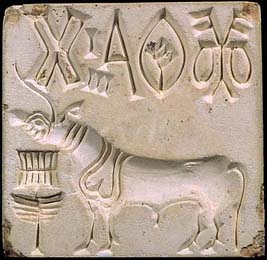
[source: Harappa.com]
Calling this the Bull Unicorn (Bull with a single horn) is an European error - caused by their identifying it with unicorn myths from their cultures. IVC people were extremely scientific and I doubt if they’ll represent mythical creatures on their seals - when all along, they’ve only depicted fauna native to their region as we have seen above with the goat. My interpretation is that this is a cow - specifically, the species Bos Indicus (or the Zebu) with a short or non-existent hump and horns. Look at a picture of the current day cow from this breed.
Okay, but why only one horn, then? I thought long and hard about this and finally tied this to their engineering/architecture capabilities. One of the first lessons in Engineering Graphics I learnt in college was the Plan View and Elevation View (also known as perspectives) - a system to represent 3D objects in 2D using the observer’s view point. They must have used these techniques to create the layouts for their buildings and town plans - and they must have applied those to their seals as well. Now, if you observe a cow on its side and profile it, you will notice only one horn.
In fact, this plan view and elevation view perspectives repeats itself in many seals, so i see it as a critical component of the Indus Symbology. For instance, the bangles in the peepul tree worship seal. If you use the perspectives method, you can see why they depicted the bangles the way they did.
By now I am sure you appreciate the 8-point 10-point symbology. Are there any dimensions missing? I’d love to hear your views on this.
Next week we cover the IVC religion in-depth. Stay tuned.
Sukumar - Why did people resort to so much symbology in those days? I mean, when we communicate, we don’t inundate our messages with symbols - do we?
The only idea I have is this - Their languages probably were not as advanced as ours. Maybe the meanings had to be derived contextually. So, they had all these symbols?
Or, as an extension to the above - a picture is worth a 1000 words. They had many illiterates, so they communicated the bulk of the message thru symbols, providing only some details (which couldn’t be easily communicated thru pictures) using their script?
Or perhaps they had different tribes speaking different languages that they regularly interacted with - all perhaps following the same religion & trading with each other - that symbology was the best way to reach all of them in 1 fell swoop?
Priya ..
I think the purpose of Language or written script evolved as transactions and the process increased and civlization devlopment…So Alphabets have undergone similar change…
When Cave men and later Neotlithics existed the only thing they needed to communicate is about food,weather fire etc …now this was enough with pictorials..but as people grew the number of words kept increasing hence it was not possible to draw each in everything …hence we get aphabets a short hand version of Pictorials..If we look at Classical Greek…it has its orgins from the Phoenician script which itself was a derivative of Proto-Canaanite alphabet which again is a derivative of Egyptian Heilographics(courtsy Wikipedia)..Now Egyptian Heilographics as nothing but pictures..which probably is a derivative of the orginal diagrams of Cave men…
The post is great Sukumar. Priya very interesting questions. Could it be some early form of calligraphy which Buddhist cultures adapted widely later on? We all know that many spoken languages need not have scripts. Will that make them less important?
Karthik - What you say is correct, as far as the origin of writing goes. People couldn’t draw everything, so writing arose. But, that’s not what I’m asking.
My question is very different. In the Bronze Age, why did people resort to so much symbology when they already had a viable script? In the IVC seals, you can see plenty of symbols & writing, together.
Egyptian Hieroglyphics are highly stylized pictures & unless someone is trained in reading that script, its impossible to read. Even Egyptian tablets are like the IVC seals - plenty of repeating symbols, along with writing in hieroglyphics.
Which is why I think 1 or more of the reasons I’ve quoted would hold good.
Vamsi - I think languages that don’t have a script can’t create & spread literature. Which means, their contribution to human thought will be considerably less. They’ll also die out.
I wonder why ancient religions flooded the world with symbols. So much so that - religions that subsumed them had to take over most of those symbols. And either deify or demonize them.
There must be a reason for all this symbology.
Great post and the interpretation of the seal was brilliant. But I request you to check out this post on Ch1b ((https://ch1blogs/blogs/Symbology_HinduGods/2007/07/27/star-maps-and-iconography-of-shiva/)where the whole night sky is mapped in terms of hte constellations. This seal looked very similar to me. I have a few questions.
Krtihika is believed to be made up of 6 stars not 7. The story goes that each star nursed muruga and when Parvathi picked up the children they fused together. Thats how Muruga has 6 faces. Howcome there are 7 females here.
Regarding the cow. I sort of diagree that the perspective is the reason for one horn. If that was the case, there should have been only 2 feet to 4. Which ever view you look, it is quite impossible to hide the horns becuse they are very often shaped differently. In fact it is easier not to see 4 feet but quite hard to miss the horns, don’t you think.
Loved your symbology framework. You seem to have given it a great deal of thought.
Archana - Pleiades is made up of more than 7 stars, but only 6 of them are easy to see with the naked eye - Atlas, Alcyone, Maia, Taygeta, Electra, and Merope. Perhaps that’s how Krithika had 6 women in mythology to start with. Later when they realized there were more stars, they made it 7 celestial virgins?
Just a guess.
You may be right, Priya. But the point is, if they knew during IVC time that it was made up of 7 stars, the legend of Muruga should reflect it isn’t it, with 7 kanyas and 7 faces for Muruga?
Archana - Please note that Krithika has been categorically identified with Pleiades.
There would have been 2 versions of the Muruga creation myth - 1 with 6 virgins & 1 with 7. The more advanced cultures that had a better understanding of astronomy would have a version with 7 virgins.
This is not uncommon & multiple versions of the many myths survive to this day.
I don’t doubt that Krithika is Pleiades. That was not my questions. If IVC people knew about the 7 stars of Pleiades, then the earliest myths of Muruga must be with 7 virgins. That does not seem to be the case, right, given that Muruga is always associated with 6 faces.
Archana - Why do you think the IVC version of Murugan would be the oldest? Truly, they aren’t the oldest people in India. They are just the people with written & surviving records & had a glorious civilization. There would have been others, similar to them, but less sophisticated at the same time.
Anyone simpler than the hard-core IVC folks - even those newer than them - would have found the 6 virgin symbol more acceptable - that’s what they could see.
What I mean is this. The 6-virgin version which Tamil Nadu relies on might have been - would have been - older. And that seems to be the accepted version down South. Its not uncommon for people to rely on outdated ideas - because the originators of the newer & path-breaking ideas have been subjugated or disappeared.
Awesome Sukumar…It has really taken some time for me understand this .Lots of things are really falling in place..I was trying to decipher the seal …..I was intirgued by the crab like creature between the sapthakanikas and Hunter…
First this reminded me of Archana Ch1 Blog ..and her observations we in line with that
Then I took another call ..I was comparing with the Hercales gp of Astronomy…I tht the peepal tree could be hydra…Female could me Hera and crab all fell in place (12 labours of Heracles ..I was able to locate some ) but ladies were out place there
Then looking at your observations ..I can add couple of points to this…Now Karthikeya is assocaited with Kritika but his birth star is Poosam or Pusya ..Pushya in English refers γ, δ and θ Cancri of Cancer Constellation ..I fact I feel this seal constructs the entire birth of Kartikeya …
U have Rudra on the left the seeds that person who is squating could be Agni (my assumption ) below is Nakstra is Poosam and then transports to the Kartik girls …. and animal associated is a goat….now peepal tree probably symbolises divine mother ( may be parvati)
Priya, Vamsi, Karthik,
On why the seals and scripts are symbology based - as Priya says it must have been very easy to convey information as pictures which is what we still do. The best analogy to a seal i could think of is a powerpoint slide with a visual and a bullet - we have been analyzing mainly the pictures so far, the markings above the seal are the real script and if you look closely they are also stylized symbols. Sumerian hieroglyphs is the first form of writing in the world and as i have proven to a great extent, it passed through to all the 5 supply chain members. Cuneiform is a later improvement which the Sumerians made which later became a full fledged alphabetic script like Phoenician or Aramaic - the first few alphabetic scripts. China, Japan, Korea still continue to chug along with their ancient pictographic scripts. In short, pictographic is probably the most natural thing to do.
Additionally, as Priya says, a language without a script is bound to die sooner than later. In fact, if a language doesn’t quickly adapt to the newer communication media like dramas, movies, radio, television and now blogs etc, it is likely to see its demise because ultimately the amount of published content directly correlates to the vibrancy of a language. You can already see some of the Indian languages failing to do this well and are on the verge of dissappearing. Anthropologically speaking, the death of a language is a sad thing because it takes with it an entire body of knowledge, customs, rituals etc. down with it. But we don’t know if there is any way to preserve old languages other than by video/audio recordings.
Archana/Priya,
Interesting discussion on Pleaides. Since it is one of the constellations that was easily visible to everyone, many cultures including cultures from the pleistocene era had myths about them - http://en.wikipedia.org/wiki/Pleiades_(star_cluster)
Now whether it had 6 or 7 in India - here is my view, Parvati taking the 6 babies born and fusing them to create the 6-headed muruga is likely to be the most accurate version because it repeats so many times everywhere in the muruga symbology - 6 heads, Aarupadai veedu, 6 days of Kandhar Sashti etc. There is also an established myth that there were 7 sisters. My guess is that they included parvathi also in the list - parvathi + 6 krithikas = seven wet-nurses or mothers.
In any case, no one is going to know the mind of the IVC artist that created this seal, we can only guess. Given that pleaides in the form of 7 women is a repeating concept, we need to take than and move on.
Hope that helps.
Archana,
Thanks for your kind words.
A cow can always shuffle its feet but it can never shuffle its horns - hopefully you agree with me on that? You should take a closer look at the zebu cow in your neighborhood. Even today i saw a bunch of them prancing around, and their horns are very symmetrical.
In any case, the indus seal makers using perspectives is a clear symbology that is present in so many seals.
If you are still unconvinced, take a look at how they depicted a bull in the URL below.
http://www.harappa.com/indus/gif2/bullseal.jpg
Remember that both the cow and bull were important to the IVC people.
Archana,
I remembered your star map post and i went back again and read it. The Sumerians divided up the sky into 12 zodiacs of 30 degrees each corresponding to 1 month for the sun position. In the same way, they allocated 30 stars for the moon positions. In the IVC, they had only 27 stars maybe because some of the stars visible in Sumeria were not visible in the IVC or for some other religious reason we don’t know about.
The post you wrote shows the samething that the entire sky was divided into constellations and that the pleaides occurs in the constellation of Taurus which was called as Rishabha by the IVC people. I believe based on the religious symbology they chose, which I will explain, the sun rising in Taurus during the Vernal equinox became the new year - it also set the agricultural season in motion.
Now Shiva himself is a IVC God who was incorporated into Vedic Hinduism by connecting him to Rudra who is a Vedic God of destruction. Originally Shiva was a God of Love. We will see more about this when I talk about the IVC religion later this weekend or next week.
In sum, i agree with you in that we in India knew about the zodiac etc and quite a bit of astronomy but that was essentially borrowed from Sumeria.
Hope that helps.
BTW, it is extremely interesting to me that you didn’t comment on the peepul tree ritual? Isn’t that there in your family circles? It is very much there in mine.
Archana & Priya,
Parpola has a good explanation for the 6 krithikas instead of 7. Please read http://www.harappa.com/script/parpola12.html and you’ll see why. Also, remember, that next to the fish we have 2 rows of 3 short-straight lines (which equals 6). Here’s what Parpola says on why aru-meen and 7 krithikas. I also read somewhere else that it is the reason why one of the krithikas has a inverted “V” on top of her head to signify that the 7th one is more godly, than earthly (as she was able to re-join her husband).
—————————————-
20. The six or seven ladies (the Pleiades?) on an Indus seal.
The Pleiades hold a prominent place as the mothers or wet nurses of the newborn infant in one of the most ancient and central Hindu myths, that of the birth of the war-god Rudra/Skanda, who evidently represents, among other things, the victorious rising sun (and as vernal sun the new year). The Pleiades are said to have been the wives of the seven sages, who are identified with the seven stars of the Great Bear.
21. Inscription on seal from Harappa.
The Great Bear’s Old Tamil name elu-meen ’seven-star’ corresponds to the combination of the pictograms ‘7′ + ‘fish’, which alone constitutes the entire text of one finely carved Indus seal (Fig. 21).
The Satapatha-Brahmana (2,1,2,4) states that the six Pleiades were separated from their husbands on account of their infidelity; other texts specify that only one of the seven wives, Arundhati, remained faithful and was allowed to stay with her husband: she is the small star Alcor in the Great Bear, pointed out as a paradigm of marital virtue to the bride in the Vedic marriage ceremonies.
—————————————
Karthik,
Thanks for your kind words. I believe that Rudra, the hunter/destroyer is a Vedic God who got merged with Shiva who was actually the God of Love. I am sure you know the reason why the Vedic people would have done such an assimilation/incorporation.
Given that background and the fact there are no males depicted in this seal, there is no Rudra in it.
As for your interpretation of the peepul tree, you are sort of right in that the Tree Goddess is Parvathi - i believe that it is a manifestation of Parvathi who is the great goddess or great mother goddess in the IVC religion.
As for Poosam star, you are right that is Muruga’s birth star and when i looked up the almanac, it is the 6th star from Krithika. So i think [Citation Needed] those are the 6 Pleaides stars starting from Krithika to Poosam.
This seal as i explained is likely to be the Peepul Tree Worship ritual for infertility.
Sukumar,
Very good post. I agree with the peepul tree explanation. it corroborates with a lot of other information. Also, it is brilliant to figure out the “cradle” on the feet of the kneeling god.
I have a few questions / suggestions.
1. I don’t think that it was only women who were wearing bangles. Men were also shown with bangles in IVC symbols. I’ll dig up the references to this. I too initially thought that only women were wearing bangles, but corrected my thoughts later. Would love to hear your ideas on this.
2. I don’t agree that the picture shows a goat. The horn is that of a bull, the neck folds are that of a bull, the body is that of a bull. In my opinion it is trying to depict a bull (a symbol for sun). On top of the bull (sun), we have the aru-meen (fish and 6 strokes) depicting that the sun and the great bear coming together to form the vernal equinox. Also, why should the same thing be represented twice. The aru-meen depicts krithika already.
3. On your unicorn seal, I can understand the 2d depiction of a 3-d image. I buy it. Another thought I had (based on priya’s original idea) is whether this seal is regarding goods coming from greece or the baltic region where they believed in unicorn. Also, note that the script used in this seal, the letters are not repeated anywhere else in other symbols (according to harappa.com and Farmer). I might be reading too much into it, but this script looks closer to greek :-). Seal M-57 however, has the script that hasn’t been repeated either (with similar unicorn / bull)
4. Another angle to think about in your symbology is whether the script relates closer to any of the existing letters in proto-dravidian languages. For example, I thought H372 and H373 relates to tamil (A and AA - 7th and 8th letter in Uyir ezhuthu), H205 and H206 looks like Ya and Yi (11th letter in Mei ezhuthu). I also saw La and la, but at this point I might be seeing things
BTW, I found all the scripts sent for ISO encoding in the document “http://std.dkuug.dk/JTC1/SC2/WG2/docs/n1959.pdf”.
I agree with you in that Parpola model is the one that sounds most logical and I go with that too.
Love to hear your thoughts and ideas.
Sukumar,
Another thought that keeps coming back to me is this - Most trees depicted with leaves have 3 leaves or 3 node leaves. There’s an old saying that my Patti used to use - Molaichu moonu elai vidalai - when she used to tell us that we were immature or not old enough. I am wondering if the 3 leaves or 3 node leaves is trying to depict a sign of maturity or something that is old (mature tree, old crop, valued goods, purer silver etc). Just a thought.
Sukumar,
Check this one out and tell me whether this posture resembles a god that we know.
http://www.harappa.com/figurines/25.html
Also, see that Iravatham has a similar explanation to that of yours on the Unicorn
(http://www.harappa.com/script/mahadevantext.html)
———————————————-
What do you think about the unicorn?
A: We still do not know exactly what animal it is. There is no animal with a single horn like it of course. It still is very likely that it is only a pictorial representation of an animal with two horns, where the other horn is behind the one horn we see from one side. The animal looks more like an antelope than like a bull, this has been commented on. The first problem is in identifying the animal, about which there are several theories.
———————————————–
Sukumar,
Sorry to flood you with many notes. Here’s the doc that has a better picture of your Post 3 symbol. Please look at page 15. Granted, this is from Steve Farmer, but look at it for the picture
http://www.safarmer.com/indusnotes.pdf
Sukumar,
I was talking to Priya about this.
South indian gods are on top of a small mountain. Muruga is always on top of a mound and so is ayyappa (18 steps). This is also similar to the sumerian culture where they had EKUR (e - building/temple, Kur - mound). Incidentally, Kur sounds like Kundru in tamil which means high mound (smaller than hill). I wonder if the dravidians borrowed having Gods on high mounds from Sumerian civilization.
Priya brought up the point that Thirupathi is on a mountain too, but it’s for a non-dravidian god. She also brought up the point that dravidians say that it used to be a dravidian god on top of that mountain (citation needed). The temple is in dravidian style and art form. I also read that the temple is described in one of the Sangam literature (citation needed) and originally there was a lord only in tirumala and nothing in Tirupathi (citation needed). All of this made me thinking about the names for the god (balaji, srinivasa, govinda, venkatachalapathi et al). I wonder if any of these names sound dravidian to you? (Govindan does to me, but I could be wrong). Do you have any thoughts/ ideas?
Sreedhar,
Thanks. I did see parpola’s explanation for the 6/7 stars. With all due respect to that great man Parpola, i think he has not figured out what religion IVC people were following. The Saptarishi Mandalam (seven sages) and the shathapatha brahmana are all later Vedic documents. So quoting from Vedic documents to decrypt IVC seals is not the correct thing to do because we may make mistakes. I am sure some of the Dravidian myths were incorporated into Vedic Hinduism like the Gods have been incorporated and hence some Vedic myth may originally have been a IVC myth - example of this is Muruga’s birth which now masquerades itself as the Vedic Skanda Purana. I think the simpler explanation is that he 7th one is a mother - parvathi or someone else. As you correctly pointed out, the 7th one doesn’t have a single horn the others have (i believe the single horn is used for demi-gods and three horns for gods).
Sreedhar,
Thanks. for your 4 points:
1. That’s interesting. I didn’t know males wore bangles. it is definitely possible. Can you please give me references?
2. I haven’t yet begun to even look at the script yet. I am mainly focused on the pictures and the symbology. So you may have a point. The only argument i have to make is that, they seem to represent animals consistently in nearly the same way, if it is a cow it looks nearly the same everywhere (perspectives may change). Here is how they represented a bull
http://www.harappa.com/indus/gif2/bullseal.jpg
i have also seen other seals where the goat figures. i also don’t know of bulls that have a wavy antler/horn. It is possible that it was some unique species of bull of that time that had that feature.
3. That is an interesting possibility. We need to analyze the origin of the Greek unicorn myth and date it. If the dates coincide with IVC, then there is definitely a possibility.
4. That is really insightful. I have read somewhere that even though the basic scripts were copied from each other, script makers use old symbols [Citation needed] as script elements. Given that the language is proto-dravidian and tamil is a derivative, Tamil Brahmi script makers may have used some Indus symbols. I don’t think Tamil was ever written in Kharosthi [citation needed], the only other alphabetic script in India in the medieval world [Citation needed].
Thanks for the ISO document. That is a great find.
Sreedhar,
yes i have heard that mulaichu moonu elai comment several times. I think it has got something to do with the no. 3 which was an important number for them. It may also have a meaning like what you propose. I will think some more.
i guess the figurine looks like Ayyappa?
Thanks for the Mahadevan reference to the unicorn. In my view, people don’t associate cows and horns because cows typically don’t have horns. Zebu is one of the few species that have a horn in the female. i think that might thrown people off aside from the stylized representation of 2 horns as one using the perspectives method.
Thanks for the Farmer notes. I didn’t read this carefully, because their fundamental premise was wrong. You have proven that even such ludicrous papers have valuable information. i will reread this paper again. Thanks for opening my eyes.
Gods and Mountains. My research shows that, the mountain is another sexual symbol usually representing the male. That is why all sacred muruga temples are on hills. The confusion for me comes from the fact that the mother goddess is also the goddess of mountains - parvati. So i suspect it may represent different sexes based on the context.
As for Tirupathi - this is a significant possibility because Tamilnadu was amongst the last regions to be Aryanized and given that Vishnu is a Vedic import, they may have converted a Muruga temple into a Balaji temple. We will never know. Also, nothing prevented the Vedic people to come up with their own mountain god temple to rival Muruga’s influence in Tamilnadu and Kerala. So for all you know it may just be a conspiracy theory with some merit. But definitely, the balaji temple is relatively very new compared to the older murugan temples.
Hope i have answered your questions?
I would like to mention this to all readers - i am merely proposing a potential interpretation and it is highly likely that i have comitted errors when we know the kind of errors accomplished historians have comitted. so please fee free to poke as many holes as you can. we will all learn in the process.
Sukumar
First of all thanks for an interesting post.Never thought after so many years (especially after school days studying about IVC) i would start digging/searching about this.IMHO, i think the seal has alot to do with lord murugan.
My thoughts on this, let me start with the fish symbol first.I am not sure i see a fish with six strokes.I see a fish symbol with a dot inside which according to Parpola is “tilak” wore by married woman.I am guessing that would be “Parvathi”, muruga’s mother.
Next , the “goat” symbol.My view is that it is the symbol of “skanda” a ram-headed god.Which again has strong connection with lord murugan.
Finally the tree, is it possible it is “ala maram” /banyan tree.If it is then , the god pictured in the tree would be Lord shiva,muruga’s father.
The human figure kneeling down near the tree would be Muruga, as it differs a lot from the 7 women.
So, my conclusion being, this represents the worship of Lord shiva by his son ‘Murugan” with the presence of Parvathi and Sapta kannikas.
AGAIN, this is just my view. Please feel free to correct me if i am wrong.
Sukumar,
I’m little skeptical about the seal interpretation, because of following reasons.
1.I saw the patterns of Indus seal, as you mentioned they had really great engineering brain. See the first seal; they carved bull as it is from slightly top angle. Now question is, why they carved peepul tree not as whole tree from root and stem and nodes and leaves as they see.
http://www.archaeologyonline.net/artifacts/photo-gallery-3.html
2.Seems to me, this so called tree was erected and not a natural tree. This leads to think that this was a holy place and it artificially created.
3.The human figure kneeling down, very near to holy tree seems to me like a man priest not a woman. The crown is making the difference, similar to pashupati http://en.wikipedia.org/wiki/Pashupati
4.The goat is special one, because it wears jewelry and well decorated, because may be it is “pali adu” for sacrifice.
5.The symbol of tree structure is same as om seal. You can find this seal and om seal in same row.
http://www.archaeologyonline.net/artifacts/photo-gallery-3.html
Please let us know your thoughts…
Subba
Sukumar,
/*Shiva himself is a IVC God*/ that is why I thought the figure at the center was Pashupathi not a lady as you have interpreted. But your explanation makes more sense.
Regarding the Pipal tree, there is not doubt it has great religious significance. Most temples in the south have an arasamaram and the cradle belief you mention. Apart from that, this tree has great significance in Vedas. The samit for the ritual is got form this tree. It considered to be as divine as all the gods of hinduim. There is a verse which says, the root is brahma, the trunk is vishnu, shiva its branches and all the 330 million gods are its leaves. It is considered a big sin to cut down this tree, that’s why in traditional rituals only twigs that fall out from the tree are used in homa.
Maheswari,
Your interpretation is very interesting and imaginative.
The pottu meen as parpola calls it is a great observation you make. Per Parpola it is Rohini or Aldebaran which is also in the constellation of Taurus. So that still leaves us with Sreedhar’s question - why depict the same Taurus twice - once in the form of the 7 ladies and second in the form of pottu meen?
In general, my observation is that these seals give instructions for rituals or sacrifices. So i believe this is referring to a ritual. They represent the Aala Maram differently, you may want to look at some more seals.
You are right about ram representing Muruga. I hadn’t thought of that. That is a real good one. It may be the symbology for begetting a son like Muruga which is the purpose of this ritual.
I also believe that all humans in this seal are women. As we advance to the next few posts, you may see some more evidence of that. Stay tuned.
BTW, i am very happy to hear that this series has sparked your interest in history and IVC. You made my day. If at the end of it, i have sparked some interest in people, that will be great.
Thanks Archana.
As someone who has performed Agnihotram with sticks of Samithu (twigs from the Peepul tree) I am well aware of the Vedic connection. However, Vedas are an Aryan creation and they arrived much later than the date of this seal. Like Shiva and many other things, the Peepul Tree was also incorporated into Vedic Hinduism.
Sukumar
Interesting post and meaningful discussions. I’m collecting my point of view also. For some reason, I’m not able to post my comments yesterday. Hopefully if this goes thru, i will post my comment.
Subba
Sukumar
I’m little skeptical about seal interpretation, because of following reasons.
1.I saw the patterns of Indus seal, as you mentioned they had really great engineering brain. See the first seal; they carved bull as it is from slightly top angle. Now question is, why they carved peepul tree not as whole tree from root and stem and nodes and leaves as they see. Because this ritual now happening in natural trees in Tamil Nadu.
2.Seems to me, this so called tree reveals a symbol, most probally OM symbol. This leads to think that this was a holy place and it artificially created. In the above link, OM symbol seal and this seal are in same row.
3.The human figure kneeling down, very near to holy tree seems to me like a man priest not a woman. The crown is making the difference, similar to pashupati http://en.wikipedia.org/wiki/Pashupati
4.The goat is special one, because it wears jewelry and well decorated, because may be it is “pali adu” for sacrifice.
5.Seems to me, this is a preparation of marriage, I just checked goat and marriages and found sidhi hindu marriages they have tradition of sacrifice goat before marriage.
http://india.mapsofindia.com/culture/indian-weddings/sindhi-wedding.html
Please let us know your thoughts…
Subba
2.Seems to me, this so called tree reveals a symbol, most probally OM symbol. This leads to think that this was a holy place and it artificially created. In the above link, OM symbol seal and this seal are in same row.
3.The human figure kneeling down, very near to holy tree seems to me like a man priest not a woman. The crown is making the difference, similar to pashupati
4.The goat is special one, because it wears jewelry and well decorated, because may be it is “pali adu” for sacrifice.
5.Seems to me, this is a preparation of marriage, I just checked goat and marriages and found sidhi hindu marriages they have tradition of sacrifice goat before marriage.
Please let us know your thoughts…
Subba
PS:Sorry for multiple posts, for some reason my reference URLs blocking me to add comments
Thanks Sukumar!
Letz go by your theory, a women performing ritual for begetting a baby.Then “Pottu meen” or “rohini” nakshtra presented on the seal makes sense , since rohini nakstra represents ruling crops and fertility.So my guess would be she is performing the ritual on the day of Rohini nakshtra in the presence of 7 ladies.
Come to think of it, i have a personal experience with this number 7.My parents lost 2 children at birth before i was born.So they had done the ritual similar to this one.Amma had hanged a “thottil”/cradle in the tree in a “amman” temple known for this issues.After i was born, they had to “beg” (yeap, “picchai eduppu” in tamil) with me in their hand , in 7 different houses before entering our home.Belief is that it would make my life longer :).
Again, for the above reasons, may be the god represented in the seal can also be a woman?
Subba,
Man, you have great imagination as well. With the collective imagination of this group now, i am certain we can make a big dent in the IVC script decipherment efforts.
I am responding to this comment of yours http://www.sastwingees.org/2008/02/13/the-real-history-of-india-part-4-a-new-ivc-symbology-for-better-decipherment/#comment-1905
Everything else seems to be repeats [When you include more than 2 links wordpress marks it as spam automatically and i have to unspam]
1. The seal you are referring to is either the same Zebu cow from another angle or It is a Water Buffalo. Given that they are representing the cow with the stylized one horn, the 2 horned one could be a water buffalo.
2. The om symbol seal you pointed to is the Swastika seal. How did you get to OM from that? That is very imaginative.
3. I have a different interpretation of the Pashupathi seal. That also is a woman, i will prove that later in this series.
4. Since no male is depicted in this seal and there is the peepul tree worship, it may not be a marriage. One possibility is that this ritual could have been part of an IVC marriage and this seal could be a part of a bigger seal string (i guessed above that’s how they must have created sentences, chapters and books).
5. As for why they represented only 2 branches of the tree, i will explain the religious symbology in my next post.
Hope that helps.
4. That is a good one. Even now we say “Aadu Vetti Kozhi Vetti” for festival days. So it could be a goat sacrifice also.
Sukumar,
Another thought on the unicorn seal. I am not convinced completely on the 2-d depicting the 3-d picture yet. Why show unicorn (or bull) alone with one horn when other pictures are shows in side view with 2 horns? Also, there is not just one unicorn seal. Over 300 unicorn seals have been founds so far. It can’t be coincidence that this animal alone is depicted this way.
Here’s my theory - There were no horses in the indus civilization until it was introduced by the indo-europeans later. They only knew about the Rhinoceros, which had a horn, but had never seen a horse before. At the same time, horses were there in the sumerian civilization that they were trading with. My theory is that indus civilization was trying to picture the horse, but came close to it and depicted the horse with a horn similar to a rhino, and decorations similar to a bull around the neck and back.
Maheswari,
wow! That is fantastic. This is exactly what i want all of us to do. We must all go back into our family rituals and see if it correlates. In fact, this is how i have been testing my theories.
Yes, i believe that all the humans in this seal are women.
Now, can you please ask your mom and dad the following questions:
1. What day of the week and which month did they do this ritual?
2. Did they do the ritual only once or they had to repeat it many times?
3. When they tied the votive cradle to the tree, were there anyone else either from the immediate family or from the village present during this time?
4. Was there any priest involved in this ritual? If yes, when were they involved - preparing for the ritual or during the ritual or after the ritual?
based on my interpretations, i know the answers to those questions.
Please let me know.
Sreedhar,
That is a great question and one that has been bothering me as well. My views:
1. The fact that there are hundreds of seals means that they decided they will depict this animal in this way. I strongly believe that being engineers they applied this consistency principle very well. There are a few variations of some representations, but for the most part they use the same symbol. Which is why i believe we need a separate IVC symbology.
2. Your point about Sumer is interesting and that is a great imaginative connection you have made. The problem is, Sumer also didn’t have horses, they were Onagers (some type of donkey). In any case, Onagers don’t have horns. Given the tight linkage with Sumer as i have proved already, they didn’t need to guess what the onager would look like but could actually see one on their trading visits to Sumer.
3. Water buffalo was also an important animal for IVC. If you think about seal technology, they probably didn’t have any way to distinguish between the water buffalo and a cow - one is black and othe other is white or tan. Please take a look at the water buffalo seal, see Subba’s link above. I believe they represented the water buffalo in the traditional 2 horn view, you can actually look at the seal and perceive what viewing angle the artist would have used.
Maybe the one horn representation of the cow is to signify its status - numero uno. One of the most important animals for them.
Sukumar - I have heard of my granma talk about a similar ritual, like Maheshwari mentioned. It was done by her MIL in similar circumstances. I will get the exact details from her and post it here.
Sukumar,
Good point.
1. I am going to put this on hold for now until I have something more substantiative to add to my point of view.
2. Yes, you are right. I also cross-verified that Old tamil and Brahmi had only “Ivuli” for onager and “kuthirai” came much later to denote “jump up and ride”. I am not giving up on it yet.
3. See how the figurines for water buffalo are depicted. Granted, the horn is broken in this picture “http://www.harappa.com/figurines/36.html”, but you can see that there’s a difference between the bull and the water buffalo. Not sure why they couldn’t have used a similar approach on the seal.
Also, I am sure you would have seen this seal as well “http://www.harappa.com/indus/35.html”, where they have a bull, an antelope and the controversial unicorn. So, the unicorn can’t be a bull. Could be a cow. Let me think about this some more.
Thanks Sridhar.
1. Thanks. Please continue to research.
2. Thanks. Please share what you find further on this.
3. Interesting. I have seen it, but didn’t pay attention before. It does look like water buffalo. Did you see Subba’s reference above? I think that is aso a water buffalo? Any thoughts?
4. Yes, i have seen that one. Didn’t know what to think of it. But i doubt they would have represented 3 diff animals. It could just be a perspective view - just a wild guess.
Yes, i also believe that the unicorn is a cow - in fact i have argued above that it is the Zebu cow which is a breed for which even the cows have horns. Typical cows don’t have horns only the bulls do. If you can find any additional citations that prove this point, it will be immensely helpful in proving the unicorn=cow hypothesis.
That is great Archana. If your MIL can answer the questions that I have asked, that will be extremely helpful.
Sukumar,
Here are the answers to your questions.Got it from Grandma and mom, hope this helps.
1.These rituals are usually done on tuesdays and saturdays.In my case, it was done 7th day after my birth.And 8th day was naming ceremony.
2.They did the ritual only once.But all family members make it a point to go to this temple whenever we are going thru that way.
3.They offered the cradle on the 7th day and most of the cases, immediate family were there.But in my case, some of the extended family members were there.My parents offered feast for all of them.
4.Priest was there and was involved during the whole procedure.
In my case, they tied the cradle to “ala maram”…here is where i am getting confused..
Sukumar ..Based on what Maheswari was saying..
What is only the meen represents Taurus…and seven ladies could represent seven days of week..Now i dont know if its picture quality or some mistake in seal itself..but the 3 rd lady has no horns..( or porjection that is coming out)….If that that is way oof showing that one carries the ritual on 3 rd of week when Rohini is the star..
Now this is really a wild guess as I am not sure of the Week’s orgin….i dont even know if the IVC people used weeks and months to calculate the period…
Maheswari,
thanks a lot. Maybe i am misunderstanding? but you seem to be describing rituals performed after you were born. Whereas the peepul tree worhsip ritual is for women who are having problems conceiving.
So what you are describing could be a thanksgiving type ritual and in which case maybe the aala maram is involved in that. Could be because Aala Maram symbolizes Long Life since olden days.
Can you please ask your mom and grand mom what rituals if any they did before you were born?
My guess is that since your mom already had 2 children and they died prematurely, she wouldn’t have done the peepul tree worship because that is for infertile women.
Any case, it will be great if you can confirm?
Karthik,
That is an interesting guess. My current level of knowledge indicates that they had months but i am not sure yet whether they had days of the week?
Sukumar,
According to my mom, she had gone to the temple (before i was born) prayed that she will perform this ritual once the baby is born healthy.So yes, all these rituals were done after i was born.They didn’t do any rituals as such before i was born.So your point on Peepul tree is correct.
-Maheswari
Thanks for the follow up Maheswari. Much appreciated.
Sukumar - I think the seal represents people collecting the cow’s blood to make a drink. The Masai still do this - they mix cow’s blood with milk. A sieve is used to filter out blood clots - and there’s a sieve in this seal as well.
The Masai believe that a gourd of blood can be extracted from a cow once a month from the folds of its neck without harming the cow in any way.
Just describing this grosses me out, but there you have it.
http://www.congocookbook.com/other_recipes/cow_blood.html
Priya,
Outstanding! That’s a great find. I think you’ve cracked this seal.
Looking at the symbol above - Sukumar suggested that it’s a recipt. The 2nd element of the script from the left is a cutting instrument - to denote “vettu one, thundu 4″ - 4 parts are being cut into I part and III parts. The link you provided also talks about a similar 1 part milk 3 parts blood. I think the milk is coming from a woman and not from the cow.
Also, the X symbol could mean mixing it all up.
Very very interesting.
Sukumar,
Another theory - In IVC symbols, any human symbol that carries a grown crop (Kathir in tamil) is a woman. My reasoning behind this - Muruga is called by the name “Kathir Kama Kandan”. I think this is depicting Parvathi (mother goddess) as Kathir, Siva as father.
Even today, when you introduce yourself, you have to say who your mother father are - I am sure it got plagiarized during Vedic period and became “Abhivadhay” - to introduce one self by telling which family you come from.
That’s the reason why I think the 1 part milk is coming from mother’s milk (in concurrence to your thought that the last symbol on the right is a mother).
So, wherever there’s a crop head, it is a woman and where there’s a straight line, it’s a man. Now, if mother is kathir, I wonder how an immature girl would be displayed. How to distinguish a man who hasn’t achieved maturity yet? Thoughts to ponder.
Sukumar,
Two more thoughts on the symbols
1. I think the leaf life symbol depicted inside a seed is barley. I read that IVC had wheat and barley with the possibility of rice and peas getting included in later years of the IVC culture (citation needed). I can understand barley as even today, barley is a staple in dravidian culture. I started investigating how these plants look like from a botanical perspective. Barley is the one that has the leaf structure similar to a fan. See pictures from attached
http://www.albertabarley.com/kids/processing.shtml
http://www.fotosearch.com/DGV092/73091496/
The part that holds the barley and the thin straw like leaf is called straw. I think this is what is being depicted as a fan shaped straw plant.
2. I might have landed upon why “Molaichu Moonu elai vidalai” theory. Wheat plants have a unique characteristic
http://www.fao.org/DOCREP/006/Y4011E/y4011e05.htm
Please look at the tillering section. Wheat tillers come out when the 3rd leaf is fully expanded. Tillers in turn have the wheat buds. So, when tillers come out it is time for wheat buds to come out (meaning wheat plant is having a baby). Excerpt from the article
Tiller emergence
Tillering normally starts when leaf 3 is fully expanded and leaf 4 is emerging on the main shoot with the appearance of the first leaf of T1 above the ligule of leaf 1. Further tillers are produced in the regular sequence, their appearance coinciding with the emergence of the third leaf above the leaf subtending the tiller.
Since wheat was one of the main grains harvested by IVC, and they have lot of observation time on their hands, I am sure they would have figured out that when leaf three comes out, the plant is ready to produce the grain. Hence the “molaichu 3 elai vidalai” to depict you are not mature enough (to have a baby).
Priya,
This is very insightful and out-of-the-box. Given that we all came from Africa originally, there may be some serious merit here.
Sreedhar,
Thanks. You are right, i also believe that any anthropomorphic form with a tree or a tree branch is a woman. For males, they use the phallic symbol.
Overall, for this interpretation to hold, we need to find this same practice in 2 reference cultures. That’s what i did for the peepul tree worship interpretation - the same ritual is still done in Tamilnadu and is a well-known practice in the Celtic region.
In the same way, if you can find 2 reference cultures that this cow blood ritual is done, then it will become a valid interpretation. Happy digging for more evidence.
Sreedhar,
Barley is an interesting explanation. Mulacihu Moonu Ilai Vidalai is brilliant.
NK made an interesting point that it could be ritual blood-letting for the cattle. There’s a Sumerian goddess “Mudkesda” for blood-staunching. Perhaps there’s a connection.
Can’t help thinking that the sieve before the cow had something to do with blood letting or staunching.
The 10 point framework looks interesting. I am loking forward to discover more along these lines about IVC. Will other aspects of IVS “culture” (for want of a better word) fit into these? Like their customs and practices? Perhaps you may cover them as part of their religion? Or is it worth another dimension?
I don’t agree with most of Senthil’c comments elsewhere in this blog, but based on one of his comments, I thought “politics” could be another dimension of this framework. It could be used to explain the administrative set that was followed in IVC.
Thanks Meenaks. Yes, customs and practices are part of religion.
Interesting point on Politics. I think it makes sense to add it. Let me think some more.