The Real History of India Part 1 - The Gond-Australian Aborigine Connection?

Updated Feb 16,2008: JK from Varnam.org has included this post in their history carnival. Thanks JK. We are honored.

Updated Feb 2, 2008: This post has been Desipundited. Thanks a lot Patrix.

Updated Jan 30, 2008: Thanks everyone for the great discussion. Ganesh, Karthik and Senthil raised some important points on genetics. Based on some more research, it turns out that Gonds are not the only ones that can lay claim to the oldest people of India. There are the tribes in Andaman & Nicobar Islands and the Munda who speak an Austro Asiatic language. I am still looking for clear genographic proof on which is the oldest. For now, i am concluding that Gonds are only one of the oldest peoples of India and may not necessarily be the oldest.

Many of you know that Anthropology is one of my favorite subjects. Recently, I have been reading up a lot on India’s history to get a better understanding what exactly has happened in India since the Indus Valley Civilization and before. I am utterly shocked by right wing demagogues who are systematically revising India’s history to suit their Hindutva needs. I am okay if someone wants to propagate Hindutva or any other ideology, but when it extends to doctoring history and spreading hatred and divisiveness, I am AGAINST it. I have learnt a number of things about India and I decided to share that with you all in a new series - The Real History of India. You are welcome to offer criticism.

With that prologue, I want to write about some of my findings from the period 60,000 to 5,000 BC. This post has been triggered by Archana Raghuram who says in her most recent post on tribal art in India:

There is a striking similarity between this art form and Australian aboriginal art form, in the sense they use dots or lines as fillers and not continuous color.

In my research I learnt that India was populated by Australoid People during this time. The reason for the term Australoid to is denote the unique physical characteritics of the Australian Aborigines. A majority of australoid people in India from this time speak Dravidian Languages including the Gonds - a lot of whom speak Gondi - a central dravidian language. Attempts have been made to connect Dravidian Languages to Australian Aboriginal Languages, but have been unsuccessful so far.

Let us come back to what Archana has said. Interestingly a key variety of Australian Aboriginal Art also known as Desert Art or sometimes Dot Art is mainly composed of Lines and Dots like the Gond Art. I picked up Archana’s Gond Art exhibit and a dot art painting from the Munupi tribal art from Australia and included side by side below.
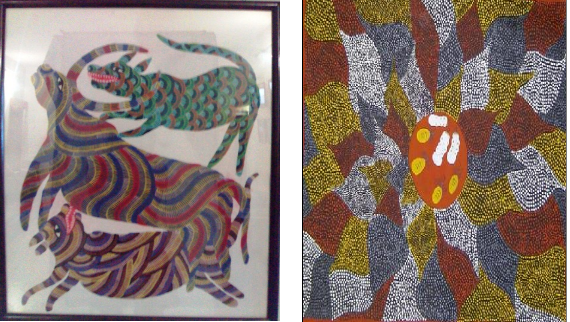
Gond and Australian

I am sure you can see how similar this is although the Australian example is dot art. If you look at the Gond religion, it is a tribal religion with many similarities to other tribal religions. In my research I could not find similarities between the religions of Gonds and the Aborigines, not could i find similarities in burial/cremation customs etc.

Now let us look at physical similarities. Here is a picture of an Aboriginal man from the Encyclopedia Brittanica.

Here is a picture of a young Gond boy. I am sure you can see why these are called Australoid people.

Next I decided to see if there could be some clues in Genetics. So I turned to National Geograhic’s amazing Genography project which is attempting to map the movements of human beings across the planet all the way from pre-historic times (200,000 BC). My jaw dropped when i looked at the snapshot from 60,000 to 55,000 BC. You can see from the picture below that the M* genetic group left Africa and reached Australia and they passed through the Gond’s area in Madhya Pradesh. If this is the same people from that time, Gonds are likely to be the most ancient people in India one of the most ancient peoples of India.
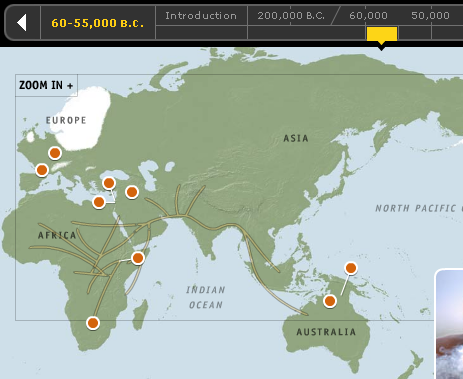
aborigine 60000 BC

If you look at Aboriginal Art from 40,000 years ago it is mostly rock art and there is no comparable Gond rock art that is similar, so I looked at the Genography project’s data from the year 10,000-5,000 BC. You can see the picture below and see that some more groups have passed through to Australia via the Gond Area in India. It is likely that these latter day genetic groups who developed this dot art form took it with them all the way to Australia.

australia5kbc

It will be easy for revisionist Hindutva ideologues to conclude that the Gonds also follow Hinduism - nothing could be farther from the truth. Please read this description of the Gond religion. Having said that, today’s Gonds do practice Hinduism and their contemporary art may reflect this.

I picked the dot art painting from the area where Australian Aborigines landed. See picture below from aboriginalart.org which shows the various tribes populating this area. The inset shown in the map below matches with the genography map above.
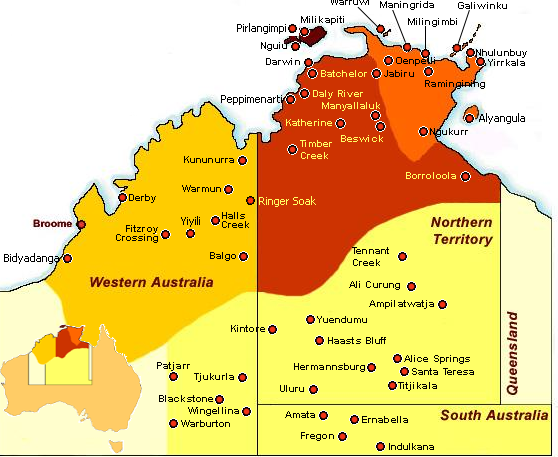
australia map

In sum, we seem to have found one of the oldest peoples of India.


Trackbacks & Pingbacks

  1. varnam trackbacked Posted February 15, 2008, 10:12 am

    Indian History Carnival - 2…

    (Image from the Hoysala trail by backpacker)The Indian History Carnival, published on the 15th of every month, is a collection of posts related to Indian history and archaeology.Sukumar finds a connection between Gonds and Australian aborgines. He says…

Comments

  1. Quote
    Priya Raju said January 27, 2008, 12:57 pm:

    Sukumar - Interesting post.

    Without his boomerang, the aborigine male would look a lot like a devotee in a Murugan temple :-) With all the ash smeared on him, I mean. It even looks similar to how the religious people do it in South India. Perhaps a coincidence? How did Hindus in South India decide to smear Vibhuti in the same (or very similar) manner in their torso?

  2. Quote

    Sukumar - What is totally incomprehensible to me is that people revise history so that they can feel “better” about it. Give me the truth anytime. I’d rather go with what Carl Sagan said:

    “For me, it is far better to grasp the Universe as it really is than to persist in delusion, however satisfying and reassuring”.

  3. Quote
    Sukumar (subscribed) said January 27, 2008, 11:04 pm:

    Thanks Priya for fixing the post and the comments.

    In my readings of anthropology, ashes are a component of most old religions. In India, it is a Shaivite custom which I suspect is the original tribal form, and it makes sense that it has similarities with the Aborigines since they follow a tribal religion as well.

    That quote from Carl Sagan is brilliant. Why they want to doctor history - simply to further their political gains and make themselves the guardians of Indian culture which is a travesty.

  4. Quote

    Absolutely brilliant post, Sukumar. I have no words to describe it. Great research.
    I remember a comment which Karthik made on my post in Ch1B. He said

    /*We dont have big monitor lizards in Indai..they r more common in Indonesia /papua new guinea..
    But one thing i felt was great coincidence was name of tribe is Gonds….
    India and Australia belonged to ancient landmaass called Gondwana */

    Thorough and indepth research. Looking forward to more posts like these.

  5. Quote

    there is no way anyone can claim Gonds practiced hinduism. Unlike many other tribal art forms, traditional Gond paintings do not depict any Hindu deities. In very recent times these motits have crept in, more for commercial considerations (selling in art galleries etc). I will send you a picture of what I think is their diety.

  6. Quote
    Sukumar (subscribed) said January 28, 2008, 2:49 am:

    Thanks Archana. Karthik’s comment is very interesting indeed. I did some looking up and it turns out that Gondwanaland, the ancient landmass has been named after the Gond area in Central North India - Gondwana = Gond + Vana (Sanskrit) = Forest of the Gonds.

    http://en.wikipedia.org/wiki/Gondwana

    I think this explanation is likely because the plate tectonic event that split the Indian subcontinental plate from Madagascar and collided it into the Asian plate and fused it with Australian plate to create the Indo Australian plate occurred 45 million years ago (it resulted in the creation of the Himalayas). Since human beings came on the scene only about 150,000 years ago, it is unlikely our ancients knew about the tectonic event from 45 million years ago.

    Thanks also for supporting my view that Gonds didn’t practice Hinduism. Thanks for the pictures of the Gond deities. They are quite distinct from Hindu gods.

  7. Quote

    Thanks Sukumar. I read the Gond religion, link and it made me wonder if the concept of re-birth in Hinduism was absorbed from the Gonds. As you are aware, Hinduism has developed by absorbing native philosophies. Is there reference to rebirth in presian scriptures like Avesta?

  8. Quote

    Interesting question, Archana.

    As far as I know, Avesta doesn’t interest itself in rebirth. Its primary focus is on the here & now. According to Zaruthustra, people exercise their free will - and hence must choose the right over the wrong. When people die & they’ve made good choices, they can move to the “Vohumana Dimana” - literally, “House of the Good Minds”.

    If they haven’t made good choices, their soul will not be able to cross the bridge that separates this world from the “House of Good Minds”. So, it has to learn to distinguish right from wrong first. Maybe thru a reincarnation. What Avesta says about this is much debated - at least, to my limited knowledge.

    Avesta does not believe in Karma or a mechanical righting of bad karma. What mattered to Zaruthustra was the ability & exercising it to distinguish right from wrong. People don’t go thru cycles of birth & rebirth to atone for karma. The world & life were created by a benevolent God & living it properly is a reward in itself.

    Significant differences from Hinduism, as practised now, I think. If someone who knows more about Avesta, I’ll be glad to have a discussion on Zaruthustra & understand it better.

  9. Quote
    Sukumar (subscribed) said January 28, 2008, 5:39 am:

    Interesting point Archana. I am not sure from where the reincarnation idea came from. As you said, Avesta is a potential source.

    I agree with Priya - Zoroastrianism does not believe in reincarnation. Interestingly, the Rig Veda doesn’t talk about reincarnation either. Reincarnation was first mentioned in the upanishads and later the Bhagavadgita with its Vasaamsi Jeernamsi.. shloka legitimized it. Since it didn’t appear in RV, it is clearly a borrowed concept. Gonds are a probable source, but the problem is Aryans wouldn’t have immediately encountered the Gonds since they came to the North West area first. We should probably look at the Neolithic cultures of that region and the Indus Valley civilization to see if they had reincarnation beliefs.

    The exact trajectory of Aryanization of the North is still not known, so it is possible that some contact with the Gonds was established very early on.

    Definitely a food for thought and research.

  10. Quote

    Sukumar - I don’t think we can categorically say that the “Avesta” doesn’t believe in reincarnation. We can conclude that if we looked at the “New Avesta” - which differs from the “Old Avesta” in a few other points as well.

    A soul that made wrong choices, went to the “House of the Wrong Minds”. What it is & how it relearns how to make the right choices is left a bit vague. Again, to my limited knowledge.

  11. Quote

    Thank you Sukumar and Priya. Very interesting information.

    Coming to think of it, reincarnation is not a unique concept to Hinduism. Apprently old testament talks about reincarnation. There is elaborate afterlife in egyptian mythology. Its only in newer religions like Islam and Christianity there is a clear cut dictat of only one life.

  12. Quote
    Sukumar (subscribed) said January 28, 2008, 6:10 am:

    Priya,
    Excellent point. When I say Avesta I mean the Gathas. The only way we can get a historical marker is when we look at the Gathas on the Avestan side and RV on the Vedic side. Gathas doesn’t talk about reincarnation. If the new avesta talks about it they must have also borrowed it.

    Archana, you’re right other religions had it.
    But I think the concept of reincarnation tied to Karma is unique to India. We also must understand how they came up with the Karma concept and tied it to reincarnation. Per my research Karma may have come from Jainism (not very sure).

  13. Quote

    Very interesting post Sukumar. I am learning so many new things about migration. Some people say victors write history. How far it is true?

    Also, some in Hindusim say that veda’s are ageless. I certainly do not believe it. What is the most agreed upon age of vedas?

    For a country, that was, for lack of better words, oppressed under aliens for more than few thousand years on and off, what would be the influence of the distortion? How much can we say that British distorted Indian history (did they really do?)

  14. Quote

    Great post Sukumar. Just out of curiosity, what do you think about their transportation mode from Indonesia to Australia? I think that they are the first inventors of modern science and technology too because they can not migrate this much without some technology support.

    Subba

  15. Quote
    Sukumar (subscribed) said January 28, 2008, 11:31 am:

    Thanks Vamsi.

    In my readings, I would say Rig Veda is the only one (out of the 4 vedas) for which we can somewhat conclusively put a date. Even within the Rig Veda it is the Samhita that can be dated quite conclusively, the other parts were composed later. The generally accepted dates for RV are 1500BC start and 1000 BC end of composition. Of course, the revisionist Hindutva-vadis claim dates sometimes as old as 5000 BC. I am still researching this, I do plan to include a post on this for this series.

    Again the Hindutva-vadis have written reams of stuff on how history has been distorted by the British. There is also a Gandhian scholar by name Dharampal who Senthil (one of the readers here) often quotes. Dharampal has written some books especially popular with the Hindutva-vadis that apparently show how the British have distorted history. I am researching into this as well. It is ironical that it is the Hindutva-vadis who are deliberately distorting history to suit their needs.

  16. Quote
    Sukumar (subscribed) said January 28, 2008, 11:32 am:

    Thanks Subba.

    Good question. The generally accepted idea is that when the aborigines first migrated 40,000 years ago, there was either a land connection from Indonesia to Australia or the sea was not long enough to prevent using small boats to get across.

    http://en.wikipedia.org/wiki/Prehistory_of_Australia

    Either way, it does not look like they used any great technology other than their feet and small boats. This is from what we know as of now.

  17. Quote
    senthilraja (subscribed) said January 29, 2008, 1:30 am:

    Sukumar,

    Very interesting post. Particularly, the photos of the aborigines is very interesting. I belong to one of the semi tribal groups of tamil nadu.. and in our temples, the poojaris, apply ashes all over the body, in the same way as the aborigine in the photo. Its really interesting to note the similarity, which i am part of :) .. But cultural wise, i would say, there is far far improvement than the aborigines… i feel, its because of contacts with many other tribal groups in Indian sub-continent.

  18. Quote
    senthilraja (subscribed) said January 29, 2008, 1:32 am:

    Btw, do you feel, all historians, other than the much maligned Hindutvadis, are genuine, and honest?

  19. Quote
    pk.karthik said January 29, 2008, 4:06 am:

    This was brilliant Sukumar….I have always wondered about three anthropoligal groups in Andaman.
    I mean Nicobarese are mongloid…Andamanese are Australoid and Jarwase,Onges and Sentilese are Negriod..its really amazing to see three different groups confined in small area ..and this i guess is the only place where we find a negroid tribe in Asia…

    @ Archana thanks for bringing the Gondwana thing..Sukumar’s expalination makes lot of sense….

    Regarding Hinduism Sukumar ..I have a difference of opinion..If we look at hinduism ,I would treat it as cultural group instead of organised religion …and being a cultural group it has assimilated from local traditions …so i feel it could be that Gond culture go imbibed with Hindu culture ( for want of better term)..I mean this is not new to Hinduism as we have seen Budda becoming an avatar of Vishnu in past …..

    Even Murugan was alocal dravidian diety but over a period of time he has been identified as the Aryan diety Skand and legend have been woven around…I have also read about Kali being a local diety of the East ( but now Kali is seen as an avatar or may be a form of Durga)…

  20. Quote
    senthilraja (subscribed) said January 29, 2008, 4:24 am:

    Sukumar,

    I find your own data contradictory to aryan invasion theory.. ( I need to analyse more in to this..)

    There is one more angle to it. During pokhran test, BARC digged many wells in deserted region of rajasthan to analyse radioactive pollution of water in those areas. Interestingly, they came across lot of pure waters, which is not possible in such desert area. On further analysis, they found that it was an underground stream.

    Satellite imaging also shows traces of dried up saraswathi river, and more interestingly, a lot of Indus valley findings are along this river.

    On tracing this river, it passed through gujarat and ended in arabian sea. Now, gujarat government linked up Narmada river, to the saraswati river, and used this dry bed for irrigating kutch and saurashtra region.

    (I will provide relevant links soon)

    Now, these saraswati river is mentioned in Vedas, and the maha kumbh is held at prayag (allahabad), a place where all three major rivers converge. (Ganga, yamuna & saraswati, where saraswati being a supposedly mythical river). This kumbh is supposed to be taking place for thousands of years, and we got this festival due to collective memory of people.

    Linking all these, the saraswati river mentioned in vedas match with the dry bed found through satellite images and findings of BARC. Scientifically, they date back as back as to 3000BC. This is one of the important data, that proves the Aryan Invasion theory wrong.

    http://www.eshiusa.org/Articles/Saraswati%20in%20Hindu%20Civilizational%20History%20and%20Culture.pdf

    The above article contains more details on BARC findings.

    There is another detailed article, dwelling deeper in to this Aryan theory..

    http://www.stephen-knapp.com/death_of_the_aryan_invasion_theory.htm

  21. Quote
    senthilraja (subscribed) said January 29, 2008, 4:31 am:

    I agree with karthick.. Hinduism is merely a name given by persian to denote people beyond river Indus.. Its a conglomerate of diverse cultures. So, the word Hindu, denotes all people living in India, and not based on religion.. This is one of the main stand of the Hindutva people, that you are mentioning.

    There is an interesting happening.. After Independance, the muslim priest from jamia mosque went to arabia for haj. The arabians called him as “Hindu” .. He immediately denied “I am a muslim, not hindu” .. they replied, you are from Hindustan, and hence, you are a Hindu.. by religion you are muslim.. by nation, you are Hindu..

    I read it from “Bunch of Thoughts”, a compilation of articles written by RSS leader “Guruji Golwalkar”.
    I dont know how arabians see us now.. But, i could see in lot of Hindi channels & many Hindi movies, representing India as “Hindustan”..

  22. Quote
    Sukumar (subscribed) said January 29, 2008, 8:11 am:

    Senthil,
    Very interesting that your group from your village also applied the ashes in the same way. I have seen my grandfather apply it in the same way. It is also true that the idea of ashes maybe a tribal custom that may have been incorporated into Hinduism.

    As for your 2nd question. I am 99% certain of the motives of Hindutva brigade on why they want to doctor history. There are also quite a few western historians who support the Hindutva view and I don’t understand their motives. In a similar manner I am sure there are some western historians who promote the Aryan Invasion Theory to push their own hidden agenda whatever that maybe.

    I am merely interested in seeking the truth.

    Karthik,
    Thanks. You are right about the Andaman & Nicobar. They have been a subject of many a genetic study and there are also some groups claiming that some of the tribes in A&N are older than the central indian tribals of which Gonds are a part. As for other Negroids in Asia, i think the Papua New Guineans are negroid. I need to look that up. Maybe you can too.

    Karthik/Senthil,
    I am addressing this to you both, since you both have a similar view on Hinduism.

    1. There have been a few christian and islamic ideologues who have been promoting the view that Hinduism is not a religion to suit their proselytization purposes. I have infact heard this myself from a few minorities, so i think this must be one of the proselytization strategies. I am not 100% sure because of the sample size=1 problem. Hindutva-vadis meanwhile have adopted that idea and made it their own to make them look secular and friendly to the Christian & Islamic minorities which absolutely they are not.

    2. If you look at the world religions from an anthropological perspective, they all incorporated pagan religious ideas and used that as a tool for proselytization. Mother Mary worship, the Christmas tree, even the day December 25th were all pagan ideas. They also adapted pagan places of worship and made it their own. I have seen a lot of mosques and churches in Greece, Egypt, Italy which were previously pagan places of worship.

    3. Many Hindutva-vadis claim that Hinduism is a non-proselytising religion. I would classify Hinduism as a non-overtly proselytizing religion. The examples Karthik gave - Murugan, Kali are are all excellent examples of Hindu proselytization. Parsvanath, Mahavira (Both Jains) & Buddha are amongst the greatest human beings to have inhabited the earth and they founded their religions on the express purpose of countering Brahmanic Hinduism. To include Jainism and Buddhism as a subset of Hinduism is a great disrespect to these religions and to the practitioners of these religions. It is akin to saying Islam and Christianity and Judaism are the same because all of them are Abrahamic religions. You can try arguing that with the christians and muslims and you will get your answer.

    4. What is essentially great about Hinduism or its greatest strength lies in its ability to absorb various religious concepts from everywhere and enrich itself and it continues to do so even today. Interestingly it has been done without a central authority driving this but through a grassroots diffusion of ideas. Anthropologically speaking it is a very interesting phenomenon.

    Senthil,
    Which data is contradicting the Aryan Invasion Theory? I don’t understand. I have read a lot of views both supporting and opposing AIT. I will be writing about it in this series, stay tuned.

    The proper etymology of the term comes from the Iranian/Persian name Hindu for the river Sindhu. Later the Arabs started calling the entire region of India as Hindustan. If the arabs told a muslim that someone is a hindu because someone is from hindustan, it is clearly an error much like how the North Indians call everyone below the Vindhyas as Madarasis much to the chagrin of our Kerala, Karnataka and AP brethren. Now do we take it as a correct interpretation that because North Indians call all south indians Madrasi everyone is the same and there are no differences?

    It is interesting that you quote from Golwalkar - the prime architect of the Hindutva-vadis, the man behind Mahatma Gandhi’s assassination.

  23. Quote
    Sukumar (subscribed) said January 29, 2008, 8:19 am:

    Ganesh sent me these questions by email. I am posting this on his behalf.

    Here is the evidence that you provide to establish that Gonds were one of the oldest native people to occupy India. This is based on this line of argument –

    * There was migration from Africa to Australia starting from 50,000 BC
    * Gonds resemble aborigines.
    * Gonds’s art form resemble that of aborigines

    Am I right? For some reason, I am not fully satisfied that this is enough to arrive at the conclusion that you have arrived at. I think we need more than photos and art forms – such as jaw line, skull structure being the same etc. Is there any evidence to prove this? The art form is not conclusive enough in my mind.

    They could be one of the oldest people to have lived in India. But, I do not see conclusive proof in what you have shown. Where am I going wrong?

  24. Quote
    Sukumar (subscribed) said January 29, 2008, 8:20 am:

    As i said in my post, I welcome criticism. These are great questions and here are my answers:

    1. It is not just migration. It is a finding of the same genetic haplogroup that is in the Gond area and the Australian aborigines. The photos simply serve to illustrate that the racial characteristics are similar. To further develop a scientific proof, we need to pick a good sample of Gonds and get their DNA analyzed and if that matches the Haplogroup in Australia, then it is scientific proof. Since i don’t yet have the means to do this, i merely concluded based on the geographic area.

    2. You are right, many art forms look similar. but what is unique about the australian dot art and the Gond art is that these are composed entirely of a large number of small colored dots and dashes (lines). I am still looking to see if there is any similar artform in Africa. Even if i don’t find it, it is eminently possible that the migrant group developed it somewhere on the way and in later waves of human migration these were erased and we are left with only the Gonds and the Aborigines to compare.

    Thanks for debating me on this. I get uncomfortable if no one ever questions what i write.

  25. Quote
    senthilraja (subscribed) said January 29, 2008, 8:31 am:

    Thanks sukumar.. the fact that both australian aborigines and some sections of indian people look alike, makes me think, that the lemuria continent proposed by some sections might be true..
    (i am reminded of symonds issue.. if he read this post he would have said harbajan “Thank you brother” :) (meaning both are from same ancestry) )

    Regarding AIT, the concept that aryans came from central asia becomes false, as your post tells us, that people migrated from africa to all other places.. and through india to australia..

    There is a similar version propogated by britishers in Africa.. The ethnic clash in Rwanda is traced back to this african version of AIT conspiracy..
    http://www.ivarta.com/columns/OL_060130.htm

    however, since india’s political and spiritual setup was so strong, we did not lose ourselves in to conflicts like that happening in Rwanda now.. this is one of india’s inherent strength, that even at height of anti-brahminism in tamilnadu, there was not much violence.

    This theory has been mostly a psychological attack on the natives and as a tool of divide & rule..

    i hope, you would consider the earlier links that i provided for your upcoming posts.

  26. Quote
    Sukumar (subscribed) said January 29, 2008, 8:50 am:

    Thanks Senthil.

    I don’t have much knowledge of the rwandan problem. my knowledge is limited to the movie i saw hotel rwanda. So i don’t want to comment on that issue.

    What i have talked about it in the past is only one wave of migration which is the proto-australoid people. The Aryan migration was a later wave. So the post about Gonds doesn’t either prove or disprove AIT. As I said before, I am still formulating my opinion on AIT and will write a post on that in these series. I will reference the links you have provided. Thanks for those links.

    You are right because of India’s superior spiritual setup, Hinduism survived. As for anti-brahmanism in TN, i have some views on that as to why it was non-violent. I will write about that sometime.

  27. Quote
    senthilraja (subscribed) said January 29, 2008, 9:00 am:

    Sukumar.. as per history, the paganist & pantheist culture was predominant in europe.. they are mostly tribal groups, living in rural part of europe.. particulalry, there are very interesting facts on germanic tribes.. Is there any evidence on their pre-christian culture, their arts etc..
    I remember reading that all the pre-paganist evidences were completely destroyed after christian invasion, and i suspect, there might be similar art forms there too..

    (Few months back, i heard that the doda tribes in Nilgiris are descendants of germanic tribes.. still now, its said that there are lot of german words in their language..)

  28. Quote
    Sukumar (subscribed) said January 29, 2008, 9:05 am:

    Senthil,
    BTW, Lemuria is a myth much like the Atlantis myth that is popular. I said above in the comments, that there was a land connection from Indonesia to Australia or maybe the sea was not long enough to prevent boats from crossing.

    harbhajan and symonds will definitely be from different genetic groups. Remember all Indians are not of the same genetic types. There are a number of haplogroups in India corresponding to the waves of migration that have taken place into India.

    Another thing, all of modern humanity has been traced to Africa. As people migrated out, they did so in waves. That is why you find haplogroups scattered everywhere.

  29. Quote
    senthilraja (subscribed) said January 29, 2008, 9:08 am:

    Sukumar,

    This particular article from genome project is highly interesting. This artcile analyses different caste groups based on mtDNA. Its findings are:
    1. African and Indians have less similarity
    2. Europeans and upper caste are more similar paternally.
    3. Difference b/w upper indian caste and europeans is higher than b/w middle class & eurpoeans.. ie europeans have higher affinity to middle class.
    4. Lower castes has more indigineous asian base.

    http://www.genome.org/cgi/content/full/11/6/994#SEC1

    I am surprised, particularly, on their statement, that “regardless of rank, each caste group is most closely related to Asians and is most dissimilar from Africans”

    Another link from IISC, India..
    http://www.iisc.ernet.in/~currsci/mar102004/697.pdf

    The above article from IISC shows, that the differences b/w indian castes is negligible and all belong to same group which later split in to different caste. They seem to have researched based on ApoB 3¢HVR polymorphism.

    (While i could not understand much on these technical details, i could understand their findings.)

  30. Quote
    Sukumar (subscribed) said January 29, 2008, 9:15 am:

    Senthil,
    Like I said above, pagan religions and places of worship were adapted by the modern religions (Hinduism has done that also as i said above). Yes, evidence of pagan religions were destroyed. Fortunately, i don’t think all of it was destroyed. For instance, the stonehenge in Salsbury UK is a pagan monument from approx 2500 BC. The roman baths in Bath, UK again is from the Romans who had a pagan religion. There are a number of Greek and Roman monuments that are all over these countries which have not been coopted or destroyed. Again destroying cultural and religious symbols is something all conquerors do and Hindus have done that also.

    Now specifially about pagan art forms, i think the greek, roman temples, monuments etc are pagan art forms.

    I have never heard about Todas being Germanic tribes. Do you have any proof or links for that?

  31. Quote
    senthilraja (subscribed) said January 29, 2008, 9:16 am:

    Sukumar,

    If there was land connection from indonesia to australia, how come the appearance of indonesian people varies vastly with australian aborigines.. Even malaysian people doesnt resemble our people.. (I noticed this during malaysian protest.. the malaysian police and the protesting indians who are mostly from tamilnadu. )

    We also need to consider the amount of migration that happened from india to south east asia.. particularly during chola period.. i remember reading that 12th century pot was found in Newzea land, that contained tamil words.. Many of the european travellers were said to be guided by indian sailors during those times.. (even vascadogama was said to be guided by indians at cape of good hope..)

    In that case, i would like to know, if there is any evidence on when exactly the people landed in australia..

  32. Quote
    senthilraja (subscribed) said January 29, 2008, 9:21 am:

    I think i am wrong sukumar..
    http://en.wikipedia.org/wiki/Toda_people

    but i have seen the doda chief, few months back, when i went to ooty. one of my friend told, that there are many german words in toda language.. (need to verify that)

  33. Quote
    senthilraja (subscribed) said January 29, 2008, 9:56 am:

    /** Again destroying cultural and religious symbols is something all conquerors do and Hindus have done that also **/

    I tend to disagree sukumar.. the very fact that today there is nothing other than christianity in europe, while there is so much gods, so much cultures, and so much rituals, all co-existing with each other, makes the vast difference.

    I will just quote the example.. The tanjore temple was built by the cholas.. today, its patron is the descendant of king sarfoji, who belong to maratha dynasty.. the usual tradition is that when one kings win over others, he took over the rights to protect the temple and other educational institutions.. Thus, even the saivites and vaishnavites, who are often at war with each other, later merged and accepted each other, thus we have numerous shiva and vishnu temple..

    I feel, the following link would make the difference..
    http://en.wikipedia.org/wiki/Inquisition

    There is no concept of Inquisition in indian tradition..

  34. Quote
    Sukumar (subscribed) said January 29, 2008, 10:08 am:

    Senthil,
    If you look at Geological data, it appears that the sea levels rose sometime in the past which submerged that land route to Australia. Again, if you look at human migrations, it happens in waves. There was a later wave of Mongoloids from China that went all the way to Indonesia and also to the various pacific islands (polynesian) all the way to Hawaii. This is why we observe today that Indonesians, Malaysians, Singaporeans, Pacific Islanders, Hawaiians having Mongoloid traits. In fact the Mongoloid people also went to North America and South America (this is the haplogroup B). In fact you can see all of these migrations in the National Geographic site. Remember that the National Geographic project is expected to complete only in 2010 and hence you see data only upto 5,000 BC. Given that they use some of the most modern genetic tools, their data is likely to be the most accurate on genography.

    So the evidence of when people landed in Australia comes from genetics. Aside from the National Geo project there have been several studies that have proven that the Australian Aborigines are there in Australia from approx 40-50,000 years ago. And also that the aborigines belong to the haplogroups that also are present in central India.

    Yes, there was a conquest of Indonesia etc by Raja raja Chola and Rajendra Chola and that is how Hinduism was transmitted to those areas. Whether it included a mass migration of Indian people is not known to me. I haven’t studied out of India migrations from that late a date (1000 AD or later - which is Rajaraja chola’s time and his son rajendra chola came later obviously). Personally i doubt mass migrations of haplogroups would have occurred at that late stage in human history. There might certainly have been small scale migrations because there are tamil people in singapore and malaysis and i am told they have been there for a long time.

  35. Quote

    Interesting discussion Sukumr. My knowledge of ancient history is very limited but from whatever I know, I tend to agree with Senthil’s last comment. Hinduism does not believe in destroying places of worship. As you said, the strength of hinduism is it’s ability to absorb different schools of thought and make it their own. Similar strategy was adopted for places and forms of worship too.
    You will never find Hindus destroying a church, or mosque or even a tribal temples (if you leave out the mordern day politicians). I would like to think that it was because they believed that every thing was god. Even if you do not attribute such lofy ideals, destroying was not Hindu style of operation in taking over another religion.

  36. Quote
    senthilraja (subscribed) said January 29, 2008, 10:32 am:

    Thanks Sukumar… now i understood the physical variance of indonesian people..

    Regarding malaysian and singapore tamils, the history is very pathetic. After consolidation of britishers, many of the prosperous communities became poor.. Such people were utilised by britishers for manual labour in various colonies of theirs. In malaysia, the tamil people were brought there to work in Rubber plantations.. and my grandfather was one of those went for that.. (and those who went to malaysia were prefixed with the name “Penang”

    I dont know, if there is any tamil people there before british occupation.. but mass migration happened during britishers, particularly during 1900’s.

    I have a book from one of the first generation of such people, who wrote her experiences and released as a book named “shore to shore”. She married a scottish man, and now living in malaysia. This is one of the first hand account of tamil people’s situation there.

    Its no doubt, that malaysia prospered out of indian people’s hardwork, but completely suppressed today.. ( earlier, the britishers brought chineses labourers, who perished out of hardships.. then since tamil people could able to withstand such immense hardships, they then brought tamils enmasse)

  37. Quote

    Sukumar, your statements about the pagan places of worship being adapted by many religions is so true. The most sacred place for Muslims Kaaba (http://en.wikipedia.org/wiki/Kaaba) is considered as from Pagan religion.

    I am also very eager to read your post on the AIT. For some reason(thanks to Hindutva-vadis), I feel strong that AIT is a propaganda to make native sub-continent folks feel inferior. But I will be humble to accept truth.

    Anti-brahmanism in TN is well rooted. I know one colony near Tambaram where my relatives lived. Few years back they showed me their Independence Day Flag Histing. Till then it is all nice. Then I saw in one of the pictures, another flag few hundred feet away. I asked them what is that. They told it is ‘theirs’ not ‘ours’. I had shock of my life. Right in the Chennai suburbs, I see segregation and that too for Independence Day Flag hoisting. I saw two Indias right there…one that rallies behind Kanshi Ram and his stooges and the other the traditional manuvaadis. Honestly that was the closest I could come to a caste feeling and it was very unpleasant day for me. 40 years of power by Dravidian parties and over 7 decades of social reformist movements never changed anything at the grassroots level in TN. Periar’s soul must be weeping everyday. Never it reaches salvation. Never.

  38. Quote
    Sukumar (subscribed) said January 29, 2008, 10:45 am:

    Archana/Senthil,
    I am addressing both since you are expressing similar views. i think we need to delve deeper into history to figure out how Hinduism did its conversions. If you look at churches/mosques being taken over, you won’t find evidence because these are modern religions doing that sort of thing in this day and age will be tough, not to speak of the fact that christians and muslims have ruled over us. I don’t need to remind you of Babri Masjid, but you may dismiss that as a handiwork of modern day politicians - but they are staunch hindutva-vadis whether we like it or not.

    But if you look at how Jainism was erased in Tamilnadu - utterly sad, you start to see some disturbing things.

    I am sure you have heard of the 63 nayanmars of Shaivism in Tamilnadu. The first among them is Thirugnanasambandhar. In the 7th century a King Srimaravarman in Madurai was converted to Shaivism by Tirujnana Sambandhar after a debate with the Jains. That day 8,000 Jains were impaled and killed (It is called Samanar Kazhuvu Yettrudhal). There is a lot of evidence of Jain temples being converted to Hindu temples. Samanas were tortured, killed, converted the works with the result that today TN has less than 50,000 Jains (i am not including recent Gujarati Jain migrants from Sowcarpet). Samanar Kazhuvu Yettrudhal is talked about a lot in Tamilnadu and that particular 8,000 people impalement is a matter of historical record. There have been number of impalements across Tamilnadu. It is also mentioned that Samanars put the Shaivites into a Sunnambu Calvai (Kilns) to torture them and convert. But the fact that Jains have been extrerminated shows that we did the torture, conversions etc. much better than the Jains did. Samanars would hide in what are known as Samanar Muzhai (small crevices, caves) in the mountains to escape persecution from the Hindus.

  39. Quote
    Sukumar (subscribed) said January 29, 2008, 10:57 am:

    Vamsi,
    Thanks. Yes, Kaaba is supposed to be a pagan site. I will definitely do a post on AIT, but i am not sure it will meet your expectations.

    That flag hoisting incident is shocking. i am sure Periyar would stir in his grave, as you say. But what Periyar has accomplished in Tamilnadu is certainly a case study in Social Revolutions. I don’t if ever i will get around to writing about that. Maybe i will. you may want to read Sattanathan’s Plain Speaking, a Shudra’s Story (Sattanathan was the chairman of TN’s backward classes commission which formulated the reservation policy).

  40. Quote
    senthilraja (subscribed) said January 29, 2008, 11:04 am:

    Sukumar,

    What you said is true.. i too read about samanar kaluku etruthal.. But, we tend to forget the fact, that today, both shaivism and vaishnavism are both parts of hinduism. Jainism.. Probably, i will respect the sentiments of jains.. let them decide..

    This is only a small part of our history.. there are instances where vaishnavites and shaivites are war at each other.. but due to our inherent strength, this isolation got mixed up, and later slogans like “hairyum sivanum onnu, ithai ariyathar vayila mannu” (ie, hari & siva are same.. put sands in those who are ignorant of it) were propogated to bring peace..

    Second thing is this part of history is related to the attempt to establish “Whose god is great” and not “There is only one true god, and all others are false” … so, that brutal part of history doesnt repeat.. infact, to me, this is one of the best example, how hinduism adjusted itself, and progressed..

    Thirdly, if we see the last 1000 years of history, it was filled with crusades and jihad.. Luckily, there is no such major things in Hinduism in any part of history..

    Fourthly, if we see present day’s history, the exclusivity of semitic religions called for most of separatism.. (for eg, East timor separated with Indonesia, chechanya attempts to separate with russia, ireland separatism, and lastly our own indian partition)
    whereas because of inclusive nature of Hinduism, we remain as single nation called India..

  41. Quote
    senthilraja (subscribed) said January 29, 2008, 11:11 am:

    And adding to archana’s comment, the following news gives us the magnitude of the problem. As far as 10,000 Hindu temples were destroyed there under various petty reasons..

    http://www.bbc.co.uk/dna/h2g2/A28594849

    and i believe, i need not quote pakistan & bangladesh.. Hindu population dwindled from 9% to 1% in pakistan and from 30% to 7% in Bangladesh.. During 1971 war, as far as 1 crore Hindus were driven out as refuges to india(reason implicit).
    More details are revealed in Hamoodur Rehman, in the following India today link. (infact, it was kept secret for long time, and india today was the first one to expose this 7 years before.

    http://www.india-today.com/itoday/20000821/cover.shtml

    The entire report is available in the following link.
    http://www.bangla2000.com/Bangladesh/Independence-War/Report-Hamoodur-Rahman/default.shtm

  42. Quote
    senthilraja (subscribed) said January 29, 2008, 11:25 am:

    Sukumar,

    There is an interesting question regarding periyar. Why he did not oppose BC’s and OBC’s who were the most practitioners of Untouchability. Why he targetted only Brahmins?

    It has to be noted that, before britishers came, the social setup was like that Brahmins were never allowed to earn their living, have properties, sell food, and there were numerous restrictions for them. While, even a shudra is allowed to own a house, the brahmins were left without.. they were living entirely on government grants.. after british take over, they were left to the fate, as their main patrons “the king” was displaced, and all the endowments were taken over by the government.

    In such cases, i find it extremely doubtful, why periyar targetted only brahmins, while ignoring other castes. There were lot of reasons, and the major reason is “Brahmins occupied most government posts”.. but again, that’s not their fault right.. its british who preferred brahmins and appointed them for their honesty and the fact that they are not dangerous.

    More important is that Britishers have still not apologized for their jallianwalabagh massacre.. if they ever realised that its their wrong, then they should have apologized it long before. But, still we are not confident enough of ourselves, even to demand an apology from the oppressors.
    http://www.indianexpress.com/res/web/pIe/ie/daily/19970728/20950603.html

  43. Quote
    senthilraja (subscribed) said January 29, 2008, 11:30 am:

    http://timesofindia.indiatimes.com/World/Rest_of_World/Jallianwala_Bagh_massacre_stirs_Britain/articleshow/msid-954296,curpg-2.cms

    The above link deals with call for british apology.. I just found the following lines.

    The QCA said history teachers “should be aware that this unit explores issues and events that may evoke strong feelings in some pupils. Care should be taken to present the unit in a manner that is sensitive, objective and balanced.”

    Just i thought of our people.. we too have lot of sensitive issues.. how far our media are responsible in dealing with those?

  44. Quote
    senthilraja (subscribed) said January 29, 2008, 11:33 am:

    Regarding media, i would like to quote the following interesting post.
    http://rangaramanathan.wordpress.com/2008/01/27/is-the-hindu-an-indian-newspaper-or-communist-partys-mouthpiece/

    The blogger has put up a screen shot of The hindu website, and highlighted the news articles.

    Out of 13 articles reported, 7 are about china and communists.. Can we call it as a national newspaper? or a communist mouthpiece?

    (I just referring this, to highlight media conspiracies..)

  45. Quote
    Sukumar (subscribed) said January 29, 2008, 11:34 am:

    Senthil,

    Jains decided 3000 years ago (dating back to Parshvanath) that they are a separate religion! They’ve decided a long time ago. Its the Hindus who want to include them under Hinduism! Which is very insulting to them, as I’ve already said.

    Before we conclude that Hinduism didn’t have any crusades, we need to understand that Hindus didn’t have far reaching military power in the past 1000 years. Except Rajendra Chola - who did go & proselytize Indonesia. I would leave it to your research to figure out how they did that.

    During that same 1000 year interval, we were under Muslim & Colonial rule! So when could we have conducted the crusades even if we wanted to?

    I object to any form of religious oppression. Regardless of where it happens. So, its sad that its happening in these countries. At this point, my focus is on India. So, I’ve reserving comment on these other countries for later.

  46. Quote
    senthilraja (subscribed) said January 29, 2008, 11:40 am:

    Vamsi,
    Regarding kaaba ritual, NDTV presented a program about HAJ.. many people wore white doties similar to india, and bare bodied.. (without shirts). some shaved their heads..

    regarding adopting pagan rituals, it was one of the conversion techniques.. ie, to adapt the ritual, but to change the god..

    in india too, it happened.. when i was staying in neelankarai, i saw local churches, adopting car festivals..

    Similarly, in another amman temple in outskirts of chennai, practices similar to going around the temple, were emulated, to bring in people..

    Another aspect is that if you observe, many of the churches were built adjacent to Hindu temples..

    Its up to us, to understand the real purpose..

  47. Quote
    pk.karthik said January 29, 2008, 12:02 pm:

    Archana/Senthil.

    I have to agree with Sukumar that Hinduism has its share of intolerence ..Till the advent of Islam I dont think Hindusim was a tolerant ..I feel it did not even exist before that too..we had the Saivites ,Vaishanavites and Kabalikas sects…now each of these sects tried to overpower other through both brain and brwan..I am exclude Advaitists from this…but they formed a seperate sect too..Vaishanaivtes and Saivites regularly destroyed each other and their temples ..Now in 12 century Sri Ramanaujar had to leave Chola nadu as the then king Kulathunga Chola I was stauch saivite and he persecuted both Jains and Vaishnaivtes alike…
    Same is case with Jains …Jains have supposed to have interefed in politics of pandyas and Pallavas(MahendraVarman I:hence he converted to Saivism from Jainisim)..
    So we really dont have saints here ..the dominant relegions have all always persecuted the smaller relegions….Some say St Thomas was blinded and Killed by the people of India( i am sure in Circa 50 AD it must have been mostly Hindus)…
    So i will not accept that Hindus have been tolerant always….
    I feel that Hindus became tolerant after experiencing the Oppression by Muslims and Christians….

  48. Quote

    Never heard of Samanar Kazhuvu Yettrudhal, Sukumar. Its news to me. In fact, I have never heard of Hindu procecution before, although I have heard of infighting within the various sects.

  49. Quote

    I agree with you Sukumar. Oppression and conversion by force by any religion/ any belief is a crime. If one wants to understand the situation in Bangladesh, I recommend to read Lazza. Even if we factor in Taslima’s covert Marxist support, Bangladesh is a clear testimony of forced conversions and oppression.

    I also thought the same about the reason behind no-Hindu crusades in the recent times. No Hindu King is powerful enough to crusade against any other religious rule.

    You are right about adaptation of Pagan/ existing rituals. Our Catholic Church is the best example of continuation of Roman Glory. I also remember of a snake festival someplace in Europe where some saint’s statue is wrapped with snakes and there will be a possession. I think that has paganism written all over it.
    I disagree with the opinion that Brahmins were made whatever they were by Britishers. They have to own responsibility for the social evils their ancestors propagated and practiced. Britishers might have used it to their advantage - who wouldn’t. Britishers also during that time silly beliefs on how specific races are intellectually superior - Parsis and Brahmins for all clerical and business management and Rajputs/ Sikhs as martial races etc.

    I dont know much about Periyar not doing enough to reform the BCs and OBCs. But his strategy could be that if Brahmins change due to social reforms, others will follow. If it did not work, I blame the deep rooted practice of cast-ism in the society rather than Periyar alone. Again I do not know anything about the Social revolution of TN. It must be an interesting read.

  50. Quote

    If you could spend sometime to read about Periyar that would be great. Because of him only we know the meaning of equality in all across social section in Tamil Nadu. He started Self-Respect Movement to achieve equal rights to all suppressed people. He fought for any level of suppression not necessary from Forward Caste but any caste. If you are from South Tamil Nadu, you would know that suppression was happened from Backward class towards SC people. So my point is, his Self-Respect Movement was for any suppressed people not necessary from Forward Caste.
    He was become very anti-brahmin after Rajaji’s Hereditary Education Policy, the policy is if you are a son of carpenter, you should learn Carpentry, a priest’s son chanting hymns and a barber’s son hair cutting and shaving after school in the afternoon. This is the turning point of entire Tamil Nadu’s history. After decades of decades fight now all BCs, SCs was finally getting educated, this was a clover play by Rajaji to suppress again first generation BCs and SCs who were admitted in school after rigid rule by hindu upper caste. If Periyar were not there at that time frame, Tamil Nadu would be the most backward state in Indian union because IT industry will not find this many bright software engineers. :)
    You can read more http://en.wikipedia.org/wiki/E._V._Ramasami_Naicker

  51. Quote
    vamsi (subscribed) said January 29, 2008, 7:37 pm:

    The Hereditary Education Policy is very bad idea. It is in some ways unconstitutional I believe. Thanks for all the info. I will check details of the self-respect movement

  52. Quote
    Sukumar (subscribed) said January 29, 2008, 10:00 pm:

    Boy, this is a great discussion going on here.

    Senthil, Why Periyar targeted Brahmins. I think you should read up some more about Periyar. Please read Subba’s comment. I include Periyar amongst the greatest human beings to have walked in India and possibly the world. If all of you think that you would need some enlightenment about Periyar, i will write. Please let me know.

    As for British apologizing. I don’t how that matters. Jallian walla bagh is a blot on humanity. Though not similar the Samanar Extermination in India especially in TN is a blot as well. Why wouldn’t the VHP leaders apologize for that?

    As for newspaper coverage and their motives, it is too far away from the topic of this discussion, i am not commenting on it.

    Thanks Karthik. You are right. There was a severe fight between the sects of Hinduism as well as you say. In fact, if you goto Mahabalipuram, you can see evidence of several layers of art - whichever was in power erased and redid the art to conform to the religion in power. So the fact that we don’t deface or take over other religions work is not true. Ultimately religion is also a source of power and this is true across the globe. Converting the King and then converting their subjects was a popular strategy practiced by both Jains, Hindus and Buddhists.

    Archana,
    It is suprising that you don’t know about the persecution of the Samanas. Without Sambandhar, Appar, Sundharar, Manickavasagar there would be no hinduism in Tamilnadu. They and the other Nayanmars worked for the Saivite revival and all kinds of tactics - tortures, debates, temple take overs etc were done during that time.

    Vamsi,
    Thanks. Subba has given some very good points about Periyar. Like I said, if you want me to write about Periyar, I will.

    Subba,
    Thanks for highlighting Periyar’s work. In my view, without Periyar we will be nowhere.

    Vamsi,
    The Kula Kalvi thittam as it was called by Rajaji was a major league blunder. Don’t know what he was thinking. I am glad Periyar fought against it.

  53. Quote

    Subba - Periyar did not become anti-brahmin after Rajaji’s misguided Educational Reforms in 1953. Periyar’s anti-brahmanism can be traced to his tenure in the Justice Party, which predates independence.

    I’m quoting A.N.Sattanathan’s lectures to the University of Madras. ANS was the Chairman of the Backward Classes Commission in Tamil Nadu, BTW.

    How a patriot like Rajaji, who was beyond casteism came up with a brain fart like the educational reforms of 1953 - is beyond my comprehension.

  54. Quote
    senthilraja (subscribed) said January 30, 2008, 1:13 am:

    Vamsi , sukumar & karthick,

    Regarding periyar, i have completely opposite views, and i feel, no amount of argument will be going to bring any change.. so i am leaving it.. Particularly, i would like to quote one instance.. its popularly believed that periyar lead the Vaikom movement.. But, that’s not true.. if there is any kerala people reading this, they can shed some light on this..
    the following tamil blog sheds some light on this..
    http://kichu.cyberbrahma.com/archives/159

    Regarding vamsi’s statement of Brahmins, perpetuating evil, i think there is no substantial evidence.. and most probably, these are completely propogated out of context.. one big example quoted is Manu smriti.. Again its a hollow argument.. Manu is a king, and a king is a kshatriya, and not brahmin.. how can brahmins be accused, for a smriti brought forward by a kshatriya?
    (Note: I am not a brahmin… :) )

    And for Rajaji’s gula kalvi, i could not understand why its so much demonised.. His proposal was, that students, “In addition to education” would learn their gula thozhil as part time.. how can it be termed in to oppression or suppression?

  55. Quote
    pk.karthik said January 30, 2008, 1:28 am:

    Priya …Going by ur luv for animals…i can just say one thing about Rajaji ..”yaanai kum adi sarukum” :)…..
    @ Sukumar

    I am intrigued by one thing ..what makes races dominant when there is an intermixing?

    what i mean is if an Negrito and Caucasan mix the resultant genelogy has prominent Negrito features ..

  56. Quote

    Senthil,

    In every single religion - and not just in India - the priests garner enormous power by with-holding the right to perform religious ceremonies. The masses were pretty terrified of incurring the wrath of gods, so they went by what the priests said. The priests used this power to meddle with the kings. Which is why you’ll find many kings playing 1 religion with another - to dissipate the power of the dominant religion’s priests.

    (Note: I am very much a brahmin :D )

    True, other high-caste Hindus also perpetrated plenty of evil. They just ganged up against the brahmins since they wanted a share of the pie too.

    Let me understand this. You think the “Kulak Kalvi” scheme is a great idea. So, a brahmin would learn Vedas, a Vellala would learn tilling the land and a scavenger would learn - what? Rajaji’s scheme simply perpetuated casteism. His intent may have been noble. But he clearly did not understand that people (especially the lower castes) wanted to move away from their less-glamorous hereditary professions. They didn’t want to be slotted into pre-existing categories because of their birth.

    Lower caste people needed their dignity. And they hated anything connected to the caste system that denied them that dignity. What beats me is, you don’t understand this obvious thing. As long as people didn’t know they had options, people accepted the caste system. When they know that they can become a collector or a doctor - they don’t want to spend even a small part of their time to learn to be a barber, just because they were born in that community.

  57. Quote
    Priya Raju said January 30, 2008, 2:05 am:

    Senthil - What was Rajaji’s intent anyway? If all he wanted was for people to learn a profession, he could have given choices like Carpentry, Smithy, Cooking, Singing, Embroidery, Printing & Book-binding etc - and asked everyone to choose 1 of that. Why push “Kulak Kalvi”?

    Since Rajaji was a nice person, I can only conclude that he was a little misguided & didn’t have evil designs.

  58. Quote
    senthilraja (subscribed) said January 30, 2008, 2:32 am:

    /** Lower caste people needed their dignity. And they hated anything connected to the caste system that denied them that dignity **/

    I think, this is wrong interpretation .. The reality doesnt reflect this.. the dalits were very much attached their caste.. caste is not a problem here.. rather only the caste disputes..

    Even without rajaji’s kula kalvi system, the hereditory continued till now.. my father continued the profession, and tomorrow, i have no objection to enter in to fields and do agriculture..

    And same for other community people.. the pot maker family still continues their tradition.. the barber family still continues their tradition.. the aasari family still continues their tradition.. there was no discrimination.. in that social setup, everyone benefitted.

    If at all, they left their profession, its because that’s not economically viable..

    Let me ask those questions.. who would continue the tradition of temple pooja, if the next generation of brahmins renounced their kula profession? Can we shut down, all the temples?

    Our society was structured to benefit from one another.. vaishyas contribute with wealth.. vellalars contribute with food.. labourers contribute with their physical labour.. and the brahmins prayed for the whole society..

    The problem with us now is that we see ourselves through western culture.. we tend to believe, that because the priests withheld enormous power there, it would have been here too.. i beg to differ here..

    As i said earlier, in indian societal structure, there was no high class or low class.. Every class has a duty towards society.. it was established by kings, not just to suppress people.. but, to serve a purpose in his kingdom.. (in history, one chola king sent around 60,000 vellalar families to pandya king, to support their population..)

    I read the history of Isreal.. they initially established self supporting kibutzus.. the jews have never done physical labour work so far.. but, in that kibutzu, a set of jews were made to do works like carpenters, labourers etc..

    In a society, all sections of people are needed.. i hope, in your home, you would have maids and servants.. and are they living the same life as we are? most probably, they might be living in slums, or in small houses..

  59. Quote
    senthilraja (subscribed) said January 30, 2008, 2:43 am:

    Priya.. in addition to scavenger question, there was another argument put forward by Dk members.. what would the daughter of a daasi should do? .. (that’s very valid questions.. will deal with it later)

    You are right in the fact “he could have given options”.. i agree to it..

    But, based on my understanding, as per his plan, the student has to accompany his father, in the afternoon, to learn his gula profession.. it was NOT intended to be taught in schools.. (and hence the option of providing choice gets irrelevant here)..

    To be simply put forward, if his plans were implemented, i would have studied in school in morning, and accompanied my father in his profession in the afternoon.. (without that itself, i did it, during holidays till mycollege).. similarly for a brahmin.. he would have studied in school in the morning, and learned vedas in the afternoon, assisting his father in preistly activities…

    For those less dignified work, we could have easily provided alternate options, if we had approached this problem in positive manner..

    One big advantage i foresaw was that when given opportunity one could have easily moved to better job, else, he could have survived out of his gula profession.. (its really a bad situation, where thousands of degree holders, remain unemployed, unable to compete and unable to sustain themselves with any other profession..)

    I don’t say, it was the best ever plan.. but, definitely, it was not for oppression or suppression as we believe now..

  60. Quote
    Priya Raju said January 30, 2008, 3:01 am:

    Senthil - I’m amazed that you are unable to see alternate ways of making societies work: free-will. Such a thing exists, you know. I hope you know what it means.

    So, the only option open to you if brahmins refuse to learn the vedas is to close down your temples! How sad. Even then, you can’t think of letting non-brahmins who want to learn the vedas become purohits.

    Its a revelation to me that there’s no high class or low class. You see, Ive seen my stupider brahmin relatives in the extended family cleanse the chair with water when a supposedly low caste person sat on them. Such cleansing was not done when Pillais, Mudaliars, Chettiars, Nairs, Reddys & Naidus sat on the chair. And I’ve heard about the oppressed classes barred from using the “high-caste well”. According to you, those are somehow not signs of treating other castes badly.

    At this point you may say, “Oh, our Vedic ancestors didn’t do all that. The evil British divided us & made us do all this vile things”. You know what, I think that’s irrelevant bunkum. Casteism was alive & kicking for at least the past 200 years. Whether it was in this form 3000 years back is irrelevant. I’m not going to debate that point in this post. In any case, what’s happening now & in the near past is what is relevant. If we were so holy, why did we let the British turn us into rabid casteists? We were willing accomplices & we should have enough grace to accept that.

    The less glamorous roles are done by unskilled people who don’t have much choice because of lack of opportunities or poverty. Yes, I have maids & drivers. All I know is, I’m helping their family & children get well-paying positions in the IT industry or in other sectors of their choice - by paying their tuition, getting them interviews or by being their mentor. Your suggestion for me would be to, what, stop such favors because our “society needs servants”? In the developed countries, most people don’t have servants - because of the economic prosperity of the erstwhile lower classes. That’s precisely what India needs.

  61. Quote
    Priya Raju said January 30, 2008, 3:15 am:

    Senthil - Your much-maligned “Western View” of India gives us something that we’ve never had: An Alternate Perspective. When we look at ourselves thru a fresh pair of eyes, we can see problems & plus-points that we never knew existed. Otherwise, our thinking will just be boxed in.

    Now, its upto us to employ perpetual hot denial or serious introspection. Defending our blights & blisters will alienate people. Then you won’t be able to interest people even when you point out the glories of our culture.

    And that would be a pity. Because, like any ancient culture, India has great things to offer to the world.

    Karthik - Yes, I agree with you. Rajaji was a great man & even great people make mistakes. I don’t think he wanted to suppress people.

  62. Quote
    pk.karthik said January 30, 2008, 5:41 am:

    @ Senthil….

    I really dont think Kulakalvi thitam was right in any way
    “For those less dignified work, we could have easily provided alternate options, if we had approached this problem in positive manner..”

    How do we define what is the less dignified and what is more dignified.

    I really feel employment and education should be matter of choice and should never be imposed upon.
    I mean if a person choses to clean the drains ….It should be his choice and should not be forced to do it …If that happens then I am sure there should be not question of dignity ….but unfortunately we dont have that in India were people from certain sects are allowed to take up certain professions ….
    I mean what is wrong is a Nadar takes up to learn Vedas and works in a temple or what is wrong if Brahmin learns the gold trade and become s goldsmith..it is not fair to brand the asaris into this proffesion….

  63. Quote
    Priya Raju said January 30, 2008, 7:00 am:

    Karthik - Bang on target - Well said. Exactly my thoughts.

  64. Quote
    Sukumar (subscribed) said January 30, 2008, 8:51 am:

    Karthik,
    Why some feature becomes exhibited depends on whether it is a dominant feature or not. So it may not be straightforward to say if australoid and caucasoid mix only the australoid will dominate. In fact, in India most populations (except the tribals) have been mixed up so much that even the genetic studies conclude that there is not that much difference between the various castes (except the lower castes) and the mix is different between North and the South.

    Subba,
    Priya is right on EVR. He got his anti-brahmin sentiments much earlier in his life.

    Senthil,
    I think Priya has answered all your questions effectively. Karthik has also captured this very well. One’s life should be based on one’s own choice a.k.a freewill. Indian caste system by not allowing free will has really thwarted human endevor. Not just that, the caste system is also insidious because it tied the lack of free will to one’s karma in the previous births, effectively neutralizing any potential attempt to break out of the shackles of the caste system - this is known in psychology as the self-fulfilling prophecy - or you only can do what you believe you can do. Thus in my mind the caste system presents the most insidious scheme ever conceptualized by humanity - there is no parallel for this anywhere in the world.

  65. Quote
    senthilraja (subscribed) said January 31, 2008, 3:27 am:

    karthick & priya & Sukumar..

    I feel, the argument would be never ending. Instead of me, forcing anything over you, i would simply provide the relevant source, from where i inferred, much of the details. I hope, you would also give some little consideration to these sources, before making any conclusion..

    Please read the following quote from Dharampal’s book “Beautiful Tree” (www.dharampal.net)

    “In the eastern parts of the district, where the manners of Bengal pre¬vail, there is a class of Brahmans who officiate for the lower castes of Sudras, and their knowledge is nearly on a level with that of the dasakarmas. The dasakarmas, who act as priests for the higher order of Sudras, can read and are able to pray from a book. A good many of them have studied for a year or two under a learned teacher, and have some slight knowledge of grammar and law. Some of them can understand a part of the ceremonies which they read, and some also can note nativities. A very few of the medical tribe in the south east corner of the district have studied the sacred tongue.”

    ————————————————————————————–

    Page#28 from “Beautiful Tree”"

    “It has generally been assumed that the education of any kind in India, whether in the ancient period, or just at the beginning of British rule was mainly concerned with the higher and middle strata of society; and, in case of the Hindoos (who in the Madras Presidency accounted for over 95% of the whole population), it was more or less limited to the twice-born. However, as

    will be seen from Table 2, the data of 1822-25 indicate more or less an opposite position. Such an opposite view is the most pronounced in the Tamil-speaking areas where the twice-born ranged between 13% in South Arcot to some 23% in Madras, the

    Muslims form less than 3% in South Arcot and Chingleput to 10% in Salem, while the Soodras and the other castes ranged from about 70% in Salem and Tinnevelly to over 84% in South Arcot”